Showing posts with label News. Show all posts

January 24, 2010

Traumatic rhabdomyolysis

In recent news, a survivor of the 7.0 earthquake in Haiti have been found after 10 days -- including a 22 year old, Jean-Pierre.  In the rubble of the collapsed hotel he fed on cola, beer and cookies to stave off dehydration and malnutrition until his timely rescue.

He was lucky enough to dive underneath a desk as the earthquake hit, avoiding major trauma.  What if his legs were pinned under tons of rock and timber?  What if he were held immobile for the better part of a week?

Jean-Pierre was spared the fate of acute renal failure/acute tubular necrosis by traumatic rhabdomyolysis.  It would start as dark red urine, that eventually lessens until there is no urine being produced at all.


--------------------------------

Myoglobin is a heme-binding molecule present in skeletal and cardiac muscle. It makes our muscles red, especially the slow-twitch (Type I) muscles. It is similar to hemoglobin but greedier -- it's affinity for oxygen is much stronger.  Underwater mammals like seals and whales are able to hold their breath much longer than us due to their higher concentration of myoglobin in muscle.

For reasons that are not entirely clear to us, when muscle tissue breaks down from trauma and immobility, myoglobin is released into the bloodstream and subsequently filtered by the kidneys where it can cause major damage -- nephrotoxicity by iron-dependent and -independent mechanisms.
1) Ferrous oxide (Fe2+) is oxidized into Ferric oxide (Fe3+) and leads to free radical damage in the kidneys.
2) Tubule obstruction and direct toxic effects are thought to occur as well.

Aggressive saline infusions with possible addition of sodium bicarbonate to alkalinize the urine (and prevent conversion of myoglobin into its more toxic metabolites) are the sole treatment of this kidney condition.  This makes sense, since you're clogging up the filtration system with this muscular gunk, you vigorously flush the whole system out!

We're talking about boluses of 20cc/kg (or ~1.5 L of NS for the typical person) initially, with maintenance IVF of 200-300cc/hr thereafter!

This is expected to go on until the urine output hits 2-3cc/kg/hr (or 150-200cc/hr for the typical person) and the urine clears up.


Hopefully you find this topical and interesting as well.


References

Photo by simminch via flickr

BurnDoc ICU Rounds:
-Traumatic rhabdomyolysis/Crush Syndrome
-Acute Renal Failure

Myoglobinuria - Medscape

December 29, 2009

No Such Thing as "Healthy Obese"

I've been doing a lot of thinking about Science Writing.

Here is an example of great Scientific Journalism from Forbes.com (via Dr. Ves)
Study Debunks Notion of 'Healthy Obese' Man

The report concisely analyzes a new study in the journal Circulation, including the patient size and population (1800 Swedish men) and most importantly, context: ("starting at age 50 for an unusually long time, 30 years, recording those who have died of a heart attack or stroke.") Problems with previous studies did not track patients over an adequate period of time (in which patients were only followed for 15 years or less.)

The results:
the study found that over the 30-year period, the risk of cardiovascular disease was 63 percent higher in men of normal weight who had metabolic syndrome, compared to normal-weight men who did not have metabolic syndrome. It was 52 percent higher in overweight men without metabolic syndrome, 74 percent higher in overweight men with metabolic syndrome, 95 percent higher in obese men without metabolic syndrome and 155 percent higher in obese men with metabolic syndrome.


The only thing that this report fails to do is cite the original article, which I will do (along with an older one that is readily available on PubMed.)

Circulation. 2008 Jun 17;117(24):3057-9.
Healthy lifestyle: even if you are doing everything right, extra weight carries an excess risk of acute coronary events
.
Johan Ärnlöv, Erik Ingelsson, Johan Sundström, and Lars Lind
Impact of Body Mass Index and the Metabolic Syndrome on the Risk of Cardiovascular Disease and Death in Middle-Aged Men
Circulation, Dec 2009
Poirier P.

-----------------


It's topical and relevant, especially in this holiday season :)

So what will I tell my patients?
If you are a middle-aged Swedish male with a pot-belly, high cholesterol, elevated blood sugars, and high blood pressure, you are doubling your risk for a cardiovascular event (1.74x for overweight, 2.55x for obese.) If you only have a pot-belly you ALSO increase your risk (1.52x for overweight, 1.95x for obese.)

This is likely even higher for other more at-risk populations.

October 30, 2009

The Mito Mystery

Brownout: The Mitochondria Detective work Gets a Little Easier

“The mitochondria are like engines,” he says. “When a car engine doesn’t work right, it smokes.” Similarly, malfunctioning mitochondria produce nasty gunk Enns refers to as “biochemical smoke.”


I love little pictorial metaphors that just make sense.

The article delves into the medical mystery of a young girl who is "anorexic" despite a healthy appetite who had two siblings who passes away with some sort of muscular dystrophy. They get referred to a mitochondrial specialist.

But sometimes, for a single patient, a glimmer of hope breaks through the fog. Veronica Segura recently learned what’s at the root of her disease: a mutation in the cellular instructions for building the enzyme thymidine kinase 2, which plays a key role in synthesizing new mitochondrial DNA. Most important for Segura, a child must receive a bad copy of the gene from each parent to manifest disease. Segura’s husband, Aurelio, doesn’t carry the disease gene, which means their little daughter will never suffer her mother’s mitochondrial illness.


The article ends on this happy note, but I am doubtful of its veracity.
It is my understanding that mitochondrial DNA are EXCLUSIVELY inherited by the mother, who provides ALL of the baby mitochondria as the egg donor -- the sperm mitochondria do not become a part of a zygote->baby...

October 29, 2009

"The Neuro Exam is not dead"

Bedside Eye Exam Outperforms MRI in Identifying Stroke

"We only misclassified 1 out of 25 patients who had a vestibular disease that was a benign condition of the inner ear,"

"This study demonstrates the critical importance of function-linked tests over purely time-static anatomic tests in discerning the localization of vestibular dysfunction early in its course," session cochair Nina Schor, MD, PhD, from the University of Rochester Medical Center, New York, told Medscape Neurology. "It's so much the better that the tests described by Dr. Newman-Toker can be performed at the bedside in these often critically ill patients."


There are three signs to look for:
Head Impulse test
Beating Nystagmus in lateral gaze
Test of Skew with the Cover/Alternating Cover

These signs showed a Sensitivity of 100% (n=69) and a specificity of 96%(n=25) which is remarkable... while it makes sense to "wait and see" if future tests show that these results are reproducible, it really does not hurt to spend a few extra minutes in a neuro exam to check for these things:
"I No (know) Strokes!" Impulse/Nystagmus/Skew.

September 25, 2009

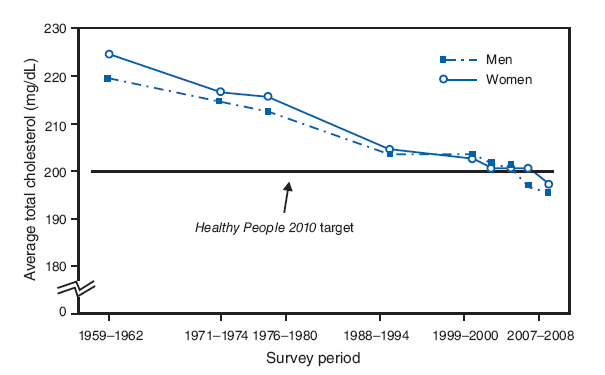
Cholesterol trends down


Some good news in the world... people are eating healthier and exercising more. Or they are taking more statin medications.

MMWR Weekly:

QuickStats: Average Total Cholesterol Level Among Men and Women Aged 20--74 Years --- National Health and Nutrition Examination Survey, United States, 1959--1962 to 2007--2008*

August 25, 2009

A Picture is worth 1000 words... but


It's been said that a picture is worth a thousand words.

And sometimes two words aren't worth telling based on a picture.

Thanks a bunch, Palin.

Dr. Rich fights back in the Covert Rationing Blog.
When Sarah Palin uttered the fateful words, “Death Panels,” she unleashed the holy wrath of the great unwashed masses, and as a result caused many of our more complacent legislators to abruptly bestir themselves into a higher state of arousal, if not outright agitation. Palin’s accusation caught more than a few of them utterly unawares, and embarassingly flatfooted.

They felt, no doubt, like they were in that dream where you unaccountably find yourself naked in a crowd. But this time, rather than reaching to hide their sadly exposed nether parts, they reached instead for their pristine copies of HR 3200. One could almost pity them, desperately rifling through the 1100 virgin pages, wondering whether perhaps they should have tried to read that monstrosity earlier after all, and muttering to themselves, “Death panels? This damned thing has death panels?”

August 21, 2009

Healthcare Reform 3200 Bill: 425-430 (Section 1233)

At a wedding recently, my aunty came up to me and asked "so what do you think of the healthcare bill?" I jokingly said "well, I read all thousand pages and... hehe. I don't know." I rely on the news like everyone else and I hear about "death panels" and "physician reimbursement for needed services." The Daily Show had a great interview elucidating some of the key parts of the controversy.

The Daily Show With Jon StewartMon - Thurs 11p / 10c
Exclusive - Betsy McCaughey Extended Interview Pt. 1
www.thedailyshow.com
Daily Show
Full Episodes
Political HumorHealthcare Protests

The Daily Show With Jon StewartMon - Thurs 11p / 10c
Exclusive - Betsy McCaughey Extended Interview Pt. 2
www.thedailyshow.com
Daily Show
Full Episodes
Political HumorHealthcare Protests

Betsy McCaughey is the writer of the controversial article: Ruin Your Health With the Obama Stimulus Plan on Bloomberg.com.

I do not know how I feel about this. The text of the bill says that it will provide payment for engaging in a discussion about end-of-life care every five years, otherwise the physician will be penalized.

That sounds good to me... carrot on one end (you get paid for something you should be doing) and stick for the other end (you get punished for neglecting to do it often enough.) That does not make it mandatory, nor does it force patients to choose DNR. I find those words despicable when I step away from the mantle of medicine... it strikes me as WRONG to label someone as "not worthy of resuscitation" when we mean to "allow their natural death" which is why I have posted previously on my thoughts in DNR does not = Do Nothing.

At the same time, it sounds really bad the way that some phrase it. McCaughey thinks the worst of the government as it quests for heartless objective quality improvement at monetary gain, which will drive elderly off the cliff to their doom! The fact that there are people who even perceive/misconceive/misinterpret this measure says something about the wording.

It should be revised and it will probably end up being dropped altogether.

That's sad because it is a great idea to give an incentive to initiate this tough discussion between people and their doctors.

Rob at Musings of a Distractible Mind puts it best in his post: Dying Patients and Ugly Politics. He talks about a discussion he has had with one of his patients with advanced dementia.
Politicians have labelled this merciful conversation as an act of rationing. That is not only ignorant, it is shameful. Talking to people about end-of-life issues will certainly save money. But it’s a contemptible step to imply that this money is saved by killing the elderly. It’s more wrong to make money off of keeping them alive unnecessarily than it is to save money by letting them die when they choose.

This is politics at its ugliest – taking a provision that will reduce suffering and help people and pervert it to be used as a tool to scare the people it will help. The discussion about healthcare has been subverted by those who want poll numbers.

Shame on you.

Psych Drugs as Venn Diagram


source: Information is Beautiful

David McCandless, a "visual and data journalist" should team up with Hans Rosling to get the public excited about Statistics that Matter.

Some of their displays about the influenza outbreak and country wealth are truly inspiring to see... it really shows how a good presentation makes all the difference in conveying understanding about an issue of numbers.

August 19, 2009

PubMed searches become easier


PubMed, I'm still waiting for the day when I can copy and paste a reference into the search field and get a single citation match! I find it absolutely frustrating that when I already KNOW the author, journal article and even the title of the article... the search bar is often unreliable and refuses to post the link when I type in NEJM instead of New England Journal of Medicine.

August 11, 2009

Red pill vs Blue pill


One of my friends sent me this article from the Economist: Friends for Life - Big Drug Firms Embrace Generics
"If there’s a blue pill and a red pill, and the blue pill is half the price of the red pill and works just as well, why not pay half the price for the thing that’s going to make you well?" Thus Barack Obama captured one of two powerful global trends forcing pharmaceutical giants to look for a new business model.
The new model that they refer to incorporates smaller generic-drug producers into larger drug-name companies. Basically, providing "responsible" oversight in exchange for name-brand recognition with the original patent holder/drug producers.

My personal opinion is that drug companies should not be "for-profit" entities. Otherwise they put the company ahead of patient interests and defy responsible and ethical regulations. That's my Hippocratic bias and I guess stockholders should get some benefit of the doubt and perhaps they invest in drug companies for nobler reasons than "oooh, they've got a new great drug on the market for the next ten years that will rake in profits and give me a 7% return on my investment!" :-\

Pharm company takeovers of smaller generic producers is a good trend in my opinion! The thought of my local drug store buying generic drugs that turn out to be contaminated with lead or nephrotoxic chemicals terrifies me. It's been done with toys and dog food in China which has shown itself to be notoriously unreliable in its oversight relative to its ability to provide cheap labor and products.

It's funny that the drug companies are going to be providing oversight for these small generics companies (basically providing them with a reliable name) so they can continue making money. The next inevitable step will be in aggressive, large-multicenter, multinational studies in comparative-effectivness research that demonstrates benefits of certain drugs WITHIN a drug class that will provide them with future guaranteed profits if they happen to be the reliable producer of the best-name drug.

As a future physician, I will always choose "Obama's Blue Pill option." It is the obvious choice in his scenario... it's cheaper and just as good! Of course, Neo is seen reaching for the Red pill, so he's off to a harsher reality. So too with us, most likely.

June 11, 2009

Metoclopramide for Hyperemesis Gravidarum

Hyperemesis gravidarum is a fancy way of saying really really bad "morning sickness," severe nausea and vomiting associated with pregnancy.

There have not a lot of drug options here in the U.S., ever since thalidomide was shown to cause severe birth defects - phocomelia, where the children have shortened "flipper" like limbs. As you might imagine, pregnant women are very hesitant to participate in drug trials. It is just as hard to get children enrolled in studies. Unfortunately, the fundamental goal of trying to protect infants and children gets warped from lack of knowledge... and we know very little about how to medicate lil kiddos!

NYT Health says that Metoclopramide is safe for pregnancy. Reglan, as it is more commonly known, is a common anti-nausea medication has been shown to be safe in over 80,000 births in southern Israel.
Our study [The Safety of Metoclopramide Use in the First Trimester of Pregnancy] is about 10 times larger than all of the other studies of this drug put together,” said Dr. Rafael Gorodischer, one of the study’s authors and a professor emeritus of pediatrics at Ben-Gurion University in Israel. “We studied exposure in the first trimester because that is the most critical period for the development of the fetus, when most malformations would be caused by an external cause.”

“We can now say with a high degree of confidence that it’s a safe medication,” he said.

On the heels of this announcement, the British Medical Journal published their ClinicalEvidence on Nausea and Vomiting in Early Pregnancy (updated June 3rd 2009.)
Metoclopramide for treating hyperemesis gravidarum: One RCT found that metoclopramide was less effective at reducing vomiting episodes and readmission to the intensive care unit compared with corticosteroids. Other drugs and interventions may be more useful. Categorised as Unlikely to be beneficial.
Hm... so what does this mean? There is proven safety, but no clinical efficacy in severe cases. Clinical trials will need to be performed to look at this further. And thanks to this new study, we can! :)

June 09, 2009

Culture of Medicine II

The saga continues.

President Obama made some comments in the news regarding McAllen, Texas, suggesting that he read Dr. Atul Gawande's article on "the Cost Conundrum." Indeed, a recent New York Times article "Health Care Disparities Stirs a Fight" confirms this:
The [Gawande] article became required reading in the White House, with Mr. Obama even citing it at a meeting last week with two dozen Democratic senators.

“He came into the meeting with that article having affected his thinking dramatically,” said Senator Ron Wyden, Democrat of Oregon. “He, in effect, took that article and put it in front of a big group of senators and said, ‘This is what we’ve got to fix.’ ”
There's a fundamental difference in approaches between politicians and doctors. Docs are taught to care for every patient as if they were a member of our own family. Perhaps healthcare spending reflects this attitude. Politicians often abuse their constituents as if they are unwanted members of family. Perhaps they are willing to sacrifice X number of lives to save Y number of dollars in an annual budget. I say this only half-jokingly; it is a political necessity to be separated from the issues since there will always be a passionate dissenting group that protests any sort of stand they make. The difficulty, in politics as well as medicine, lies in controlling our emotions so they do not rule our intellect.


But how do you resolve the most personal and emotional issue of all?
I agree with Obama's eloquent response to the question: "Is healthcare a privilege, right or responsibility?":
I think it should be a right for every American. … for my mother to die of cancer at the age of 53 and have to spend the last months of her life in the hospital room arguing with insurance companies because they’re saying that this may be a pre-existing condition and they don’t have to pay her treatment, there’s something fundamentally wrong about that.

What price do you put on the health and welfare of your family? The New York article mentions data that provides EXACTLY what sort of numbers the government has been willing to spend on each person in 2006:
Nationally, according to the Dartmouth Atlas of Health Care, Medicare spent an average of $8,304 per beneficiary in 2006. Among states, New York was tops, at $9,564, and Hawaii was lowest, at $5,311.

Researchers at Dartmouth Medical School have also found wide variations within states and among cities. Medicare spent $16,351 per beneficiary in Miami in 2006, almost twice the average of $8,331 in San Francisco, they said.
Wow! Hawaii? I wonder if the fact that we also have mandatory healthcare (Pre-Paid Health Care Act of 1974) for full-time workers (>20 hours per week) in the nation has anything to do with these statistics. Massachussetts has a cool system too. Unfortunately, I don't know how well it is working out for them with the confluence of crises.

While it might sound appealing to adapt practices Aloha-style... that really would be doing things just for the love of it. A lot of doctors in Hawaii (regardless if they were Hawaiian doctors or not) are retiring, leaving the state or cutting back on their practice because of low reimbursements for Medicaid/QUEST and Medicare patients. So on the surface, it sounds appealing from a political point of view to slash wasteful spending but this can run antithetical to the goal of improving primary care by chasing doctors away.

Another thing that clogs up the gears of the glimmer of hope for Hawaii's healthcare... recently, the Medicaid/QUEST contract has gone out by two Mainland firms: UnitedHealth Group Inc. and WellCare Health Plans Inc. These companies were under investigation in billing fraud and improper claims scandals. Also, there is concern that the 37,000 enrolled aged, blind and disabled patients may have to change providers and lose continuity of care. Waianae and Waimanalo, the two regions on Oahu with the most Native-Hawaiians ironically are the two areas where the Community Health centers have opted out. (citation DENIED, see below)

I hope that the nation does not look at Hawaii for all the answers. It's much more likely that our docs have just gone uncompensated for a lot longer.

(Disclaimer: My commentary comes from the point of view of a medical student trying to stay informed on health-related news while studying to become a doctor in these changing times. As such, notmysecondopinions are not the best source around on health policy! I wish I could provide better local references... unfortunately the archives for the Honolulu Advertiser are on a pay-per-article access of $2-3! That model is detrimental to quick online Google News Searches for proper content.... gr.)

May 31, 2009

Concierge Medicine or Direct Medical Practice?

First it was Hello Health, now it is Personal Pediatrics.

Dr. Natalie Hodge is the "first iPhone doctor" for pediatrics.
She is going back to the basics of primary care by doing what a lot of doctors no longer can afford by reducing her overhead, moving out of the office and into your home.
“We intend to be an entirely mobile platform –there is no need for an office, at least for pediatricians,” Hodge said. “I have found that everything I need for my practice could fit in the trunk of my car,” Hodge told mobihealthnews in a recent interview.

“Some would call Personal Pediatrics a ‘concierge medical practice,’ but I prefer to call it a direct medical practice,” Hodge explained,”because we’re connecting patients who want house calls to physicians who want to make them.”
I love this idea. It is the Ideal Micro-Practice... just you and your doctor. There are many situations where such a model will breakdown, but it does reduce the barriers to care that so many people complain about. No more long wait times at the office. No more late appointments, made months after a phone call. No more problems calling up the doctor in the middle of the night when there's a problem. Best of all, no more 15 minute visits!

This is a small business model that ADAPTS to new technology. It UTILIZES resources so much more effectively to care for patients without any clunky outdated systems. (Disclaimer: I am a huge fan of paper charts over electronic medical records in terms of access and organization. However, EMRs as they stand today are terrible because they are designed with ancillary personnel in mind instead of physicians. As a result, hospital "chart review" becomes an exercise in "Where's Waldo" searching for the single line on a page of text that has been altered from the "Copy Note" function by nurses and docs alike.)

I am not sure where I fit into this picture, but I know I would like to practice in a similarly independent and free manner.

However, I also would like to care for a population of the lower socioeconomic status... and that is where the Concierge model fails. How can patients on medicare afford a subscription with a retainer fee for a personal physician? Especially (from their perspective) when it is "cheaper" to go to the Emergency Room for care?

Hmm. Questions that need answers. Someday, I hope to provide a solution that makes me happy.

For now, Drs. Jay Parkinson in NY and Natalie Hodge in CA(?) have their solutions that they hope to spread. Good luck to you both!

Jay Parkinson at Pop!Tech from Jay Parkinson on Vimeo.


Jay Parkinson at Pop!Tech talking about Hello Health.

He created a new kind of medical practice on September 24, 2007 summarized by:
1. Patients would visit his website.
2. See his Google Calendar.
3. Schedule an appointment online and provide a chief complaint.
4. His iPhone would tell him.
5. He’d do a house call.
6. and get paid via PayPal!

May 25, 2009

We Do what is Needed.

New York Times: Where Life's Start is a Deadly Risk
BEREGA, Tanzania — The young woman had already been in labor for two days by the time she reached the hospital here. Now two lives were at risk, and there was no choice but to operate and take the baby right away.

It was just before dawn, and the operating room, powered by a rumbling generator, was the only spot of light in this village of mud huts and maize fields. A mask with a frayed cord was fastened over the woman’s face. Moments later the cloying smell of ether filled the room, and then Emmanuel Makanza picked up his instruments and made the first cut for a Caesarean section.

Mr. Makanza is not a doctor, a fact that illustrates both the desperation and the creativity of Tanzanians fighting to reduce the number of deaths and injuries among pregnant women and infants.

Pregnancy and childbirth kill more than 536,000 women a year, more than half of them in Africa, according to the World Health Organization.
One of my early dreams in medicine was to volunteer for Doctors Without Borders (aka Medicins san Frontieres) after the completion of medical school and residency. I was a pre-med at the time and a part of the Medical Student Mentorship Program at UH. I told my mentor what I wanted to do and he said "That's charity work. Your debts will accrue and you'll fall behind." He went on for a few more minutes and I got the distinct impression that A) it would not advance my career if I wanted to pursue a fellowship and B) it would bring about financial devastation.

If I cared about those things, I would have taken his words to heart. Part of the reason why I did some research (a sideline to medical school) on Malaria was to get in contact with some of people with similar interests. I worked with a lab that has extensive connections in Cameroon and participated in research with involving the risks of malaria infection in pregnant women. (more on that to come.)

"Am I ready for something as big as this? Can I handle it? This would be a huge change in lifestyle." These sorts of anxious questions give me pause in pursuing such ambitious dreams wholeheartedly. The NY Times article has a real sense of urgency and fatigue to it. These undertrained, underappreciated doctors and nurses are working so hard and with such little help. What could I do? I would be but a drop in a bucket.

I found the words of Paul Farmer to be very inspirational.
For me, an area of moral clarity is: you're in front of someone who's suffering and you have the tools at your disposal to alleviate that suffering or even eradicate it, and you act.

My future plans to have a private practice with greatly motivated patients is tempered by my equal desires to become a teaching faculty member for a medical school and train young physicians, as well as travel to rural areas. Why do I want to do all of these things? I am reminded of something I said at a homeless clinic to my preceptor -- "We Do what is Needed." As a physician, I feel a sense of strong duty to the world to ensure that I make the biggest difference possible... and that means tackling the problem from as many angles as possible. That's my dream at least. We'll see how it all plays out.

May 20, 2009

Open Water

A couple goes out to the Gulf of Mexico and they get caught in the current, pulling them away from their anchored boat... leaving them stranded for more than 24 hours.


Wow! They are so lucky to have survived, considering that no one even knew they were gone!

SCUBA diving is a very zen activity. I haven't done very many dives yet (can still count the total on my hands) but I've noticed that staying calm is key to good diving. It is all about breath control and peace to conserve your energy and thus, your air.

Unfortunately, the fact that you try to have this sense of tranquility under water does not make it a safe activity. Just like hiking (or almost any outdoor activity,) you should always tell someone where you are going and how long you will be out there, just in case something bad happens.

May 13, 2009

Swine flu hype?


via Gapminder.org

This prompts the question? What happened to SARS? What happened to the Avian flu H5N1? Part of the silence on these diseases can be attributed to the success of our infectious disease agencies like the World Health Organization and the Center for Infectious Disease and Control. Another part could be hype.

It's easy to be dismissive in hindsight, though... and it's too early to tell which world-wide pandemic will result in economic disruption and chaos.


Other fun links:
Hans Rosling: TED talk on Stats. It is very amusing to hear him make it sound like a sports broadcast!

May 12, 2009

Obama at the White House Correspondents Dinner

Great orator, great comedian and dare I say it? Great President. From Hawaii. :)


May 11, 2009

Dr. Ted Epperly Speaks for FM with Obama

Dr. Epperly, the president of the American Academy of Family Physicians, blogged about his meeting with President Obama on Healthcare.
OUR INCREDIBLE MOMENT
And then the most amazing thing happened. The AAFP hadn’t been assigned a speaking role at the summit, but suddenly, to my complete surprise, our country’s president said he wanted to hear from the nation’s physicians—and he called on me for comments. I was shocked to have this opportunity drop into my lap. What should I say? I hadn’t prepared anything! So I stood up about 10 feet from the president, looked him in the eye, and said the words that flowed from my heart.

I thanked him for his leadership in assembling the group and said I was honored to be there. Speaking for family physicians, I told him that we believe health care coverage should be expanded to everyone in the United States, but I also warned him of the need to fix the primary care workforce so patients actually have access to that care. I told him that the nation’s FPs are ready to roll up their shirtsleeves and do everything possible to make reform work, because it’s the right thing to do.

And then I sat down, elated that the president had called on the AAFP to speak for the nation’s physicians. He could have called on one of the other medical groups at the summit, including the AMA, but he didn’t. He chose us. He chose family physicians!

I think this speaks volumes about the respect the Academy has gained in Washington and the respect the people on Capitol Hill have for family doctors in the trenches. They know family physicians and the patient-centered medical home will play a key role in the reform that’s coming. They know we are part of the solution.

I know that things have looked dire for primary care for a long time now so it is reassuring to hear Dr. Epperly's enthusiasm and passion for the future of Family Medicine.

Quite frankly, I feel very lucky to be poised on this new front of change for health care. People will be looking at my generation (and at me!) for new ideas, conviction and dedication to primary care. That's the main reason why I am excited to go to the Family Medicine National Conference in Kansas City, Missouri this summer. I'd like to get involved somehow.

May 10, 2009

Mouth Exercises Significantly Reduce OSAS

Tongue and throat exercises have been found to reduce neck circumference and improve the symptoms of obstructive sleep apnea, according to an article in the May 15 2009 Am J Respir Crit Care Med entitled "Effects of oropharyngeal exercises on patients with moderate obstructive sleep apnea syndrome."

BMI and ABD circumference did not change significantly, but neck circumference did in the tongue exercise group (n=16, 39.6 +/- 3.6cm) vs the null group (n=15, 38.5 +/- 4.0 cm) with a p value <0.05. Sleep apnea measures like snoring frequency/intensity, daytime sleepiness/sleep quality score and apnea-hyponea index were also decreased.

This is an exciting alternative to CPAP, which many patients dislike because they have to wear a mask that blasts air down their throats to sleep. If they are willing to be compliant with exercises that strengthen their throat muscles and reduce their neck size, then I would certainly refer them to the following video below for some example exercises:

Exercises include: brushing the tongue with a toothbrush, putting the tip of the tongue on the soft palate and sliding the tongue backward, pronouncing vowels quickly or continuously, and keeping the tongue in a certain position when eating.

Download the Video of Oropharyngeal exercises

References:
Am J Respir Crit Care Med. 2009 May 15;179(10):962-6. Epub 2009 Feb 20.
WebMD: Tongue Exercises May Ease Sleep Apnea

hat tip to Clinical Cases and Images

Author's Note:
I am not trying to infringe on copyright by posting the video to my blog... I am just trying to eliminate one extra step for the viewing of something that I find very interesting and want to share with others. If it proves to be a legal problem in spite of the fact that I posted the public links to the article as well as the link to download the video for personal use, then I will remove the video from my site
.

March 17, 2009

Religious Belief Linked to Desire for Aggressive Treatment in Terminal Patients

Religious Belief Linked to Desire for Aggressive Treatment in Terminal Patients
Terminally ill cancer patients who drew comfort from religion were far more likely to seek aggressive, life-prolonging care in the week before they died than were less religious patients and far more likely to want doctors to do everything possible to keep them alive, a study has found.

The patients who were devout were three times as likely as less religious ones to be put on a mechanical ventilator to maintain breathing during the last week of life, and they were less likely to do any advance care planning, like signing a do-not-resuscitate order, preparing a living will or creating a health care proxy, the analysis found.
The NYT article speculates further as to why this is: citing "to religious people, life is sacred and santified and there's a sense that it's their duty and obligation to stay alive as long as possible."

Really? I can think of a confounding factor in this study. Perhaps there's an independent factor that is influencing the choice for terminal patients to meticulously conduct advance care planning... perhaps there's another reason why some patients are more accepting of the limitations of their physicians.

Maybe they know better. They know that Docs aren't Gods. We all come to the end of our ropes at some time or another. Is a hospital bed really the place where you want to die if you had the choice? Hospice is a better option. Home hospice is even better, in my opinion.

I think that this attitude reflects a level of higher intellect and critical thinking (on average) among the less devout patients who use rational thought to guide their everyday lives rather than blind faith and misplaced hope.

I do realize that I'm a bit biased since I consider myself a part of this group. No offense, religious peeps.