October 30, 2009

The Mito Mystery

Brownout: The Mitochondria Detective work Gets a Little Easier

“The mitochondria are like engines,” he says. “When a car engine doesn’t work right, it smokes.” Similarly, malfunctioning mitochondria produce nasty gunk Enns refers to as “biochemical smoke.”


I love little pictorial metaphors that just make sense.

The article delves into the medical mystery of a young girl who is "anorexic" despite a healthy appetite who had two siblings who passes away with some sort of muscular dystrophy. They get referred to a mitochondrial specialist.

But sometimes, for a single patient, a glimmer of hope breaks through the fog. Veronica Segura recently learned what’s at the root of her disease: a mutation in the cellular instructions for building the enzyme thymidine kinase 2, which plays a key role in synthesizing new mitochondrial DNA. Most important for Segura, a child must receive a bad copy of the gene from each parent to manifest disease. Segura’s husband, Aurelio, doesn’t carry the disease gene, which means their little daughter will never suffer her mother’s mitochondrial illness.


The article ends on this happy note, but I am doubtful of its veracity.
It is my understanding that mitochondrial DNA are EXCLUSIVELY inherited by the mother, who provides ALL of the baby mitochondria as the egg donor -- the sperm mitochondria do not become a part of a zygote->baby...

October 29, 2009

"The Neuro Exam is not dead"

Bedside Eye Exam Outperforms MRI in Identifying Stroke

"We only misclassified 1 out of 25 patients who had a vestibular disease that was a benign condition of the inner ear,"

"This study demonstrates the critical importance of function-linked tests over purely time-static anatomic tests in discerning the localization of vestibular dysfunction early in its course," session cochair Nina Schor, MD, PhD, from the University of Rochester Medical Center, New York, told Medscape Neurology. "It's so much the better that the tests described by Dr. Newman-Toker can be performed at the bedside in these often critically ill patients."


There are three signs to look for:
Head Impulse test
Beating Nystagmus in lateral gaze
Test of Skew with the Cover/Alternating Cover

These signs showed a Sensitivity of 100% (n=69) and a specificity of 96%(n=25) which is remarkable... while it makes sense to "wait and see" if future tests show that these results are reproducible, it really does not hurt to spend a few extra minutes in a neuro exam to check for these things:
"I No (know) Strokes!" Impulse/Nystagmus/Skew.

October 21, 2009

ddx

I have a project that I am putting together about differential diagnosis.

it is by no means a topic that I have "mastered" by any means... but there are a few things that i try to keep in mind.

one of them is the quote:
if you hear hoofbeats, think horses, not zebras.

this quote is supposed to remind people that common things are common.

But db reminds me that premature closure is also a problem.
So I would revise the old saying thusly:
If you hear hoofbeats, think horses, not zebras. unless you're in a savannah and you see stripes.


October 19, 2009

diamond in the rough: HI 5!

"Health Initiative 5!"

I want to give my patients high-fives when they doing something to benefit their health. In this day and age, a lot of costs of healthcare are occult -- they are hidden behind the corporate/government behemoth that are the main payors of our current system.

Even doctors and nurses scratch their heads when the question is raised -- "how much will this X-ray cost?" Medications are usually more straightforward -- you find out when you go to the pharmacist that you lack drug coverage from your student insurance and the Augmentin antibiotics (that you're not even sure if you really need) will cost you $90 while the Keflex alternative would be around $20. (True story for me!)

People see so much money dumped into the system. They feel that some services are "free" when in fact, they are just patches hiding the real costs. Take Former President George W. Bush's assertion that "we have access to healthcare -- just go to the Emergency Room." To prevent the free=more wastefulnees, we need to feel like we get something back every once and a while.

One of the things I have thought a lot about is the question "How can I get my patients to feel invested in their health? How can I get them to take initiative?"

A recent lecture I attended about IBM's health plan includes "Healthy Living Rebate Programs." People get paid $150 to eat right and exercise. YESSS!!! That's exciting.

One of my plans that has come out of this consideration is the "Health Initiatives 5."
1) this is a physical hi-5.
-- Contacting palms in mid air is a show for positive reinforcement and enacting good changes.
2) this is a financial hi-5.
-- I will give my patients MONEY (as in five dollars off their co-pay) for performing certain small tasks that I outline in their health binder (another diamond in the rough to come)
-- this includes things like filling out an online form about family history. going through an extensive medication reconciliation form and review of systems at the visit. successfully quitting smoking or meeting "TLC: therapeutic lifestyle changes" goals and thus, not requiring medications for high cholesterol or high blood pressure.
--this checklist will be a series of small personal challenges for my patients; a way of defining their management plan and turning it into something tangible.

Lower co-pays with increased patient compliance and excitement to save money by working hard with me on a lot of challenging issues = happier patients, more appointments and better health.

I'll Hi 5 to that!

October 08, 2009

diamond in the rough: insurance vs assurance

(let the uncapitalized and flow of thought format convince you that this is just a ""thinking out loud" post rather than a heavily researched topic... although it is something I think about all the time and plan to turn into a formal proposal at some point.)

a lot of the healthcare debate rages over the issue of what "health insurance should cover."

what should it cover?
whatever the consumer is willing to pay to have it cover, of course.
the whole point of insurance is to stack the odds and cover for those emergencies -- you know, when you go to the hospital for an emergency surgery or you get in a car accident.

what the REAL issue that everyone is arguing about is health ASSURANCE.
we want to be able to have affordable care from our doctors to keep us healthy! as more and more medications hit the market (or have been gathering dust on the back shelves despite comparable proven efficacy and safety records) and more screening tests are shown to be helpful to prevent X Y and Z, we expect more from our healthcare providers.

Think about it.
Fifty years ago, people thought that smoking was not hazardous to your health -- now we know it causes irreversible lung damage that may require expensive home oxygen, frequent life threatening lung infections that require hospitalization and lung cancer that may convince people to make a last ditch effort to go for some surgery or chemotherapy.

we expect healthcare for our buck rather than someone who sits back and tells us what will happen if we dont do x y and z. (as i highly doubt my 10 second description of possible complications of smoking would EVER convince someone to quit.)

so what is the solution?

we need a lot of different fixes.

we need to keep health insurance -- it may benefit insurance companies if they are no longer the sole cash provider of ALL health services since many things are fought against tooth and nail from a financial perspective like pre-existing conditions as ways of cutting costs. (and thus better deferred to the government)

we need to maintain health assurance -- and that's where the government can step in. obviously, we have the knowledge and the means to keep our populace healthy. this starts with the simple concepts of public health. it worked with public sanitation, why not extend it to public nutrition and public exercise? those are the largest lifestyle changes that impact health to the public (and thus falls under public health domain.) this means that there would need to be a HUGE shift in public imagining of the way things work -- public gyms with trained physical therapists competing with private gyms with trainers. growing garden programs, subsidies for local produce, taxes on unhealthy snacks and cooking classes for those with hypertension, diabetes and high cholesterol.

we need to have this health assurance on the provider level. doctors and their staff need to be assured that they can have the tools they need to provide the best care that they can. this means no hoops to jump through to approve medications or procedures (no retarded justifications for complex medical decisions to people who may only have training in insurance policy instead of medical necessity.) No unjustified denial of payment based on deadlines that are not medically relevant. this means we need an integrated system for health sharing -- a network where a patients labs, imaging, and ideally records and procedures can be accessed by all who need this information without filling out endless requisition forms.

most importantly, we need this health assurance on the patient level. they need to feel that they have the time to talk with their doctor and understand what is going on and how they can be a team member in their game of life. docs are only coaches in this, occasionally directing the plays, but the patients make the ultimate decisions and live with the consequences. Patients need to feel free to find someone that they feel they can work with instead of being locked in a room with one grouchy overworked doc who may disagree with what they want.

i dont know where we are with the healthcare reform.
but i want to be assured as well.

October 05, 2009

Eye am so confused!

I remember when I had my one and only ophthalmology lecture in medical school (in a Problem-Based Learning curriculum, few formal lectures exist if at all.) We spent just 30 minutes on this topic and I still stumble on it, so I thought I'd clarify it and review it using a simple image (see slide three.) The rest of the presentation is just gravy, but that's notmysecondopinion.

October 01, 2009

Psychosocial Medicine

I do not believe in fate, just the idea that we can be receptive and perceptive to the patterns of the world around us.

With that said, I have been feeling touched in a special way these past few days. I traveled across the US for a rotation in Family Medicine in what might be arguably the birthplace of Psychosocial medicine... it is really nice to see a program that openly and seamlessly integrates aspects of this into daily practice.

Yesterday's Grand Rounds covered a health care model that incorporates mental health as a key component of medical health. Behavioral Health Professionals are considered to be Primary Care Providers at the clinics (in this model) and indeed, many patients actually view the BHPs as their PCP instead of the doctor!

It goes to show that a lot of the pain and suffering people have can be alleviated by having someone open and willing to listen.

One of my favorite rotations on Maui when I did my third year longitudinal outpatient experience was psychiatry for precisely this reason. We had the opportunity to have longer, uninterrupted routine visits with people who had complex psychosocial issues in addition to a number of medical problems... and such a simple process led to so much healing.

Due to privacy and confidentiality concerns, I hesitate to speak in specifics about the cases I have been involved in. Luckily, I watched the season premiere of House which illustrates many of these principles.


House is committed to Mayfield Psychiatric ward and goes through an incredible process on the road to recovery... from nearly everything that makes House a Vicodin-popping, biting caustic sarcastic jerk.

The psychiatrist he is "pitted against" exhibits a lot of great traits for a physician. He listens, he reflects, he foils almost every antic that House can throw against him in the crusade to get his medical license back. How does he prevail? He speaks openly and honestly. He has impeccable timing, anticipating, confronting and deflecting to just the right degree that he makes conflict seem like a meaningless endeavor. Most importantly, he identifies what is important to House and uses THAT as House's path to rehabilitation.

Of course, for House it is the practice of medicine. In a psych ward, he is immediately able to identify and disable all of the different characters with the right combination of words and actions. He can diagnose and antagonize... but as he discovers in the course of this episode, he finds that he cannot FIX everything. He cannot fix anything really, since these are the fragile minds of people rather than diseased organs to be removed and discarded. In the process of helping others (as tragic as it may be on occasion) he helps himself.

I am hoping to see this process recur throughout the season, with him returning to the psychosocial aspects of medicine -- it is a daring move on the part of the writers since they have freed House to be redefined.

September 25, 2009

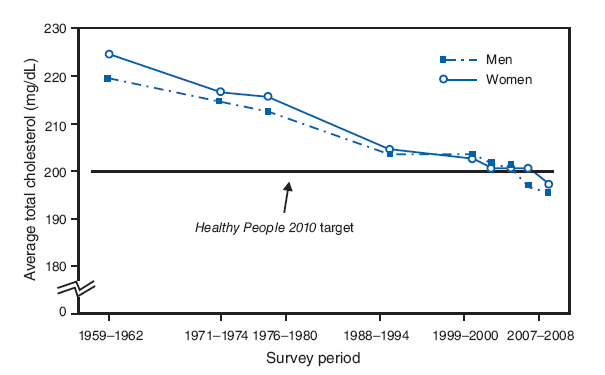
Cholesterol trends down


Some good news in the world... people are eating healthier and exercising more. Or they are taking more statin medications.

MMWR Weekly:

QuickStats: Average Total Cholesterol Level Among Men and Women Aged 20--74 Years --- National Health and Nutrition Examination Survey, United States, 1959--1962 to 2007--2008*

September 02, 2009

Pong's Postulates (II)

Pong's Postulates
1) Health is something we have until we notice we do not.
* Preventive services help people notice their health.
2) There are two types of disease: those we live with and those we do not.
3) "Docere" in latin means "to teach." Doctors primarily help people know their illnesses.

* It does not matter what doctors say; what matters is what patients hear.
4) Comprehensive Generalists see the big picture.
* Interventions happen all they way along the natural history of health to disease to complications.
5) I want to be a part of my patients' long lives through sickness AND health acting as their advocate and guide.
Therefore, I want to be a Primary Care Family Physician.


Elucidating Pong's Postulates

Health and illness:

One of my early experiences with disease is unusual. It was nothing more than a nuisance at worst but it affected me greatly. I have a condition called hyperhidrosis, characterized by excessive sweating. As a child, my palms would literally drip with sweat, sometimes for hours. I went to a dermatologist and after failed trials of topical antiperspirant and uncomfortable iontophoresis, I considered Botox or surgery. So in the midst of applying for medical school, I had a bilateral thoracic sympathectomy performed. Now I can take notes, read books and put on gloves without a struggle. I reflect upon it every time I greet a patient, now that I can shake their hands without hesitation. I am thankful for the help of my dermatologist and the skills of my cardiothoracic surgeon who have boosted my confidence as a physician.

Disease and dealing with it:

In the summer following my first year of medical school, I shadowed a few doctors at a clinic for the underserved. One patient in particular stands out in my mind. She was an obese Micronesian woman who came in with her teenage daughter complaining of fatigue, thirst and frequent urination. The resident made the diagnosis of diabetes. The plan seemed simple enough: diet, exercise and metformin. I was impressed with the way that the resident delivered the information but I noticed that she stopped listening. She broke down and started to cry. Her sobbing grew even louder as the resident started to raise his voice -- as if it would help her hear what he had to say!

"I'm sorry," I said as I handed her a tissue. "I know this is all coming as a shock to you..." I struggled with what to say next. "Are you afraid you'll be like your father and need an amputation?" Suddenly being diagnosed with the same disease that almost killed her diabetic father was too much for her. The resident apologized; "I'm sorry. Sometimes I forget that this is not as routine for you as it is for me." I have never forgotten those words -- it does not matter what doctors say; what matters is what patients hear. What can be a straightforward routine for physicians is often a life-altering alien experience for patients.

We comforted her. Diabetes was something that she could learn to live with instead of dying from it. "You need to lose weight. I do not want to say 'go on a diet.'" I said at the end of the visit. "That is temporary. We really ought to work on lifestyle changes for you AND your family... you do not want your daughter to follow in your footsteps, do you?" Both of their eyes welled with tears at that and they silently shook their heads. I was gratified to see that her daughter's half-full soda was swiftly discarded as they left the exam room.

The Big Picture and Interventions:


In my first elective as a fourth year clerk, I rounded with a cardiologist covering his partners' patients in the hospital. One of the patients we met was an elderly Hawaiian man with forty grandchildren who clotted off his stent. Three weeks ago, he was told very emphatically to gather up his family and say goodbye. Three weeks later, we found ourselves face to face with a restless grandfather. "I don't want to die here in the hospital." It was a sentiment I could understand except he had a surprising recovery. The cardiologist tried to negotiate with him to stay to make sure he was stable on the correct medications. "You may die if you leave the hospital. Do you understand?" The patient frowned and replied "Do you have grandchildren? Do YOU understand?" "No. But I understand. Do YOU?" It went back and forth until the cardiologist left abruptly.

I could see them slicing past each other trying to press their points. No doctor had given him the simple courtesy of three minutes of time in the past three weeks. He was frustrated and confused. At first, he was told that he was going to die in the hospital, then he could go home for hospice and now he was supposed to stay. I do not have any grandchildren, so I could not understand how he felt. This man cared more about his family than his own health. Perhaps it was a pervasive trend; there were many interventions that could have guided him down a different path. Yet here we were with only one thing to do: I just listened to him.

I want to be a Primary Care Family Physician:

I often wonder how the story ends for these patients. I wish I could be a guide for the mother and her daughter through health and an advocate to fight for the grandfather. I know that this is precisely what I will get to do as a family physician.

My doctors helped me prepare my HANDS for medicine. My teachers in medical school helped me prepare my HEAD as well, but it is my patients that have prepared my HEART for a lifelong commitment to medicine.

August 28, 2009

DeGowin Quotable.

DeGowin's Diagnostic Examination seemed like a silly book to have, but I inherited it from one of my previous upper medical student benefactors. I had already read through Bates... what more could it offer?!?

Boy, was I wrong.

I bought the book for my Kindle and I have enjoyed reading it from time to time. It goes beyond talking about history taking and physical exam maneuvers to philosophy.

Here's my favorite quote:
DeGowin's Diagnostic Exam (Richard F. LeBlond, Donald D. Brown and Richard L. DeGowin)
- Highlight Loc. 898-901 | Added on Saturday, July 25, 2009, 11:17 PM

Disease is a four-dimensional story, which follows the biologic imperatives of its particular pathophysiology in specific anatomic sites as influenced by the unique characteristics of this patient. Your task is not verbal, but cinematic; construct a pathophysiologic and anatomic movie of the onset and progression of the illness: the words are generated from the images, not the images from the words. After all, a picture is worth a thousand words.
Indeed, I remember my patient's problems better and I learn better when I visualize things instead of simply trying to MEMORIZE. It is tough to stay on task with it, but it is very effective during presentations -- when I've got things straight, the story comes out the right way.

August 25, 2009

A Picture is worth 1000 words... but


It's been said that a picture is worth a thousand words.

And sometimes two words aren't worth telling based on a picture.

Thanks a bunch, Palin.

Dr. Rich fights back in the Covert Rationing Blog.
When Sarah Palin uttered the fateful words, “Death Panels,” she unleashed the holy wrath of the great unwashed masses, and as a result caused many of our more complacent legislators to abruptly bestir themselves into a higher state of arousal, if not outright agitation. Palin’s accusation caught more than a few of them utterly unawares, and embarassingly flatfooted.

They felt, no doubt, like they were in that dream where you unaccountably find yourself naked in a crowd. But this time, rather than reaching to hide their sadly exposed nether parts, they reached instead for their pristine copies of HR 3200. One could almost pity them, desperately rifling through the 1100 virgin pages, wondering whether perhaps they should have tried to read that monstrosity earlier after all, and muttering to themselves, “Death panels? This damned thing has death panels?”

August 22, 2009

PERC up about Well's for PE

PERC up about Well's for PE
mnemonic for workup of Pulmonary Embolism
Items in italics and bold refer to unique features of the PERC score and Well's Criteria.

PERC Score: (PERCx2)
PaO2 <92%
Pulse >100
Extremity swollen now (DVT)
Elderly >50
Recent surgery
Recent DVT -- unilateral extremity swelling in past
Contraceptive use
Coughing up blood


Medscape: Differentiating Low-Risk and No-Risk PE Patients: The PERC Score
http://www.medscape.com/viewarticle/702755

Well's criteria: S.S. PERCC
Suspicious for PE (3)
Signs of DVT now (3)
Pulse >100 (1.5)
Extremity: Past DVT/PE (1.5)
Recent surgery/immob (<4wk/>3d respectively) (1.5)
Coughing up blood (1)
Cancer (1)

High >6.0 pt
Moderate 2.0 to 6.0 pt
Low <2.0 pt


Wells PS, Ginsberg JS, Anderson DR, et al. Use of a clinical model for safe management of patients with suspected pulmonary embolism. Ann Intern Med 1998;129:997-1005. Study used a "minimally invasive" approach to managing patients with suspected PE, emphasizing use of serial dopplers rather than PA grams in patients with a non-diagnostic initial work-up. Approach is comparable to the 1999 ATS guidelines; it does not include CT angiography. A particular strength of the study was the use of set criteria to establish clinical suspicion. http://www.ncbi.nlm.nih.gov/entrez/query.fcgi?cmd=Retrieve&db=pubmed&dopt=Abstract&list_uids=9867786

August 21, 2009

Healthcare Reform 3200 Bill: 425-430 (Section 1233)

At a wedding recently, my aunty came up to me and asked "so what do you think of the healthcare bill?" I jokingly said "well, I read all thousand pages and... hehe. I don't know." I rely on the news like everyone else and I hear about "death panels" and "physician reimbursement for needed services." The Daily Show had a great interview elucidating some of the key parts of the controversy.

The Daily Show With Jon StewartMon - Thurs 11p / 10c
Exclusive - Betsy McCaughey Extended Interview Pt. 1
www.thedailyshow.com
Daily Show
Full Episodes
Political HumorHealthcare Protests

The Daily Show With Jon StewartMon - Thurs 11p / 10c
Exclusive - Betsy McCaughey Extended Interview Pt. 2
www.thedailyshow.com
Daily Show
Full Episodes
Political HumorHealthcare Protests

Betsy McCaughey is the writer of the controversial article: Ruin Your Health With the Obama Stimulus Plan on Bloomberg.com.

I do not know how I feel about this. The text of the bill says that it will provide payment for engaging in a discussion about end-of-life care every five years, otherwise the physician will be penalized.

That sounds good to me... carrot on one end (you get paid for something you should be doing) and stick for the other end (you get punished for neglecting to do it often enough.) That does not make it mandatory, nor does it force patients to choose DNR. I find those words despicable when I step away from the mantle of medicine... it strikes me as WRONG to label someone as "not worthy of resuscitation" when we mean to "allow their natural death" which is why I have posted previously on my thoughts in DNR does not = Do Nothing.

At the same time, it sounds really bad the way that some phrase it. McCaughey thinks the worst of the government as it quests for heartless objective quality improvement at monetary gain, which will drive elderly off the cliff to their doom! The fact that there are people who even perceive/misconceive/misinterpret this measure says something about the wording.

It should be revised and it will probably end up being dropped altogether.

That's sad because it is a great idea to give an incentive to initiate this tough discussion between people and their doctors.

Rob at Musings of a Distractible Mind puts it best in his post: Dying Patients and Ugly Politics. He talks about a discussion he has had with one of his patients with advanced dementia.
Politicians have labelled this merciful conversation as an act of rationing. That is not only ignorant, it is shameful. Talking to people about end-of-life issues will certainly save money. But it’s a contemptible step to imply that this money is saved by killing the elderly. It’s more wrong to make money off of keeping them alive unnecessarily than it is to save money by letting them die when they choose.

This is politics at its ugliest – taking a provision that will reduce suffering and help people and pervert it to be used as a tool to scare the people it will help. The discussion about healthcare has been subverted by those who want poll numbers.

Shame on you.

Psych Drugs as Venn Diagram


source: Information is Beautiful

David McCandless, a "visual and data journalist" should team up with Hans Rosling to get the public excited about Statistics that Matter.

Some of their displays about the influenza outbreak and country wealth are truly inspiring to see... it really shows how a good presentation makes all the difference in conveying understanding about an issue of numbers.

August 19, 2009

PubMed searches become easier


PubMed, I'm still waiting for the day when I can copy and paste a reference into the search field and get a single citation match! I find it absolutely frustrating that when I already KNOW the author, journal article and even the title of the article... the search bar is often unreliable and refuses to post the link when I type in NEJM instead of New England Journal of Medicine.

August 11, 2009

Red pill vs Blue pill


One of my friends sent me this article from the Economist: Friends for Life - Big Drug Firms Embrace Generics
"If there’s a blue pill and a red pill, and the blue pill is half the price of the red pill and works just as well, why not pay half the price for the thing that’s going to make you well?" Thus Barack Obama captured one of two powerful global trends forcing pharmaceutical giants to look for a new business model.
The new model that they refer to incorporates smaller generic-drug producers into larger drug-name companies. Basically, providing "responsible" oversight in exchange for name-brand recognition with the original patent holder/drug producers.

My personal opinion is that drug companies should not be "for-profit" entities. Otherwise they put the company ahead of patient interests and defy responsible and ethical regulations. That's my Hippocratic bias and I guess stockholders should get some benefit of the doubt and perhaps they invest in drug companies for nobler reasons than "oooh, they've got a new great drug on the market for the next ten years that will rake in profits and give me a 7% return on my investment!" :-\

Pharm company takeovers of smaller generic producers is a good trend in my opinion! The thought of my local drug store buying generic drugs that turn out to be contaminated with lead or nephrotoxic chemicals terrifies me. It's been done with toys and dog food in China which has shown itself to be notoriously unreliable in its oversight relative to its ability to provide cheap labor and products.

It's funny that the drug companies are going to be providing oversight for these small generics companies (basically providing them with a reliable name) so they can continue making money. The next inevitable step will be in aggressive, large-multicenter, multinational studies in comparative-effectivness research that demonstrates benefits of certain drugs WITHIN a drug class that will provide them with future guaranteed profits if they happen to be the reliable producer of the best-name drug.

As a future physician, I will always choose "Obama's Blue Pill option." It is the obvious choice in his scenario... it's cheaper and just as good! Of course, Neo is seen reaching for the Red pill, so he's off to a harsher reality. So too with us, most likely.

August 06, 2009

Pong's Postulates (I)

In the movie Pi, by Darren Aronofsky, a paranoid mathematic genius recites a near daily mantra:
Restate my assumptions:
One: Mathematics is the language of nature.
Two: Everything around us can be represented and understood through numbers.
Three: If you graph the numbers of any system, patterns emerge.
Therefore, there are patterns everywhere in nature.
Evidence: The cycling of disease epidemics;the wax and wane of caribou populations; sun spot cycles; the rise and fall of the Nile.

So, what about the stock market? The universe of numbers that represents the global economy. Millions of hands at work, billions of minds. A vast network, screaming with life. An organism. A natural organism. My hypothesis: Within the stock market, there is a pattern as well... Right in front of me... hiding behind the numbers. Always has been.
I found it to be an excellent, albeit strangely rigid way of honing in on a mission statement so to speak for this character. He proceeds from an axiom: math = nature, follows a logical set of basic principles and subsequently derives a set of values and his motivation for his current project. A way to predict the numbers in the stock market.

--------------------------

I would like to derive my own set of postulates.
A mantra that I can repeat to myself on a daily basis to remind myself of what keeps me going. My personal mission statement, if you will. The abstract version at least. If all goes well as I review my entire medically related personal history in preparation for the all-encompassing personal statement... I'll discuss each section in turn over the next week.

Pong's Postulates.
1) Health
Health is something we have until we notice that we don't. (or is it "aren't"?)
2) Illness
There's two types of illness: those we live with and those we don't.
3) Physicians
Doctors help people notice their diseases.
4) Primary Care/Prevention, Family Physicians
Primary Care helps people notice their health. Some doctors value long-lasting relationships with all sorts of patients, treating them as a part of a family-unit striving for health.
5) My Role. My Choice. My Calling.
My observational and problem-solving skills qualify me to be a great clinician, since you only see what you notice and what you notice is what you know.
My passion for science, my love of learning and my joy for sharing knowledge qualifies me to be an excellent educator in disease and prevention.
My strong sense of duty to help those in need, my commitment and my desire to make a difference in the lives of those I work with qualifies me to do hard work for the underserved and push for changes where they are needed most.

Therefore, I want to be a Family Physician -- an advocate, a coach, a guide, a mentor, a healer. It's almost like being married -- I want to be a part of my patients' long lives, through sickness and health.

August 02, 2009

Patient Centered Medical Home... say what?

One of the key components driving our healthcare debate centers on something called the "Patient Centered Medical Home." In a simplified, beautiful poetic statement it is:
"A continuous relationship with a personal physician coordinating care for both wellness and illness."


At the recent AAFP FM NC (American Academy of Family Physician's National Conference) for Residents and Students that I attended... the speaker Dr. McGeeney said:
People get the concept. People like the idea. It's the NAME that they hate.


I will freely admit, it sounded like just another silly buzzword that's thrown around to me. I do readily subscribe to the concept of a medical home -- and I do want to put my patients first in all respects. These are things that I got excited about planning for my future practice without even realizing what a PCMH is!

One of the commenters at the end of Dr. McGeeney's talk summed up my own sentiments quite nicely. He raised his hand and said "it sounds great and all, but you REALLY have to change the name. No one knows what that means. I get that it's an old concept from 1967, but it needs to change. It sounds like a nursing home to me."

So, I found myself thinking about the CONCEPT.

What does it mean to have a PCMH?
To me, it means having a doctor for life. Someone you can trust. Someone who has known you through thick and thin.
It means having a group of people who work with you. Dietician, exercise trainer, medication manager, physical therapy, diabetes educator, etc... "ancillary services" that deserve a central role in care.

Why don't people get it?
I think Home is a solid object in a lot of people's minds. When you tell them "we are going to give you a medical home" they think of a location, rather than a group of awesome people who are trying to keep them healthy! A funny story is that one of the family medicine residency programs got a phone call from a reporter, asking to see their new medical home. "So, this home. Is it a house? A clinic? What sort of structure is it?" After some forehead slapping in trying to explain that it was just a concept, the director ended up just telling him their address. UGH. PCMH really doesn't lend itself well to a clear definition.

So what's your brilliant solution?!?
I am very biased on this point. I'll say it up front because it is a shameless plug for my specialty of choice.
I propose that we call it Patient-Centered Medical Family.

Think about it.

July 15, 2009

Doctors are Gamblers


Doctors are Gamblers.

One of the questions in surveys that determine what sort of career in medicine you want asks:
How much ambiguity can you tolerate?
read: How much are you willing NOT to know? The answer is surprisingly telling.

I thought that as a physician in training, I would learn how to become more confident in my diagnosis when in practice, this is a very difficult thing to achieve. Especially in a brief visit where there are no clear labs or studies to elucidate the answer. Take a simple cold. A patient comes in with a sniffly nose, fatigue and a sore throat and asks: do I have strep? You can do a throat culture, but that will take time. You can do a rapid strep antigen test, but the test is not sensitive and you may get a false negative. Even for the most common conditions, there is a great deal about which we DO NOT know, nor can we ever know. We don't even have the tools to test for a lot of the different viruses that may cause a common cold... and why bother? It'll go away on its own with some fluids and rest.

Take another common concern: Doc, what are my chances of getting a heart attack?
We gamble on answers like this when we prescribe medications to reduce risk factors for coronary artery disease like high cholesterol (diet, exercise and statins,) and diabetes (diet, exercise, and metformin.) We risk stratify patients based on a collection of factors that have been shown to lead to increased risk of a heart attack in the future. The biggest study of this is the Framingham Heart Study. From a collection of statistics gathered from anamnesis (patient history) and labs, we can determine the 10 year risk of a patient for having a heart attack!

That's pretty powerful. But it is still just a Chance.
And how often do you really have a discussion like THIS with your doctor?!?
You're a 57 year old male. Your total cholesterol is 275. That's high because it's bigger than 200. Your HDL(good) cholesterol is only 35. That's low because it's less than 40. On top of that, you're still smoking and your systolic blood pressure(big number) is 150 despite being on medications!

You know, that means you have a greater than 30% chance of getting a heart attack or something similar in the next ten years. Think about that.

If you quit smoking and exercised to bring your blood pressure down to normal (120,) you could pull your risk down to 18%. That's still high but if we put you on a medication to lower your cholesterol and it was brought down to a normal level, we'd bring it down to 12%!

We can cut your risk in half with some simple changes. What do you think about that?


We gamble with people's lives. Some people live gluttonous self-indulged lifestyles and never have any health problems. Other people are health nuts but suffer from multiple ailments.

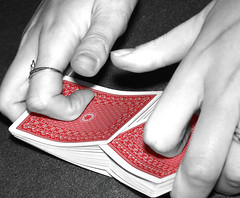
We don't know what hand people are dealt... but we can help stack the deck in their favor.