September 24, 2006

My Personal Statement

Dr. L entered the room as my heart anxiously pounded. I hesitated before shaking hands with him, not because I was entrusting my life in his but because I knew my hands were cold and clammy. "This will be the last time I'll have to shake someone's hands like this," I said with a grin. He had told me how the procedure would work: the sympathetic nerves of Kuntz would be severed to alleviate my hyperhidrosis. Although the surgery itself was quick, it changed my life drastically. I knew then that I wanted to be a doctor. Even though I now had the confident hands of a doctor, I needed more to actually be one. With my new hands, I started working on gaining the head and the heart of a doctor as well.

My critique: I'm sure many applicants have struggled as I did, trying to tighten prose without losing the context. Just to clarify, I had a bithoracic sympathectomy (video link), a surgery to cure palmar hyperhidrosis. I was disappointed that I couldn't adequately explain "hyperhidrosis"... it would have taken too much room to explain it. The people who read it caught on well enough, so that was good to hear. I could only hint at the details I really wanted to cover. Now that I know a little bit more, I'm embarassed to say that the facts are minorly incorrect too. The entire sympathetic chain was severed, not just the weird excess Nerves of Kuntz... but I tossed that in because it sounded cool.

Looking back at this PS makes me wince. This is what got me into medical school? Granted, it was a significant improvement over my opening statement from the prior year (which had the same gist, except I didn't make the hands/head/heart connection until the end of my PS.)

The poetry of gaining the hands of a doctor from a thoracic surgeon was something that I would have liked to elaborate on. I didn't see the doctor very often as a child, but palmar hyperhidrosis was something that I had been dealing with since 2nd grade.

You might be asking yourself: What's the big deal about sweaty palms?
Well, we're not talking about damp hands like someone who is just nervous. Yes, my sweaty palms were triggered by nervousness too, but we're talking about minor anxiety triggers. And it wouldn't go away... I would have to deal with sweat dripping off of my palms for the rest of the day. Imagine washing your hands and not drying them off afterwards. That's how my hands would be at their worst, mere seconds after I would wipe them on my jeans.

I would have to wear jeans everyday and a light colored shirt otherwise sweat stains would show on my thighs and armpits. My hands would freeze in cold weather, because the sweating just... kept on going.

Paper was my adversary. I would ruin books just by holding them and flipping the pages. I needed a folded up pad of paper to soak up the sweat when I took notes in class. My computer keyboard and mouse were all gummed up. I was afraid to touch anyone, especially girls, afraid of their barely concealed looks of disgust; I was afraid of intimacy.

I knew it would be a hindrance in pretty much any profession that did something hands-on, from social handshakes to labor-intensive crafts. I was concerned about shop, art and especially science LABS. Putting on gloves is a nightmare with damp hands. Wiping off equipment after touching it is annoying and disgusting.

I'm sure you get the point by now, after my woe-is-me story.
It was amazing to me that a decade of grief was wiped away after a same-day surgical procedure! I had tried so many other things, like topical antiperspirants (Drysol) and even palmar electric shock (Ionophoresis).

In typical understated doctor-speak, this surgery "improved the quality of my life."

I was inspired by the changes I saw in myself... something so minor that had such a large effect on the rest of my life and what I could do with it. I felt a newfound confidence from it, free from social anxiety and frustrating note-taking.

I was ready to make the same changes with other people. I wanted to become a doctor.

Despite the rough and clumsy nature of my opening paragraph, perhaps the admissions committee saw my PASSION and my . To you aspiring applicants, that's what you should put in your words. Share yourself and share your passions.

September 17, 2006

Should suicide be legal for people in pain?

I am on OkCupid. While I will admit that I like looking at profiles of people who "match" with me, I am not in the right emotional state to start dating again, since my last girlfriend broke up with me a week through med school and moved to Japan to teach high school English. Ah, but don't feel too bad for me... we talked about it for months and I couldn't convince her to maintain a long-distance relationship together.

I like taking the tests on OkCupid... but I don't really like answering the polling questions. I recently learned that they added some features, allowing you to blog about the questions so you can argue some of the points... and I realized that many of the ones I have problems answering are the medical-ethical ones! Here's my latest entry on suicide:

Should suicide be legal for people in pain?
  • Yes
  • No

Technically, suicide IS legal, because you can't punish someone who is already dead. Also, we probably should limit this question to "physician-assisted suicide," aka PAS, since that is likely the issue that the question is intended for.

So the question becomes: Should it legal for doctors to help patients in pain commit suicide? My first liberal inclination is to say yes, however, the term "pain" must be defined.

Are we talking about someone with emotional pain? Did they just get dumped?
Are we talking about someone with physical pain? Did they just hit their knee?
Are we talking about someon with spiritual pain? Uh... I don't even know what this would be.

Are we talking about someone with an incurable medical condition which causes them intractable pain and they have 6 months or less to live? Cancer patients, very old people (who have "failed to thrive") and perhaps a few other special conditions may apply.

People have a right to death with dignity (DWD) in OR... perhaps the gentle euphemism encouraged the proposition to pass in 1994 and again in 1997 under the name Pain Relief Promotion Act.

There has been efforts to have DWD approved in HI also, under the last set of conditions listed above. Since 2000, less than 50 people die with dignity as many go through a process screening for depression, coming up with alternate palliative measures like increasing pain medications, encouraging family support, etc. That is only 0.0014% of all deaths in Oregon.

This is a rare situation... just because people like Dr. Kevorkian abuse the system and commit ethically and legally unsound acts doesn't mean that Death with Dignity should be a rule.

Everyone wants to die with dignity, surrounded by the people who care for them. However, physician-assisted suicide should not be a RULE. However, I strongly believe that there should be EXCEPTIONS.

More to come.

September 16, 2006

Funny, how fickle fate falls

Michael started off at Cal Poly as a triple major, acquiring credits in political science, history and liberal arts over the course of 5 years. He paid his own way through college, despite having affluent parents and he was determined to do things on his own. His pride might have cost him in the long run, but his strong sense of independence and led him to his current unique situation and changed his life for the better. He had big dreams of moving to My State and becoming a manager of a major hotel, "just another white guy moving in and taking over," he added jokingly. After graduation, he left his friends and family with a mountain bike and $400 in his bank account to begin his life anew.

He applied for jobs all throughout town. As an articulate college graduate with strong grades and an excellent resume, it should have been easy for him to find a job. He was involved in student government representing the small liberal arts community at Cal Poly. His friends regularly came to him asking for help with their papers. Still, he had no luck getting a job.

After a few weeks of job searching, he finally found a job working at Jamba Juice. Ironically, his friends back home in San Luis Obispo founded the company that he found himself working at... and he kept grinding away at his job applications. After a year or so, he found himself another job at Sunset Grill. Just a few weeks into his job, he developed a pounding headache and he called in sick to work. Two days later, he was in the hospital and unbenownst to him, he was fired from his job. It turned out that he had a pituitary tumor and he had no health insurance.

Queen's Hospital treated him well and they removed the tumor. Lucky to be alive, he found himself with new problems. He was going to get kicked out his apartment in a week and he had no job, no money, nowhere to go. He applied for jobs, but still, no luck.

On a Tuesday night at 2:00 am in the morning, he found himself in front of the Institute of Human Services. The homeless shelter's caretaker was hesitant to let him in. Dressed as he was, with neatly pressed slacks and a collared shirt, talking the way that he did with a polished educated voice and looking the way that he did (white and privileged,) he might have run into problems. It was recommended that he go back to the area that he came from and find a place to stay. That bike ride back was a tough one... he suddenly saw the people sprawled out underneath trees in the shady parks, in the back alleys of paradise. These were people that he had once thought disparagingly of. "Clean yourself up, shave and get a job!" These words now had a biting sense of shame since it was something that had happened to him.

Michael was too ashamed to contact his family. He did not want to be thought of as a failure. He would pull through on his own... and because of this decision, he became a stronger person. He learned a lot about himself. He learned more about life from his fellow homeless than he did in college.

He found himself an alcove behind a church to sleep at. And it began to rain. For more than forty days straight, it poured rain of biblical proportions. Yet he was grateful for the rain... it limited his chances of being discovered by people and removed from the church grounds. He read the newspaper everyday and learned about other homeless people getting kicked out of Ala Moana park. How they had no where else to go, but a few churches had been sheltering them until a more permanent solution could be found.

A janitor had found him sleeping in the alcove one night and gave him a blanket, for which he was grateful.

Michael had fallen in between the cracks. Down on his luck, he had to stand in long lines for food alongside other homeless people in downtown... as cars of young healthy people whizzed by, talking on their cell phones and sipping their morning coffee.

A few weeks later, the janitor struck up a conversation with him about the Ala Moana homeless. "I read about that in the newspaper," he said. "They are all staying at Central Union Church, right?" The janitor laughed and gestured around. "This IS Central Union Church." For weeks, he had been sleeping, starving and freezing outside while there was a bunch of homeless who showed up every night to sleep, eat and keep warm inside the church!

He was part of the initial exodus that was transferred to the homeless shelter just a few blocks from My Medical School.

A man from a church group recognized Michael's potential and he was soon hired to work in the program Helping the Hungry Have Hope.

And that's what brings me here today. He said, wrapping up his story for our class.

I was touched. Here was a man who did nothing wrong, yet he still found himself quickly abandoned by society. He could have died in California, lacking health insurance, but he didn't. He could have given up on life, but he kept trying and trying and trying.

He was the same age as all of us... he could have been a medical student. We could have been homeless. I remember in high school how I wanted to be homeless. My ideas were closer to "hoboism", riding trains and finding oddjobs, instead of the harsh, insecure realities of homeless life. Worrying about where your next meal will come, whether or not you could find a safe place to sleep for the night, trying to avoid becoming a victim of violent crimes.

Homeless people have parents who wonder what happened to their children.
Homeless people have lives and goals no different than our own, but they lack the means to achieve many of them.
Homeless people have sob stories to beat anything that someone who has job security and a home could possibly say.

They need to know that people care. Then, they can be helped to help themselves. They can be given a sense of purpose and be proud of their responsibilities. It all starts with someone to listen to their story, learn more about their priorities and be nonjudgmental about their values.

I'm sure Michael will contribute great things to society and he can give hope to others like himself.

September 13, 2006

Pity for a Pass

Dave Attell is a comedian who used to be on the show Insomniac, where he bummed around bars in the middle of the night all around the U.S., filming his crazy exploits. In one of his stand up shows, he said "You know who I like to make fun of?!?!?"

"Amish people. That's right... they can't get offended seeing me on T.V.... they are never going to know!"

The same can't be said of the people at the homeless shelter I visit twice a month. You'd think that they are out of touch with the world around them, but they scrounge up the money for the television!

I turned my attention away from the cubicle with the family watching cartoons on repeat back to the patient at hand. He was equally distracted, flipping his cell phone open and closed absent-mindedly while the third-year medical student taking his case consulted with the family medicine resident.

"So he came in with this EKG and said that you'd sign off on his bus pass..." the MS-III said in a tired voice. It was close to the end of the clinic time, 9:15 pm, and Thursdays went on for far too long for him.

There was a problem, though. The rules and regs for getting a disability bus pass are such that you need to qualify by having difficulty with one of the following:
  • negotiating a flight of stairs, escalator, or ramp;
  • boarding or alighting from a City transit bus;
  • using the City Transit bus due to confusion or disorientation;
  • reading informational signs; or
  • walking more than 200 feet.
His EKG read "sinus arrhythmia." Unstable heartbeats aren't on the list of "things that get you a cheap bus pass," so he was claiming that he often "gets confused about which stop to get off at, etc."

The family medicine resident wasn't too happy about the situation. Obviously she had given the patient the impression that she would for sure sign off on his bus pass. We all sat down with the patient and she went through a long discussion with him about his past... what led him to homelessness... and he had been discharged recently from the military. There were some stipulations about his heart condition that complicated his health benefits with the military and he had been in Iraq for a while.

We went through a psychological assessment and she felt that he might be having suffering from Adjustment disorder and he needed some time to sort things out.

---------------------------

This is the point where I thought long and hard about the ethical issue at hand. Here's a guy who wants a cheap bus pass. He's only going to be using it for a short period of time while he gets adjusted and as a homeless person, it would help him out big time, since public transportation costs a pretty penny. However, fudging the data on his bus pass is a risky move. Doctors sign off excuse slips for sick patients all the time... could this be any different? What are the legal consequences of claiming that this man is disabled? He's a veteran for sure, rejected by the military no less. And that put him out on the streets with a bad heart. Surely a little pity could go a long way.

Nuh uh. I wouldn't do it.

Would you?

September 08, 2006

The Seal of NMSO


As if this site needs an Official NMSO seal... but here it is anyway!

Get your own free personalized seal here:
http://www.says-it.com/seal/index.php
Make it as funny or as professional as you'd like!

via Aetiology

September 06, 2006

The Cranberry UTI Connection

Last year, I shadowed an FP around her rural clinic. It was very educational and I'm willing to bet that I've forgotten more from her than I learned from medical school so far. ;-)

A lot of the most educational bits did not necessarily come from my interaction with her; rather, they came from my interactions with her patients. I can remember one in particular, when I was reading about "Woo" on Respectful Insolence. This lady came in for a routine checkup and she brought up the subject of frequent urinary tract infections.

"I've been doing a little research online..." she said.

Little red lights and alarms started going off in my head. Bweep bweep bweep! This is probably going to be something a little wacky... prepare yourself!

"And I started taking supplements of D-mannose. My urinary tract infections disappeared soon after that!"

Here's the simplified process of the urinary tract infection. Bacteria from the environment gets up into the ureter through the urethra. This is more common in women than men because guys have longer urethras (hehehehe... I'm still immature and I need to giggle a bit at that thought.) So male "hoses" are a protective mechanism preventing bacterial infection. One type of bacteria that normally infects the ureters is E. coli. No, not the nasty ones that people die from that cause bloody diarrhea and death... just your plain jane bacterial buddies that hang out in everyone's gut. The female anatomy is not well suited to prevent the bacterial transfer from anus to urethra... and that's a reason why female hygiene is so important!

E. coli can only fasten onto human cells if it has the right proteins and sugars to use as grippers. Special strains of E. coli with grippers aka type I pili that can bind mannose can climb more easily into the urethra from their old hangout spots. They get to relax and stretch out in their new home... but the body doesn't like it too much and that causes pain, redness and frequent urination.

Anyway, I wanted to talk about D-mannose. So, the lady hands the FP a small little packet that she printed out on these supplements. Without so much of a glance, the FP takes it and tosses it on her chaotic nest called a desk. I look at it and notice that the website is buyalternativemedicines.com or something like that and I think nothing of it. Obviously, my FP didn't think it was anything worth mentioning to me... but I had wanted to learn more about it.

Does D-mannose turn the urinary tract into a sudden slip and slide for the E. coli bugs and wash them out? I tried to do a search on the efficacy of D-mannose pills on PubMed, but my uber-search skills were limited last year.

What does this have to do with cranberry juice? Well, cranberries are chockful of indigestible sugars like D-mannose!

Yesterday, I revisited the cranberry, D-mannose, UTI connection that I had previously dismissed and I was pleasantly surprised to find that there have been some studies done that have shown minor improvements in the prevention of UTI with cranberry juice and cranberry pills. However, I personally think that better awareness and hygiene would be a better alternative to drinking nasty stuff like cranberry juice. Yuck! It's a bit too bitter for my taste. Apparently, those E. coli think the same way.


References
Jepson, R.G. Cranberries for preventing urinary tract infections. Cochrane Database Syst Rev. 2004;(1):CD001321.

P.S. I put up a brief version of my findings on Wikipedia under mannose.

P.P.S. [edit 9/12/06]
According to Biotech Weblog, here's a few more things tha cranberry juice can do because of the tannins in the drink as well:

* They change the shape of the bacteria from rods to spheres.
* They alter their cell membranes.
* They make it difficult for bacteria to make contact with cells, or from latching on to them should they get close enough.

Wow! Sometimes its the simple stuff that I find most surprising in my learning of medicine.

September 05, 2006

Women's Health

Here's a collection of links on how to perform the female physical examination.

OBGYN-101 is a great clinical resource for everything related to women's health; fact cards, sample progress notes, how to perform procedures, etc.

Harvard Medical School has a Virtual Patient Reference Library with a "Woman at midlife", covering Physiology of the Menstrual Cycle and Menopausal Transition, Effects of Postmenopausal Hormone Changes on Target Tissues, Assessing and Discussing Risk with Midlife Women, Screening and Preventive Practices for a 50 Year-Old Woman, Breast Exam, Pelvic Exam, Guidelines for Postmenopausal Hormone Replacement, Abnormal Genital Tract Bleeding.

UCSD's Practical Guide to Clinical Medicine has a portion on the breast exam, and UCLA's Fundamentals of Clinical Medicine has both the breast and gynecologic exam.

More generally, MedlinePlus features Interactive Health Tutorials for patient education.

September 02, 2006

Four A's of Smoking Cessation

A sk
  • ID all tobacco users at every visit.
  • Determine exposure to environmental tobacco smoke at home/work.
  • ID patients with nicotine addiction.
A dvise
  • Provide a strong, clear and personalize message urging them to quit.
  • Review the benefits of quitting and risks of continuing.
  • Assess their willingness to quit.
A ssist
  • Have the patient develop a quit plan
    • Set a quit date
    • ID sources of support for cessation (family and friends)
    • Remove tobacco and other cues from the home and work environment
  • Provide counseling, informational materials and other behavioral interventions.
  • Recommend use of pharmacotherapy
    • SR bupropion
    • Nicotine gum
    • Nicotine inhaler
    • Nicotine nasal spray
    • Nicotine patch
A rrange
  • Provide a reminder on the quit date.
  • See patient shortly after the quit date to ensure success.
  • If unsuccessful, ID barriers and methods for their removal.

via the National Cancer Institute

Know your ABC's of heart attack treatment

A spirin (Anti-Anginal)/Atenolol
B eta-blockers and BP
C holesterol and Cigs
D iet and Diabetes
E ducation and Exercise

August 31, 2006

My First Patient Interview

This month, I have had a few patient experiences. Already? Aren't you in your first month of school as a med student?!? They already have you seeing people?!? Yep. That's right. Skills that I thought I had, like interviewing people and learning more about them, counseling on problems and encouraging behavioral changes... I see all of these things in a new light now. Being a good doctor is hard work!

Last week, I had a simulated patient experience that did not go as well as I would have liked. I was put into a small group with a "teenage patient who had just been drinking and driving in a car accident" (played by a MS-2 student) and we had to use HEADSSS to direct our questions and learn more about her. Unfortunately, the actress was playing the part right from the script -- I felt as though she was firmly sticking to the limited information she was given and didn't want to improvise any real answers with our genuine, conversational questions. The HEADSSS acronym proved useful in insuring that we covered all of the appropriate topics, but it did not generate any information from our patient other than "Yeah," "No," or "I dunno." We were getting frustrated towards the end because nothing we did really brought her out of her hostile bubble. Perhaps that was the whole point of the experience (though others in our class had different ones,) because the MS-2 came back into the room, reviewed what we had talked about and offered this advice: "Well, you could have invited her back for another appointment if there is anything she wants to talk about." As one of my group members put it: "There was no way we could have won that scenario." I think he took it especially hard because he had the counseling portion on responsibility, drinking and life goals.

On Tuesday, I had my first clinical skills experience. A group of us carpooled with Our Selected Preceptor out to a local rural hospital and we went over some of the components of the "chief complaint" and the "history of present illness," two parts of the patient write-up that doctors do. I took a few notes and then we were shuttled off to different hospital rooms to see our first patients!

I was in a group of three and I was assigned the role of History-taker. We chitchatted with Mrs L. for a while to find out why she was in the hospital and I was happy that the OLD CARTS mnemonic came in handy for the chief complaint. She had a fever and severe lower abdominal pain that prompted her to seek medical attention. She talked about her work in a restaurant, the stress involved, her kids and all that good stuff. I wrapped up my section with a good feeling about the experience. She was being transferred out of the Intensive Care Unit because her condition had improved significantly during the week that she was in the hospital. Two of my other classmates performed the vitals and examined her head, eyes, ears, nose, throat, lungs and heart. I was happy that they did it because I didn't really review the components of the physical exam beforehand and I was afraid that I might have missed something.

As it turned out, I missed a lot. Most of the information that a doctor picks up doesn't come from the physical exam; it comes from the patient's unwitting self-exam and history. On the ride back to school, Our Preceptor wanted a mini-report on Mrs. L. I botched the order of presentation, not really realizing the importance of standardizing the report for the listener (as opposed to sharing things in the order that they came up during the interview.) All of my questions were good ones... but I didn't follow up with the right sort of questions.

"So she had a left lower quadrant pain... what is located there?" asked Our Preceptor.
We outlined the various organs located there: her ovaries, her ureters, kidney, large intestine, etc.

"Did you ask about her stool? Was it red or black? Was she constipated? Did she have diarrhea?"
"Ah.... no. Well, I only asked her about the diarrhea, actually."

"What about her urination? Was she having trouble? Did it hurt when she went to the bathroom? Did she have to go often?"
"No, that didn't come up either. She mentioned that her pain worsened when she coughed..."

"She had a recent surgery. Did you ask her about it?"
"Well... I thought that the surgery actually happened after she was admitted to the hospital and we weren't supposed to find out her intervening treatments as a part of this exercise."

The questioning wasn't as brutal as I make it out to be, but I did realize how much of an art it is to properly interview a patient. They aren't going to offer all of the appropriate data freely, sometimes they need prompting, sometimes they might not have even noticed it themselves until you bring it up. It is certainly difficult to try and be an expert when we haven't even covered abdominal problems in our case studies yet... but I'm trying my best.

I'll be reviewing the physical exam sequence and proper medical record documentation so I can be more prepared in the upcoming weeks.

August 27, 2006

Ethical Principles

The other day, we had a special guest come in to speak with us about Medical Ethics. I perked up upon hearing this; after all, it is a special interest of mine (and one that has been sadly neglected on this blog.)

This doc was very engaging, very funny and very Chinese. He's a doctors as well as a lawyer, so he's well versed in the legalities and professionalism of medicine. He made a quadrant on the board with an ethical principle in each section:
  • Non-maleficence -- Do no harm. ("Primum, non nocere" was nonsensical to him, since it is Latin (and Hippocrates was Greek.)
  • Beneficence -- Do good.
    • Confidentiality -- To gain the trust of a patient, we must keep it.
    • Truth-telling -- To learn the truth from a patient, we must tell it.
  • Autonomy -- The Patient has a Right to Decide.
  • Distributive Justice -- This was a new one for me. I had never thought of correcting health disparities as a guiding principle, but as we grow in power learning more about ourselves and how we can save lives, it makes sense that we shouldn't reserve it just for the rich and powerful.
The Bates' Guide to Physical Examination listed the principles of a London conference in 1998 in Tavistock Square called the Tavistock principles:
  • "Rights: Patients have a right to health and health care.
  • Balance: Care of the individual patient is central, but the health of populations is also our concern.
  • Comprehensiveness: In addition to treating illness, we have an obligation to ease suffering, minimize disability, prevent disease, and promote health.
  • Cooperation: Health care succeeds only if we cooperate with those we serve, each other, and those in other sectors.
  • Improvement: Improving health care is a serious and continuing responsibility.
  • Safety: Do no harm.
  • Openness: Being open, honest and trustworthy is vital in health care."
We ended the session discussing how conflicts arise between quadrants; autonomy can become an issue with minors cannot provide informed consent under most situations; confidentiality must be broken if the life/lives of innocents are endangered (legally, they must be named). A point of distributive justice bothered me the most.

We were posed the question: what would you do if a convicted felon needed a heart transplant? Would you pass him/her over on a transplant list to give it to someone more "deserving?"

We tried to wiggle out of it with qualifying factors: what crime did the prisoner commit? (Someone countered with 'Does it matter?') Is the prisoner a perfect match? Is there someone who is closer to the hospital? What about age?

A girl behind me in class was obviously disgusted with the idea of giving the heart to someone who was obviously heartless. "What if you did the heart transplant and the prisoner escaped the next day and killed your mom? How would you feel?" she asked me.

"That would make me feel bad." I replied. An emotive answer, then a rational one. "But it does not make sense to use that as a reason to deny someone a heart. 'Sorry, but I'm afraid you might escape and kill my mom.' That is a fear reaction. Hopefully it doesn't become a regrettable reality... but it is our job to care."

It is tempting to take a utilitarian POV here and deny the prisoner the valuable organ because he/she is not valuable to society. It is easy to rationalize why they shouldn't get it by looking at an assortment of biological factors. It is nice to hide behind this sort of "objective" rationale...

Which makes me wonder how often these hard decisions are made and who makes them. Do we still have "God Squads" who decide which person lives and which one dies? Do courts injunctions demand one ruling over another?

Just so we aren't left in a sticky situation of ending with difficult rhetorical questions, I'll end with this thought. Ethics are high ideals that we aspire to. Laws are just the baseline of things that can be enforceable. Most of us are stuck somewhere in between.

August 22, 2006

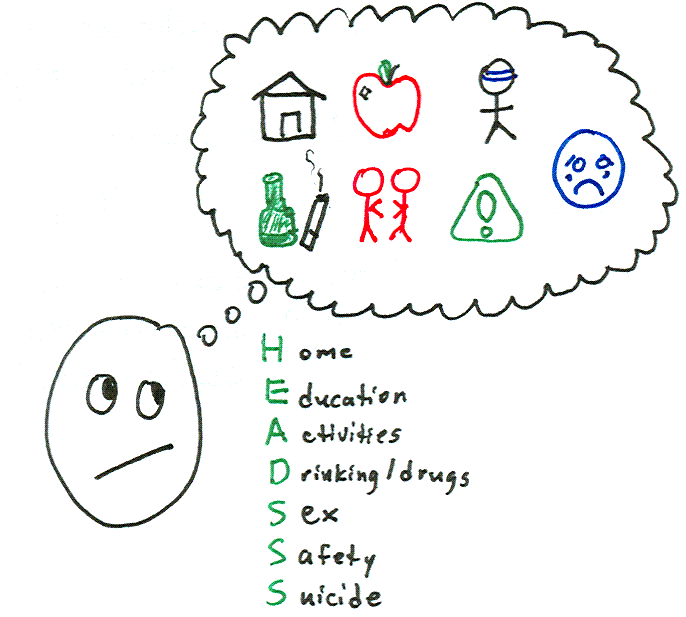
Use your HEADSSS to talk with adolescents


Ask questions in HEADSSS format to perform a psychosocial history on adolescents.
(Originally just HEADSS, now it is HEEADSSS.)
  • Home: Who lives with you? What are your relationships like at home? Who are you closest to at home?
  • Education: What classes do you like best? Least? Grades? Tell me about your friends at school.
  • Activities: What do you and your friends/family do for fun? What sorts of hobbies do you have? How much TV/video games do you do in a week?
  • Drinking/Drugs: Do any of your friends smoke? Drink alcohol? Do you? Have you tried other drugs?
  • Sex: Are you attracted to boys? Girls? Do you have a boyfriend or girlfriend? How long? Do you get along well? Do you have sex? Does it go OK? Do you know how to say “no”? Do you know how to protect yourself from STDs and pregnancy?
  • Suicide/depression: Are you “bored” a lot of the time? Have you lost interest in things you used to enjoy? Have you started hanging out with your friends less and less? Have you ever thought of hurting yourself or suicide?
  • Safety: Do you feel unsafe? When? At school? At home? In your neighborhood? Have you ever been hurt by someone?

Additional Tips:
Start the conversation with light banter to make them feel at ease and possibly open up with something personal after a nice compliment about their clothing or something that reflects their personality.

Accentuate and praise positive behaviors that suggest maturity and resilience.

Use open-ended questions and do not make assumptions during the interview.

Ask questions about friends first -- youngsters are willing to divulge their friends' behavior more readily than their own.

A good way to wrap things up is by asking teens to sum up their life in a word.
Alternately, ask for a " weather report" for the week.

Reference:
Goldenring, J.M. Contemporary Pediatrics. "Getting into adolescent heads: an essential update" Jan 1, 2004.

August 21, 2006

CAGE'd by Alcohol

When asking about alcoholism, it is common to ask the "CAGE questionnaire."
1) Have you ever felt the need to cut down on your alcohol use?
2) Have you ever been annoyed by criticism of your drinking?
3) Do you ever feel guilty about drinking?
4) Do you need to drink in the morning to wake up (eye-opener)?

Ewing, J.A. Detecting Alcoholism. The CAGE questionnaire. JAMA, Vol. 252 No. 14, October 12, 1984

August 20, 2006

Overwhelmed by False Information

It must be frightening and frustrating for people to be immersed in a world of Information, unable to process all of it. The answers are out there, for the most part -- its just a matter of knowing how to look for it and knowing who to trust. Homeopathy takes a holistic approach to medicine that utitlizes (or perhaps, capitalizes) on the fears of the patient -- "we are sick," they say, "and we want help." If an M.D. cannot provide the health and comfort that they desire, then they will turn to other sources for a cure. It might be a cure that offers nothing but support... and attention. Perhaps that is all they really want.

Another reason is related to our visceral belief, our need to feel that we are pure. That we are unflawed at birth. The truth of the matter is... we are not. We are creatures borne of error in the face of chaos, risking everything, day by day. We live to defy our own destruction -- and it scares us. Innate health, the belief that we can heal ourselves... to be truly dependent is a pleasing one. "Why take medication when our bodies makes the same things, the correct things?" I often ask myself. Medicine itself is a dynamic process, changing year by year as we increase our knowledge of the human body. Like the body itself, it comes with inherent limitations. We cannot conquer all boundaries, we must all face the same ending. Inevitability and uncertainty are our enemies. A doctor must be an ally in the process, not an antagonist. They must listen with humanity and empower their patients with confidence and acceptance. Confidence that modern medicine is doing it's best and acceptance that there can be nothing better. Snake-oil is pricy, especially for something that's actually nothing.

Why I'd like to maintain my Pseudonymity.

The time was a year and a half ago, a week after spring break. I got an urgent phone call from the Biology Dept asking that I make an appointment with the dean ASAP. I received a merit scholarship award a few months earlier and they didn't even bother to call me about that, so I was a little bit concerned. I went in to see the dean that afternoon and he started asking me some odd questions.


"Have you ever seen a Dr. Nx?"
"Do you have a personal blog where you made any negative comments about him?"
"He's accusing you of slander, for painting him as an inconsiderate, tardy doctor."

BWA? Sure. However, this was an event that was a year old and I had gone on a trip for spring break to shadow some doctors with a club. A bunch of doctors had agreed to let the pre-meds follow them around in various parts of the hospital and clinic. I was just commenting on my experiences and I mentioned that "Dr. Nx left me sitting around for half an hour, then when he got to work, he left me sitting around for another half hour so I ended up following another doctor around." It was just a sentence in a long reflection entry. This was on a blog entry that I had made "private", but unbeknownst to me, Google had a cached version of the entry.

The dean believed me and told me that he thought the doctor was on pretty thin ice to get me on academic probation for libel, especially if the incident was well over a year ago and no longer "public." I was given the doc's phone number so I could call him to apologize.

I swallowed my emotions and I called up Dr. Nx. He seemed very upset, but he tried to talk to me in a reasonable manner, telling me how "I screwed him over." He calmly explained how easy it would be for someone to Google his name for a job interview only to see my little careless blurb about his tardiness that stains his reputation as a doctor. Then he proceeded to give me his excuse/explanation for why he was late and why he ignored me when he arrived.

Okay, I can see how unprofessional it would be to be googled and have these negative impressions pop up #7 of maybe 20 sites. I didn't write with the intent to upset anyone; I just wanted to say "oh, I had a fun trip, except for a few rare instances."

Then, he dropped the bomb.
"If I weren't such a nice guy, I could call up your medical school and .... talk with Dr. Sx, your medical school interviewer, right? I could tell them that you slandered me. I could make sure you wash test tubes for the rest of your life."

This certainly implied that he had been reading through my entries since the event.

I thanked him for being a nice guy. I promised to "contact Google to get rid of its Google cache of my personal blog site." They were both lies, but they placated Dr. X... and that was sufficient. My Undergrad School had their "formal record" of the story from both sides and received no further complaints from Dr. Nx.


This was an eye-opening experience for me. This will be the ONE and ONLY time I will make negative comments about anyone on NotMySecondOpinion. I've learned that casual comments on the internet can last forever... luckily for me, there weren't any regrettable consequences from my harrowing experience.

August 17, 2006

Alcohol "allergy"

If you happen to be Asian, you might have noticed a difference in your playful drinking habits compared to other ethnicities. Still, it's summer and you want to enjoy your last few days carefree! So you go out and have a beer with your buddies. You feel a flush creeping over your face. After a few more drinks, your face turns noticably red and perhaps it is brought up by your good natured friends. You persist in alcohol consumption and you start to feel nauseous. A few hours later, you excuse your self to the bathroom as best as an intoxicated person can. Your dinner takes a shortcut to the toilet.

"Oh, I'm allergic to alcohol..." you might say. The flushing reaction, the nausea, vomiting and headache sound like good symptoms.

Not quite. You actually have a mitochondrial enzyme deficiency in "ALDH2." What is that? Well, alcohol is absorbed in your stomach and your liver starts grinding away at it with alcohol dehydrogenase (ADH.) The byproduct of this reaction is acetaldehyde. In most people, this acetaldehyde is converted into acetate with the enzyme aldehyde dehydrogenase (ALDH.) However, some asian people lack this enzyme and the aldehyde builds up. The high concentration of aldehyde (along with alcohol) builds up in the blood, leading to those unpleasant feelings that other people might get after having 10x as much alcohol.

The fact that this is a "mitochondrial enzyme" made me wonder if this meant that you could blame your mom for your intolerance to alcohol. After all, you inherit all of your mitochondria from the parent that bore you into the world. I poked through a few scientific journals on PubMed. I learned that it was a dominant allele (meaning that your parents are much more likely to pass on to you and affect you.) ALDH is active in mitochondria AND the rest of the cell (likely by ALDH1 or something like that)... so you actually clear acetaldehyde slowly... and your dad might be to blame.

"Why would evolution punish me so?!?" you might ask, being afflicted with this horrible, party-pooping disability that cripples your now-withering social life. Well, there's a theory that it has to do with cancer. HepB is a sexually-transmitted virus that you can get from your mom at birth if she has it -- and a lot of women in Asia have this virus. HepB greatly increases your chance for liver cancer. Drinking adds to this risk by causing liver damage and cirrhosis, so having ALDH2(2) might be a historic marker helping to prevent cancer! Nowadays, we have a vaccine that prevents Hepatitis B, as I've mentioned before.

If that is not enough for you, be glad that it prevents alcohol toxicity, which can lead to serious problems like blackouts, coma and death. You just get minor aldehyde toxicity instead. Just remember, there's a reason why it is called inTOXICation.


References
Crabb, DW. Genotypes for aldehyde dehydrogenase deficiency and alcohol sensitivity. The inactive ALDH2(2) allele is dominant. J Clin Invest. 1989 Jan;83(1):314-6. PMID: 2562960

Jenkins, WJ. Subcellular localization of acetaldehyde dehydrogenase in human liver. Cell Biochem Funct. 1983 Apr;1(1):37-40.

Lin, YP. Why can't Chinese Han drink alcohol? Hepatitis B virus infection and the evolution of acetaldehyde dehydrogenase deficiency. Med Hypotheses. 2002 Aug;59(2):204-7. PMID: 12208210

August 13, 2006

Concept Mapping

I love CmapTools.

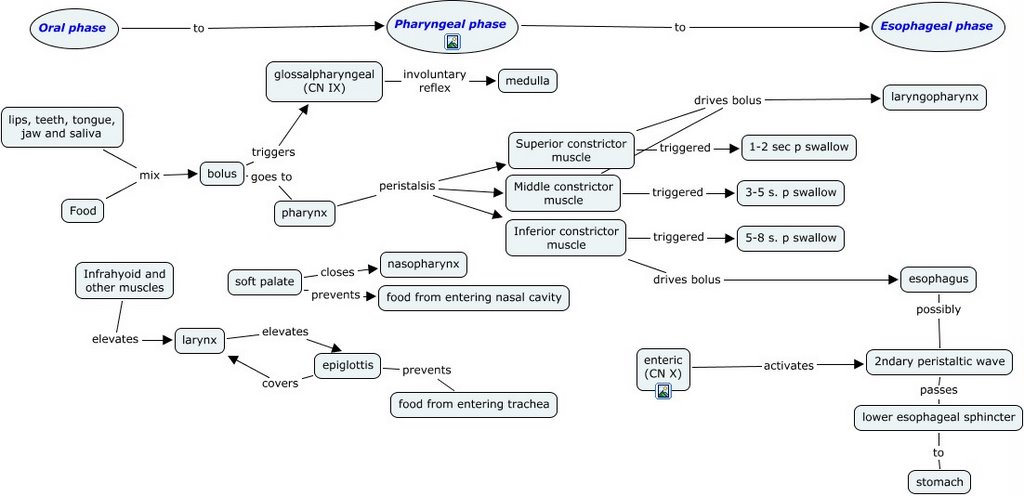
This program allows you to freely link concepts together in a simple-to-use, free program with a lot of powerful features like synchronous editing (for maps hosted online,) suggestions (that offer linked-concepts from other maps) and an outline view (with a list of the concepts made, prepositions used and linking phrases.)

How is this useful for a med student? Here's a few maps that I've made last night using this program -- the little icons illustrate the ability to link resources to the map!


It is very useful for visualizing mechanisms and learning where your knowledge is deficient!

Here's a wikipedia link to a list of concept map programs that you can check out.

So you're starting med school...

And you're wondering what sort of things you need for this venture. It can be overwhelming and there are a TON of resources that you'll be utilizing. You're strapped for cash and this whole school thing is already cutting into your future pay. So what do you do?

Some professors will have a recommended reading list -- they might even require some texts. There's only a few that I've been told are really required and those are the only ones you should really buy in your first year.

You might also be hearing about PDA software. You don't need to fork over a lot of money to get the portable info you need. There's a few programs that everyone I've talked to uses and I'll share them with you.

First, some reading lists:
So you'd like to... know what books I bought for medical school Amazon.com
So you'd like to... succeed in medical school Amazon.com
Notice the overlap in books.
A medical dictionary like Taber's or Stedman's comes with software. I bought the Stedman's with PDA software and I really like it. Since I'm pretty clueless at this stage in the game, it has been very helpful.
Robbin's Pathologic Basis of Disease is a must buy. Some people recommended that I read through the 1st ten chapters of this big book by the end of the semester. Sure. That doesn't sound so bad, but it is dense reading. Perhaps "baby" Robbins (Basic Review of Pathology) would be better suited for this purpose.
Lippincott's has a review of Biochemistry, Pharmacology and Microbiology. Biochem is the favored Lippincott's text; the other subjects have different books that suit different people.
Clinical Microbio made ridiculously simple looks ridiculous alright. At first, I didn't really like the pictures, but they are starting to grow on me now. I already took microbio in college, so most of the concepts are not very helpful. There are a lot of fun mnemonics though!

Each school has their own curriculum. My Med School is geared by case-based studies of organ-systems, so the books that I have are mainly looking at differential diagnoses, rather than "basic" science subjects covered in the USMLE Step 1.


PDA software sites
Ectopic Brain is a blog with a lot of up-to-date resources.
Doctor's Gadgets
CollectiveMed.com
Yee's Medical Palm Info is little outdated, but he still has some good info.

Epocrates Rx free is a drug reference program that also has a formulary based on local insurance policies so you can write the right prescriptions.
Medical Mnemonics.com - Use this! It is a lot of fun... and I've already been posting up a few mnemonics from this program that I've found useful.
Johns Hopkins Antibiotics Guide is an "Epocrates Rx" for Abx.
MedCalc - I'm hoping I won't get in trouble by relying on this one too much in the future.

On a different note, I really like using McPhiling to switch quickly between my programs without going to Home first. It also has a cool pseudo "Alt-Tab" feature to flip back and forth between your current and previous program.

Well, I hope that has been helpful!
If you have any other links or books to recommend, please feel free to comment.

August 11, 2006

OLD CARTS: 8 attributes of a symptom


Well, I wrote "7" when I was sketching this out, but I guess I meant "8." Bates' Guide to Physical Examination only used the mnemonic OLD CART and I unconsciously added an "S" for severity.

August 10, 2006

Hm... blogging is hard!

Well, I started medical school recently. I've been busy studying and working on small group presentations. It is good that I've been learning a lot, getting to know my classmates, having a lot of fun in the sliver of summer break that everyone else still has left... but I haven't been devoting the sort time to this blog that I really wanted to. I intended to use this as a place of reflection on my experiences, to make sure that I maintain my balance -- to learn about ethical, philosophical and spiritual issues alongside the biological and clinical lessons that I am taught in school.

The thing is, ethical issues are HUGE. I feel like I don't give the time they really deserve if I poke in and comment on the few issues that crop up day by day.

Philosophical entries are monstrous as well. I love thinking about these things, but it is difficult to trim down my thoughts into a coherent essay -- a recreational essay at that -- and give it a solid opening and closing.

So, I'm going to change my focus a bit. My other goal of this blog, educating the public (read: you!) about health and social issues, has been much more successful. I think that the addition of the mnemonics section to my themes will give you new entries to check out on a daily basis. Mnemonics and news are just short little clips that I can pop out with next to no effort or thought.

Unfortunately, next-to-no-thought is not what I want this blog to be about. Weekends will give me the time to compose myself and write the better entries that I have been stewing in my mind that I have not had the time to write during the week.

August 09, 2006

Sarcomere recall: Zoe is a horny mama!

One of my classmates asked me for a quick way to remember the different parts of a sarcomere. I whipped out my trusty PDA, typed in "muscle" into the search function of MedMnemonics and I found two great ones that I thought I'd share with you as well.

The parts of a sarcomere correspond to the following mnemonic:
Zoe (Z-line)
Is (I-band)
A (A-band)
Horny (H-line)
Mama! (M-line)


Additionally, the light and dark bands are isotropic and anisotropic. The second letter of each word corresponds to the band name and its properties.

dArk (A-band, anisotropic)
lIght (I-band, isotropic)

Cleverly provided by:
Medical Mnemonics.com

August 04, 2006

On the "Quality" of Purity

pu·ri·ty Pronunciation (pyr-t) n.
1. The quality or condition of being pure.
2. A quantitative assessment of homogeneity or uniformity.
3. Freedom from sin or guilt; innocence; chastity: "Teach your children . . . the belief in purity of body, mind and soul" Emmeline Pankhurst.
4. The absence in speech or writing of slang or other elements deemed inappropriate to good style.
5. The degree to which a color is free from being mixed with other colors.
[Middle English pur, from Old French, from Latin prus; see peu- in Indo-European roots.]
What is so great about purity?

Frankly, I'm not such a big fan of the idea. I am not suggesting that the other extreme of corruption is ideal either... but the broad advocation of purity does not sit well with me. I think that balance should be the focus, not purity!

What am I referring to?

Plenty of things. Innocence, for one. Lack of "taint" or "color" for another. Finally, too much of one good thing.

What about innocence?

Innocence is a quality that can only recede or remain constant in people over time. Experience constantly exposes us to new things; some of these things shocking and horrible like the death of a close loved one, or the marriage of another. ;-) Other things can only be experienced with other people (like sexual intercourse) in an intimate setting -- creating a great deal of mystery about what goes on behind those closed doors.

Unless we block out our memories, traumatizing events will remain with us for the rest of our lives. Even if we forget, paper records, people and other things exist and remind us that we are not so innocent after all.

Why is innocence valued?

When we see young children playing, people often comment "oh, to be so young and innocent again..." These children have something that we never will. However, is Ignorance a thing to be treasured? What about Confusion? Children are clueless, chaotic little creatures that need guidance and discipline. They can be brainwashed to learn absolute garbage or they can be groomed to become multi-talented bright young stars. Purity provides adults with a blank slate. Careful though! Kids scribble on slates just as well as parents do.

It is nice that children have a fresh outlook on life. This gives us perspective and in many ways, it balances our own lives.

We might get lost in the day to day "grown-up" activities of making money, paying bills and acting busy that we forget the reasons why we are working hard. Children live life. They want to learn new things, be amazed by the world and experience things! It is this process that enriches the lives of parents who rediscover their child-like wonder.

What were you saying about lack of "taint" or "color"?

How many colors are Red and Yellow and Blue? (Answer: Three.) Now, if you mix these three colors together in as many ways as you can think of, how many do you have now? (Answer: Lots! All the colors we know!) From an aesthetic point of view, which do you prefer?

Purity is boring. In many ways, purity is a cultural force that drives us to become stiff, self-conscious and dull. Purity can leech our lives of things that might be dangerous, exciting or fun. It also drives us to a single, unifying extreme; polarizing the world by drawing constrast between Us and Them.

How can we have too much of a good thing? What is wrong with that?

I'll answer with a story. In ancient Peru, Incan settlements were far apart from each other, from the Amazonian jungles in the east, through the mountainous Andes in the center, to the coastal plains in the West. In order to travel these long distances, Incans often carried bags of small leaves that gave them a boost of energy and suppressed their hunger. These leaves were so important to travel that distances were measured in how bags one ate along the way!

When the Spaniards first heard about this magical leaf with the powers to imbue strength and energy, they dismissed it as ignorant nonsense. However, they soon found out that they were true and they began to use it as a cash crop. It also had properties of pain-relief and it was beginning to worm its way into medicine.

The active ingredient in the leaves was isolated in 1855 and it was the subject of Albert Niemann's dissertation in which he stated that:
"Its solutions have an alkaline reaction, a bitter taste, promote the flow of saliva and leave a peculiar numbness, followed by a sense of cold when applied to the tongue."
Cool! It began to be used as a cure for flatulence, teeth whitening, toothache, morphine addiction. It was put into various drinks to enhance their ... experience. Coca-Cola is a famous example.

This magical leaf comes from the coca plant; the active ingredient that was isolated is cocaine. The Victorian era that used cocaine as a harmless anesthetic now looks quaint in comparison to now. We have a strong street drug culture hooked in the powerful cycle of addiction.

This might look like we have been tainted by the influence of cocaine on our society, making it less pure. This is true, to some extent. I prefer to see it as the purification of cocaine from the coca plant as the root of our current problem. Same goes with the poppy seed story. And perhaps,

What is the real evil of cocaine, though?

It is not the knowledge of how to isolate and purify these narcotic compounds. It is not necessarily their use either -- someone on their deathbed might need powerful painkillers as a palliative measure (and if they are going to die, the risk of addiction is irrelevant.)

The real evil is the ABuse of these drugs. The people who are irresponsible and use these powerful chemicals to mess up their bodies big time for a single, very selfish purpose -- entertainment and recreation.

Why should we be wary of purity?

It is important to remember that there is a balance in all things. Too much innocence makes kids vulnerable to bad influences because they don't know any better. Protect them, but at the same time, let them explore. It is important to educate them about consequences and responsibility.

Adults are just old kids. They can be subject to brainwashing too. In order to differentiate between good and bad things, we need the knowledge of good and evil. We make our judgments about what actions to take based on this knowledge -- an uninformed opinion is one in danger of being 50% wrong!

Everyone has their differences. Stamping a few of these differences out because they make other people feel uncomfortable is not a good thing. Diversity, exposure to many novel and interesting things, is what gives us a broader perspective about the world.

The isolation and purification of any particular thing, be it a certain group of people or a chemical, can lead to an overdose if abused! Purity driven by self-righteousness, greed, selfishness or hedonism is a destructive influence.

Purity must always be tempered by the virtues of balance, education, diversity and responsibility in order to be used wisely.

August 03, 2006

PERLA & I Palpate People's Abdomens

Here's two mnemonics that might help out during a physical exam:

PERRRLA or PERRLA or PERLA

P upils
E qually
R ound, Regular, Reactive to
L ight &
A ccomodation

This one is well-used by physicians. The doctor turns off the lights and determine light reflex with a penlight or opthalmoscope.


I (Inspection)
Palpate
People's (Percussion)
Abdomens (Auscultation)

This one will help you remember the various techniques you can use to assess the patient.

Cleverly brought to you by:
MedicalMnemonics.com

July 30, 2006

My First Blood Draw

The homeless shelter's free clinic was slow that night. The doctors suggested that we practice doing blood draws on each other and I went inside the trailer to observe. A girl was doing inserting the needle into a docs arm.

"Look away! You might feel a slight pinch!" she said, as if she were talking to a skittish patient instead of a hardened FP.

"Don't let go of the needle!" the doc said, commenting on her technique. "Hold it still so it won't slip out.

"Ok," she replied. Like a true ditz, she promptly let go of the needle to insert a vacutainer into the syringe-cover-looking thing.

"Uhm... you let go."

I laughed, a giddy nervousness spreading through my body. We're all inexperienced at these sorts of things. Even the third-year medical students aren't experts at blood draws; in the hospital, there is usually a nurse or a phlebotomist on hand to perform these routine (and for many, terrifying) procedures.

I had passed up the opportunity to attempt blood draws in the past. My preceptor at a small community clinic gave me the following advice about jumping in and attempting new procedures. "You will be an intern one day. For them, it is often see one, do one, teach one." Still, I chickened out on the big procedures. A small girl enthusiastically asked for a blood pressure reading one time. I attempted to read her BP and made her wince in pain as I pumped the cuff. "Whoops. Too much. I don't know what I'm doing..." I said lamely.

I quelled my nervous energy as the girl finished up, attempting to be professional despite the minor mistakes she made along the way. "Apply pressure on this gauze for two minutes and you should be fine!"

------------------------


A family medicine resident came in and surveyed the crowd. "I'm donating my left arm to whoever whats to try the next blood draw!" Suddenly, computer screens, pill bottles, and posters on the wall became the subjects of great scrunity. The only one who held her gaze was me. The other students shuffled back a few steps.

The resident seemed surprised by the response. "Doesn't anyone else want to practice?"

I steeled my resolve. I'm a MED student now, danggit! I gotta be willing to just jump into things and give them a go. "I'll try! This is only my second day of medical school though, so you'll have to talk me through it."

The resident smiled at me and said "Sure. Let me get all of the supplies set up for you." We retrieved some gloves, a small vacutainer, a needle-tube-needle, a rubber tourniquet, a few alcohol swabs, some gauze, tape and that barrel-syringe-cover-looking thing. Sorry, my terminology is not up to par. We spent a few minutes talking over the procedure and setting everything up so it was accessible and ready before I did anything with the sharps.

I learned a few tips that I would not have picked up just from observation.

Following the set-up, the rubber tourniquet is tied around the upper arm with a tucked loop. A simple pull on one end undoes the knot after the blood draw is complete. A tourniquet should be applied for no more than three minutes -- after that, the arm will begin to get the "pins and needles" sensation.

The subject pumps their hand a few times to raise the vein up. Tap along the vein to get a feel of where it is. Clean it with an alcohol swab, with a spiraling circle motion outwards from the point of entry. Hyper-extend the patient's elbow to raise the vein and firmly place your thumb on their lower arm on the vein. This will prevent the vein from rolling away from the needle.

Insert the needle bevel up (the hole angled towards you) along the vein at ~30 degree angle -- "scoop" a bit when you hit the vein so you don't puncture through the opposite wall. A flash of blood will reward you for your efforts!

Move your thumb off the vein onto the needle to secure it safely in the vein. Don't let it shift or slip. Bruising, pain or bleeding can result!

Take your other hand and insert whatever color vacutainers you need for the procedure into the barrel of the syringe-thingie. Blood should flow in by the vacuum. Don't let it get too full. Remove the vacutainer and replace with the next. Before you remove the last container, loosen the tourniquet. Remove the vacutainer before removing the needle. The FP doc told us of horror stories from his first blood draw with frothing, bubbling blood spraying out all over the place.

Fold a piece of gauze in half and place it gently on the site of injection. Don't push down hard. Pull out the needle gently and apply pressure. Have the subject fold their arm or apply pressure with their other hand while you get the band-aid/paper tape ready. Put the bandage on and you're done!


A few extra tips: used sharps go in the sharps container. Never place them down anywhere else. Communicate with the patient -- this will put them at ease and help you review what else you need to do.

Another first-year with whom I was tagging around with at the homeless shelter was emboldened by my success. For the rest of the night, the FP resident was walking around showing her bandaged arms to everyone she met.

"Two first-years drew my blood tonight," she bragged. "They both got it in on their first try for their first time!!"

It was a good feeling. :)

Here's a link on venipuncture for those of you who want to learn more.

July 27, 2006

Personal Mission Statement

The following is a mission statement that I composed as a guiding force behind my actions as I enter medical school. The template was provided by My Medical School's administration as a part of our orientation, but the values and the last two categories are my own.

We only had about 5 minutes to construct our mission statements, so the last one didn't go as well as I would have liked.


My personal mission is to be true to my commitment to myself and other as I fulfill the many valued and cherished roles that comprise who I am and who I want to be.

As a physician to be, I will strive to be compassionate, easygoing, and wise.

I realize that I am still learning how to be a physician, and as a lifelong student of the art and science of medicine I will demonstrate enthusiasm, curiosity and tenacity.

My family is very important to me. As a part of my family, I will always work towards being loving, attentive, and accepting.

My friends are special to me. I hope that I in turn can be an amusing, entertaining and engaging friend to them.

I am a proud member of My Medical School's Class of 2010. I hope to always prove to be a classmate that is diligent, dedicated, and sharing.

As a mentor, I will do my best to be inspiring, down-to-earth, and a good storyteller.

And for you, readers of my blog, I will always try to be perceptive, systematic and creative! :)

July 26, 2006

HepB Vaccine

"So, does anyone know anything special about the HepB vaccine? Anybody?"
We were all standing in a circle outside the shelter, about to open the free clinic and a medical school faculty member was quizzing us about the shots that would be given on Friday. I wracked my brain to try and come up with some ideas. Hepatitis B is a sexually transmitted disease prevalent in Asia and the Pacific, where vaccinations are uncommon. A lot of times, immigrants from these regions unintentionally transmit this disease to their American children at birth, raising their risk for cirrhosis and cancer.

"Yes, that's right! The HepB vaccine was the first of its kind to prevent cancer!"
One of the MS-3s had nailed it on the nose.

A cancer vaccine? Hey, that sounds sort of familiar... weren't some Christian groups making a big hullabaloo about another STD vaccine that prevents cancer a while back? Cervical cancer caused by the human papillomavirus (HPV)?

"There is something about the HepB vaccine that has stirred up controversy. Does anyone know?"
I bolstered my courage to try and chime in with what I knew about the cervical cancer vaccine and how "Family Interest" groups were afraid that it would increase pre-marital sex in teenagers because they would go wild, knowing that their risks of cervical cancer would be significantly decreased! Alas, that was the wrong answer.

"There was concern that the mercury contained in these vaccines were linked with an increase in autism. Since then, thimerosal has been removed from all vaccine for children. But you should know that there has been no scientific data to back up the mercury-autism link."
Gah. I should have known this one, as an avid reader of Respectful Insolence. He is on a crusade to rid the world of this misinformation.

"Our governor recently vetoed a bill that would ban all vaccines with thimerosal in them."
Of course. Gov. Lingle was worried that Hawaii would be vulnerable to the avian bird flu if we put these sorts of limitations on a safe product. She was bold enough to state that "this bill is objectionable because it restricts the use of FDA-approved vaccines for no scientifically sound reason." I am glad that she can see this... which makes me wonder. What made our state government decide to write up this bill of nonsense in the first place?

July 23, 2006

What keeps me awake at night

Tomorrow is going to be my first day as a medical student. I am excited that I get to meet new people, in the clinic and in school. I am happy about learning medicine. I am disappointed that my life as I know it is drawing to a swift close. I am afraid that my biggest fear will be realized.

Am I afraid that I will look like an idiot in front of my classmates, preceptors and patients? Nope, I've already come to terms with my lack of intelligence. I'm ready to counter it with an overabundance of enthusiasm and curiosity.

Am I afraid of taking tests and studying hard? Nope, I already spend my free time studying medicine (albeit in the casual channels of science and medical blogs) and I'm ready for my swift kick in the arse after relaxing for a year.

Am I afraid of being disillusioned? I might be a little on the idealistic side, but I still have a good dose of realism/cynicism to save me from this sort of emotional burnout.

So what is it that keeps me up at nights worrying? Well, it is precisely that. Not the worrying part, the staying up at nights part! I love sleep. I have this notion that sleep is vital to my health and sanity. I have also theorized that I study better when I read a little bit and rest my eyes soon afterwards, coming up with mnemonics and cool visuals in my head. I like my theta rhythms... they help me learn and maintain memories for long-term potentiation. I am worried that I will spend too much time memorizing things and not enough time understanding them. I am worried that lack of sleep will turn me into a smelly Oscar the Grouch. I am afraid that my 8-10 hours of leisurely delta waves will be lost and I will be forced to rely on coffee/tea/Red Bull for their caffeinated boosts of energy.

I don't like the idea of relying on a stimulant to maintain my energy. If I'm tired, I'd like to go to sleep. I suspect I will be in for some harsh awakenings in the near future.


Here's some links on the subject of sleep and Red Bull!

Pop Science: the Chemistry Behind Red Bull's "Wings"
Retrospectacle takes a look at a can of Red Bull and discovers an ingredient that might provide energy aside from caffeine and sugar.

Everything you wanted to know about sleep (but were too afraid to ask)
The link between morning larks, evening owls, puberty and sex are all put together in this amusing entry by A Blog around the Clock.

July 18, 2006

Mind of Machinia

Matthew Nagle is a quadriplegic. Five years ago, he was a healthy twenty-year old who was assaulted with a knife. Now, he is unable to move his arms and his legs... yet he can turn on the TV, flick off the lights and check his email with a few silent mental commands.

Nagle is not telepathic; his powers are the result of advanced scientific research into computer-brain interfaces (CBIs.) CBIs have come a long way in the past decade as the development of our technology and our knowledge of neurology have both increased significantly. A special computer chip was implanted in the motor cortex of his brain, allowing him to move a cursor. John Donaghue, the developer of BrainGate, believes that this tech could someday move a mechanical limb or direct a wheelchair.

However, DARPA's dreams of mechanical robots and tanks driven by the minds of super soldiers and Ironman Mech-Suits are not fully realized. The technology is not perfect. It is still bulky, experienced technicians are needed and unusual training of brain waves might require special customization of CBIs for each user. Nagle's unit malfunctioned after seven months and he had it replaced with another device to improve his breathing. He lost his ability to beat lab technicians at Tetris, but he did give the hope that this technology will one day help people with Parkinson's disease, Amyotrophic Lateral Sclerosis (Lou Gehrig's disease) or other disabling conditions.

Source:
LA Times: Quadriplegic Turns Thoughts Into Action
EMBO: When Mind Meets Machine
BBC: Brain Chip Reads Man's Thoughts

July 16, 2006

Fast Food Nation

(Sorry about the break; I went on vacation for the week with my partner. We had a great time, but I didn't have any access to the internet for the week! Agh!)

I just finished reading the book Fast Food Nation by Eric Schlosser and I found it very engaging. Schlosser weaves intricate stories that illustrate the roles that various people have had on the fast food industry. The way he links Ray Kroc, the McDonald's man, to Walt Disney almost runs off on tangents, but turn out to be wide arcs leading back to the main point. The rest of the book is not as entertaining as it trudges through the harsh realities of strained fast food employees, slaughterhouse workers, struggling ranchers, all to pursue the American Dream of the Big Buck.

This Fall, the book will be made into a movie about a fictional company called the Big One (satirizing McDonalds, of course.) I'm not sure that it needs to be turned into a story, since the book does a good job as a documentary... but I suspect it has something to do with the success of the movie Thank You for Smoking.

Here, you can compare the book to the movie. Well, just the introduction of the book and the trailer to the movie. For more, you'll have to go to the library/bookstore or wait a few months in a theater near you.


Fast Food Nation: The Dark Side of the American Meal - Page 1


[add 7/23/06]
Here's some more clips related to Fast Food Nation that might be of some interest:
BBC hosted a debate between Schlosser and McDonalds!

Part 1


Part 2


Part 3

July 09, 2006

"The Master Cleanse"


Last night, I went out to eat with some of my friends after seeing the movie "Pirates of the Caribbean." My girlfriend mentioned that we had been "doing nothing but eating" since we had been at a beach barbecue right before the movie (which we did have a lot of food at, incidentally.) The topic shifted over to "diets" and it went wayside of scary crazy.

"I just finished with my seventh day of the lemonade diet!" One girl said happily to the group. My friend Ryan filled us in on the details. Apparently his parents swear by the health and happiness that results from drinking a quart of seawater every morning and consuming nothing but lemonade+maple syrup+cayenne pepper. Oh, laxative teas are tossed in every once and a while. It had cleared out the yellows in his mom's eyes, did wonders for removing toxins from their bodies and gave them cleaner energy.

The girl that tried the diet as well said that she was hungry at first, but then it went away and her mood improved, her mind cleared and she felt so much better. (My girlfriend got a load of attitude from her when we first met her before the movie started, so we did not really get to see any positive moods from her.)

Then, Ryan piped up with his own feelings about the diet. "It was horrible. I was bedridden for days, I didn't have any energy and I started puking up blood." His parents used seasalt instead of regular tablesalt for the diet and it probably tore up his stomach.

Puking blood is not the healthy part of any diet, the "master cleanse" included. The girl amended that her own doctor didn't recommend the diet -- he strongly advised to limit it to three days if she decided to do it.

"Soooo.... what was the name of this diet? Who was the health expert that recommends it?"
I asked, both concerned and curious.

"Oh, you can find it on the internet," they said almost dismissively. "Its called the lemonade diet."

-------------------------------------

I did a little bit of poking around and I found links to pamphlets of books called the "Healing for the Age of Enlightenment (1993)" and "The Master Cleanser (1976)" by Stanley Burroughs. Amazon.com has some reviews by health nuts who rave about it and lawyer-types who rant about it. Apparently, Mr. Burroughs was charged with second degree murder for treating a person with leukemia without a medical license. The murder conviction was later overturned by the Supreme Court of California.

It is important to take the testimonials of people who try something like the lemonade diet with a grain of salt (pun intended.) There can be serious health complications and even worse results if the treatment oversteps its bounds as a "detoxification and cleansing diet" into its claims that it can magically heal all sorts of diseases. Leukemia is NOT something that can be healed with some lemonade and cayenne pepper; it takes serious knowledge to become a respectable medical practitioner.

Orac at Respectful Insolence says it best in a post about understanding alternative medicine "testimonials" for cancer treatments:
Never forget that alternative medicine testimonials exist largely for one purpose: To sell a product. Most of them are advertisements, nothing more. They are no more "unbiased" than pharmaceutical advertisements for their latest, greatest drug. In fact, they are worse, because at least the pharmaceutical companies have to be able to back up their claims with science and disclose potential adverse reactions in their ads. No such requirements exist for most alternative medical treatments, mainly because most of them claim to be supplements rather than medicines. The other problem with testimonials is that they don't rise even to the lowest level of medical evidence, the anecdotal report. Anecdotal reports in medicine require a careful documentation of symptoms, lab tests, diagnoses, exact courses of treatment, and a patient's response to treatment. Testimonials almost never present these elements in sufficient detail to judge whether the treatment actually did anything. There's just no way of telling truth from exaggeration or fiction.
If you ever read something on the internet that sounds too good to be true and they are trying to sell you something... be careful. Fact-check on reliable webpages. Read user comments and criticisms. Don't fall victim to hype and spin.

July 05, 2006

The avian flu creates a "cytokine storm" in teenagers

According to the San Francisco Chronicle, the H5N1 avian flu hits young people the hardest. This trend was also observed in the 1918 Spanish flu epidemic which killed over 50 million people. Teenagers are surprisingly susceptible to the disease compared to the elderly because of the peculiar way our immune systems fights off infection.
Evidence suggests that many young people in 1918 and quite a few in this outbreak are killed by a "cytokine storm" -- the body's own immune reaction, which floods the lungs with fluid. Young adults generally have strong immune systems.
In some ways, the strong immune systems of young people becomes our greatest enemy. Our immune systems work in such a delicate balance with our bodies... so it becomes too easy for some virulent invaders turn that to their own advantage.

This is the first time that I've heard the phrase "cytokine storm" used. A query in PubMed reveals that it has been used lightly in the past. Only 50 or so articles have used the phrase "cytokine storm", with the original published use taking place in 1993. Google Trends doesn't have much data to show for it, just a spike in search queries taking place in early 2006... but I anticipate that this will change quickly. In the process of political spin doctoring, all it takes to change peoples' perceptions is the coinage of a new term and turn it into something to be feared and reviled.

"Cytokine storm" sounds much more scarier than "bird flu." The human flu for most people is something that doesn't even warrant the effort to get a vaccine each year. The word "cytokine" is a mysterious thing in our bodies which will be translated as a "immune system messenger" that can easily send the wrong signals to our bodies.

Here's a cytokine that comes to my mind. Tumor Necrosis Factor alpha (TNF alpha) moderates our inflammatory response. TNF can kill cancer cells, hence the name. It can also kill healthy cells. TNF is involved in death when people go into shock. People who have high concentrations of TNF over time start wasting away and get cachexia.

See how spooky these things become? And thats always in our bodies, ready to be unleashed. When the H5N1 strain mutates from an "avian flu" to a "human flu that can kill millions," language like this will cultivate a more appropriate sense of fear in the public... as long as they don't get carried away in the hysteria. After all, gross hysteria and overreaction is just what this virus needs to kill you...

July 03, 2006

The Wiggles

I stare blankly at the screen of wiggles. Some of them wiggle at a regular rate while others look like an earthquake is ready to rumble through the hospital. Its scary to see how different they look... yet they both represent people that are very much alive.

"What does this mean?" I jab my finger at a sharp downward facing spike on the screen.

"Oh, that's a pacemaker." A nurse joins me in examining the screen, her eyes tuning in on the more important aspects.

"The spike is facing down because... it's located in the ventricular wall?" I think she nods, but I'm not sure. I think that the electrodes can pinpoint the location of the pacemaker, but I'm not sure. An alarm chimes and the nurse rushes off to check on her patient. My knowledge of cardiology is limited to reciting "PQRS wave" as I try to recall which part of the wiggle is the depolarization and repolarization of the atrium and ventricle.

All I can do is stare in amazement and shrug my shoulders as miracles are performed.

The heart monitor is like a crystal ball. Only those trained in divining its inner mysteries can understand what to look for and how to use that information. I can compare healthy wiggles to scary wiggly wiggles, but I don't know much about different leads, the amplitude and frequency of each part of the wave or how each heart condition manifests itself as electric current zapped wirelessly to the portal at the nurses' telemetry unit. I have a vague understanding of beta-receptors and ACE inhibitors, but IVs are still mysterious potions that course through the veins of the sick.

Knowledge is magical. It has the ability to transform weird wiggles into predictive power used to save lives. Someday I will be a magician.

July 02, 2006

Working Out

I went to the YMCA today and I had a long talk with one of my new friends there. He's been working at the Y for a while as a trainer for a few years now and he wants to open up his own business, focusing on the functional aspect of physical therapy and body building as opposed to the form aspect. He is a very smart guy and our talk made me realize that I don't know much about exercise. Not on a scientific level, at least... in my anatomy class, we spent a few months on the insertions and articulations of muscles and joints, but I haven't committed much of it to memory. My focus had been on studying the dysfunctioning body, but this doesn't make much sense unless I already have a strong understanding of the expertly functioning one.

An important component of exercising is doing it in a "proprioceptive-enriched environment." Proprioception is a part of our sense of touch. It adds context to our movements and allows us to recognize what position our body is in without looking at it. Our cerebellum coordinates our movements based on proprioceptive information we receive from muscle spindles and golgi tendon organs. Our brains learn to recruit muscles for certain actions, like running or dribbling a ball. Yet it is funny that we don't call professional athletes "smart!" They are in fact, cerebellar geniuses.

After about an hour of conversation, I started to exercise with a great awareness of what I was doing. A lot of machines in the YMCA activate specific muscles located on a chart posted on the machine... without incorporating stabilizing and synergystic muscles. While these machines make it easy for people like me to workout different muscles, they also have a big flaw, according to Mr. FunctionalFitness. Since they isolated muscles, they provided an inappropriate context for activity. It is better to work out with free weights, as long as you know what you're doing. I guess that's where the knowledge of a trainer comes in.

I did some workouts on the Freemotion machines. I haven't been to the gym in a while, so I think I'll be stiff in a couple of days, but I enjoyed it a lot too. I think a lot of things have worked out just fine.