
Let me tell you a little bit about my ideal job. Maybe that will tell you something about my ideals, my values, my goals, my hopes and dreams.
I would like to be a family medicine primary care physician for a small community. I would be in private practice, but I would have excellent connections with local supportive ancillary services like dieticians, diabetes educators, physical therapy, and sub-specialty care. I would have a broad and diverse patient population that challenges me on a daily basis. Babies, baby-boomers, the extreme health-nut that wants education on alternative medicine, the extremely sick obese/DM/HTN/CAD/COPD/CHF/hypothyroid patient on dialysis and home O2 that needs education on everything, the ethnic-mish-mash, the indulgently elite and the financially-challenged -- I'd like try to juggle it all and coordinate care with other doctors as appropriate.
I would reduce the co-pay for my patients that get started on an exercise program and lose weight, quit smoking, go to support groups, become educated on their disease processes and start taking charge of their health -- with me as their coach. I will brainstorm other incentives for patients to these ends.
I would encourage my patients to have their own health records -- available online through Google Health or similar services to allow for seamless care if they are admitted to the hospital. I would encourage my patients to interview their families to provide an in-depth Family History. I would provide up to date patient handouts. I would create monthly emails/newsletters and update my patients on the specific conditions they have and encourage them to come in and see me if there are any concerns or changes that can be made.
I would make sure that I have adequate time with both new and complicated patients. I would make sure that patients can call and make a same-week or even same-day appointments. I will use services like GrandCentral and Google Voice to screen phone calls and organize my life with a single phone, but multiple numbers for the office, family and friends. I would take care of patients on an urgent care basis too... so they don't have to go to the ER when they don't need to. Sure, this means that I would see less patients every day but if I do my job right, then I don't have to scramble to see them again and again for the potentially-preventable things I may have caught in the first place with an additional 5-10 minutes sitting one-on-one with a patient. If that means that I have less staff to keep overhead costs low, so be it. I would like to be self-sufficient as much as possible.
I would like to take care of a young couple. I would like to counsel them about preparing for pregnancy and then be there for the delivery of their first child. (Maybe even deliver the child?) I would then take care of the kid until he/she is old enough to have children as well, completing the cycle. THAT would make me feel a sense of satisfaction as a true Family Medicine practitioner.
I would like to get to know my patients so intimately that I can provide a narrative about them, like some of my preceptors are able to do seemingly without any effort. If my patients are admitted to the hospital or sent to a specialist, I can glance at their Problem List and their Patient Narrative (two sheets I would update at each and every visit) and provide a clean, concise history that is only 1-2 pages but addresses the relevant biopsychosocial issues.
I would like to be an expert on broad differential diagnoses; ones that encompass the long-tail diagnoses on a cost-efficient yet cognitively appropriate basis. I would strive to avoid becoming a diagnostic robot and instead, really think about each individual patient.
Most of all, I would like to be a part of the SOLUTION for our current health care problems. I would like to come up with new innovative ways to integrate today's technologies with traditional doctor-patient relationships that are built upon the fundamentals of trust, confidence, competence and mutual respect.
I've read a little bit about the "Ideal-Micro-Practice" and it outlines pretty much the sort of thing that I want to do.
Of course, this is a dream job. And I'm a dreamer for thinking that I can do anything close to this in today's economic climate. There's a lot of harsh realities involving paperwork, bureucratic red tape, the BUSINESS of medicine and making enough money to stay afloat. I am only a medical student. I have a few more years to figure that sort of thing out... and I'd like to find a residency program that can prepare me for my ideal job.
These are the things I strive for in my work and think about on a daily basis, even now, to prepare myself for the future. It is exhilarating.
March 30, 2009

March 29, 2009
Sweet! (More appropriately, no sweetness at all!)
Apparently, I have a 0% chance of getting diabetes in the next ten years, according to the QDScore website.
Hattip to the Happy Hospitalist
Your 10-year QDScore score is: 0%I'll let you in on a little secret -- I've got some bizarre but benign medical conditions -- namely, multiple osteochondromas and hyperhidrosis. I would consider my health a success if I can avoid diabetes and cancer. Those two diseases terrify me.
In other words, in a crowd of 100 people with the same risk factors as you, 0 are likely to develop Type 2 Diabetes in the next 10 years. This is represented by the smileys below.
The average 10-year risk for someone of your age, sex, and ethnicity is 0%.
Your score has been calculated using estimated data, as some information was left blank.
Your body mass index was calculated as 21.8 kg/m2.
Hattip to the Happy Hospitalist
March 28, 2009
Necessary, but not Sufficient
As an undergrad, I struggled to understand what this phrase meant. In the context of a scientific experiment, it refers to a set of criteria of things that are required, but not enough to fulfill the desired outcome. This needs an appropriate analogy. And I've thought of the best one.
"Nice." As a characteristic, it is a great thing to say about someone. It's much better than "inconsiderate," "cocky" or "self-assured" (minus the self...ured) However, if this is the only thing that comes to mind... you don't think very highly of the person at all. They are lacking of substance!
I was thinking about relationships, residency and beyond and I found this thought most appropriate to both. I haven't received any evals that only say "nice," and I hope I never will. I do hope however, that I can clarify the phrase "necessary but not sufficient" to someone with the word "nice."
"Nice." As a characteristic, it is a great thing to say about someone. It's much better than "inconsiderate," "cocky" or "self-assured" (minus the self...ured) However, if this is the only thing that comes to mind... you don't think very highly of the person at all. They are lacking of substance!
I was thinking about relationships, residency and beyond and I found this thought most appropriate to both. I haven't received any evals that only say "nice," and I hope I never will. I do hope however, that I can clarify the phrase "necessary but not sufficient" to someone with the word "nice."
March 20, 2009
Bystander Affect/Effect
This is another question sent in by a reader.
The level of training is important for a health professional like myself... because if I were to rush over and pick up the child, I might be at risk for a lawsuit if the kid had a broken neck and I just paralyzed him or worse. We'll ignore the issues of compensation and volunteerism or I'll just get sidetracked.
So an accident just happened. It's something that's unexpected and you were in shock. That's totally natural! I dread the day when everyone looks to me when a crisis is happening and I don't know what to do. (I'm hoping that I'll be ready and able!) Your situation is complicated by a cultural and language barrier. I imagine knowing the phone number for an emergency "911" call should be the first number you learn when you go to a new country (or at least know where to look, i.e. travel book) to be prepared. Disclosure: I went to Spain and Japan and I even visited a bunch of hospitals in Japan and I don't recall how to call "911" offhand.
Regarding the blood exposure... it's not that bad to get tested for HIV, but turning HIV(+) after helping someone in an accident... that would be a major bummer. Universal precautions are nice, but not everyone has a set of gloves and a bag-mask in the trunk of their car. Don't worry about that. There are other measures you can do like towels and shirts that can limit exposure risks too. There's a lot of prophylactic drugs you can take as long as you request testing of the victim and yourself in a timely manner. If someone is bleeding and you are worried about getting blood on your hands... well, there'll just be more blood the longer you worry about it. There's a few things to do BEFORE rushing over and stopping the bleeding though.
The ABCDE of trauma should be a starting point for figuring out what to do. I've talked about it before in my trauma call post.
I think it's good that you are thinking about what you could have done in this situation. If it ever comes up again, maybe you'll be better prepared to take action.
I was on my way back to the school, after a student's parents had asked me to lunch and something terrible happened. A woman was hit (hard) by a truck about 50 feet from where we were getting into the car. She had a child (about 2 years old) who she had been carrying who landed maybe 15 or so feet away from her. I was appalled, as I have never seen anything like that. A bystander went and picked up the child.There's a few levels I can address this. The legal one is the most clear, since it has been spelled out in the Good Samaritan law: bystanders are protected from liability in acting to help someone else when it is "in good faith and in accordance with their level of training."
I seriously doubt there is much I could have done to helped, but of course it tortures me that she picked up the child. I feel like maybe if I had gone into the road to help I might have been able to stop her. I kept thinking of what I would have done ("help call 911" and realizing that wouldn't work at all, and I don't even know the number).
I thought... I remember stuff from first aid and the army. I could have checked for a head wound, with my hands first then checked for breathing, then... wait. I realized if I had done anything, and my hands come back with blood on them, that creates a whole new problem. I am not a medical professional, and I'm not even in my own country. I don't have gloves, or one of those safety masks for giving CPR. I've heard lots of horror stories about getting tested, and re-tested for HIV because of touching someone else's blood as a teacher.
How do you (as a soon to be professional, and yet not an EMT yourself) reconcile the two, the safety of the individual, and potentially comprising your own health by doing so.
I've got good friends here who made me immediately snap out of any bad feelings that I had after seeing that, but I am curious about what you think would be an appropriate response by someone like me (with a little relevant medical knowledge)... or what you would do if faced with a similar situation outside of the hospital.
The level of training is important for a health professional like myself... because if I were to rush over and pick up the child, I might be at risk for a lawsuit if the kid had a broken neck and I just paralyzed him or worse. We'll ignore the issues of compensation and volunteerism or I'll just get sidetracked.
So an accident just happened. It's something that's unexpected and you were in shock. That's totally natural! I dread the day when everyone looks to me when a crisis is happening and I don't know what to do. (I'm hoping that I'll be ready and able!) Your situation is complicated by a cultural and language barrier. I imagine knowing the phone number for an emergency "911" call should be the first number you learn when you go to a new country (or at least know where to look, i.e. travel book) to be prepared. Disclosure: I went to Spain and Japan and I even visited a bunch of hospitals in Japan and I don't recall how to call "911" offhand.
Regarding the blood exposure... it's not that bad to get tested for HIV, but turning HIV(+) after helping someone in an accident... that would be a major bummer. Universal precautions are nice, but not everyone has a set of gloves and a bag-mask in the trunk of their car. Don't worry about that. There are other measures you can do like towels and shirts that can limit exposure risks too. There's a lot of prophylactic drugs you can take as long as you request testing of the victim and yourself in a timely manner. If someone is bleeding and you are worried about getting blood on your hands... well, there'll just be more blood the longer you worry about it. There's a few things to do BEFORE rushing over and stopping the bleeding though.
The ABCDE of trauma should be a starting point for figuring out what to do. I've talked about it before in my trauma call post.
I think it's good that you are thinking about what you could have done in this situation. If it ever comes up again, maybe you'll be better prepared to take action.
March 19, 2009
Soy as an Estrogen Mimic
Here's a question from a reader:
Cuprite, my completely uneducated/uninformed answer on this subject is that... I really don't know.
Deriving what I do know from first principles... our bodies make cholesterol. Then, from cholesterol, we create the hormones known as testosterone, estrogen, progesterone... (and some other ones of other clinical significance like aldosterone and cortisol.) We call it the Steroid Synthesis Pathway and it's a very big deal for board examinations. There's only a few "real world" examples in which to apply it... and unfortunately, I've received no formal training on the subject of soy estrogens. (We're trained as human pathologists, not soy botanists.)
Plants make cholesterols too and they have what are called "phytoestrogens." These plant hormones can mimic the properties of human hormones.
Estrogen can increase the risk of thrombosis (which is why it is contraindicated to take birth control and smoke at the same time) and long term exposure can increase the risk of female cancers -- first and foremost, breast cancer. Hm. Adding to the confusion is that some synthetic hormone look-alikes have been used to treat breast cancer: Tamoxifen being the most famous.
So it is not so simple and we cannot simply say: "ooh, it looks like human estrogen so it must do stuff that it totally natural and safe and healthy!"
I performed a Pubmed search using the term: "phytoestrogen" and imposed the search limits of "Human", "Core Clinical Journal" and "English" and I found the following recent review article: Implications of phytoestrogen intake for breast cancer. CA Cancer J Clin. 2007 Sep-Oct;57(5):260-77. Their conclusions are as follows:
In summary, plants and animals make hormones and their interaction is complex. Eat a healthy diet, but do not take dietary supplements with the expectation that it will do something beneficial. In the US, the FDA has their hands tied for the most part but all products labeled as supplements are supposed to be safe and their claims are truthful. However, the FDA is just a regulatory agency and it is the responsibility of the manufacturers to meet this agreement since "supplements" are not held to the same standard as pharmaceuticals. There are other things beyond eating soybeans that are more likely to cause cancer. Or prevent it, as the case may be.
Thanks for your question, Cuprite! :)
What do you think about soy as an estrogen mimic. I'm currently in China, and there is a very common drink here called DouJiang, and it's "soymilk" boiled soybeans blended into hot water, with sugar added. I love it, and it cleared up my face. Then I did some reading in an article on Web MD, for effects of estrogen mimics (they were talking about herbal supplements) and they advised for women with a history of different cancers (breast cancer was sited) to avoid estrogen mimics. Other article, perhaps because of other good qualities of soy, say that it can prevent cancer. I was just curious about what you think.
Cuprite, my completely uneducated/uninformed answer on this subject is that... I really don't know.
Deriving what I do know from first principles... our bodies make cholesterol. Then, from cholesterol, we create the hormones known as testosterone, estrogen, progesterone... (and some other ones of other clinical significance like aldosterone and cortisol.) We call it the Steroid Synthesis Pathway and it's a very big deal for board examinations. There's only a few "real world" examples in which to apply it... and unfortunately, I've received no formal training on the subject of soy estrogens. (We're trained as human pathologists, not soy botanists.)
Plants make cholesterols too and they have what are called "phytoestrogens." These plant hormones can mimic the properties of human hormones.
Estrogen can increase the risk of thrombosis (which is why it is contraindicated to take birth control and smoke at the same time) and long term exposure can increase the risk of female cancers -- first and foremost, breast cancer. Hm. Adding to the confusion is that some synthetic hormone look-alikes have been used to treat breast cancer: Tamoxifen being the most famous.
So it is not so simple and we cannot simply say: "ooh, it looks like human estrogen so it must do stuff that it totally natural and safe and healthy!"
I performed a Pubmed search using the term: "phytoestrogen" and imposed the search limits of "Human", "Core Clinical Journal" and "English" and I found the following recent review article: Implications of phytoestrogen intake for breast cancer. CA Cancer J Clin. 2007 Sep-Oct;57(5):260-77. Their conclusions are as follows:
1) Data regarding the role of phytoestrogens in breast cancer prevention is conflicting, but suggest early exposure in childhood or early adolescence may be protective.
2) In several placebo-controlled randomized trials among breast cancer survivors, soy has not been found to decrease menopausal symptoms.
3) There is very little human data on the role of phytoestrogens in preventing breast cancer recurrence, but the few studies conducted do not support a protective role.
4) There is in vivo animal data suggesting the phytoestrogen genistein may interfere with the inhibitive effects of tamoxifen on breast cancer cell growth.
In summary, plants and animals make hormones and their interaction is complex. Eat a healthy diet, but do not take dietary supplements with the expectation that it will do something beneficial. In the US, the FDA has their hands tied for the most part but all products labeled as supplements are supposed to be safe and their claims are truthful. However, the FDA is just a regulatory agency and it is the responsibility of the manufacturers to meet this agreement since "supplements" are not held to the same standard as pharmaceuticals. There are other things beyond eating soybeans that are more likely to cause cancer. Or prevent it, as the case may be.
Thanks for your question, Cuprite! :)
March 18, 2009
Talking about Small Talk
Met a patient in psych today who has social phobia. She seemed pretty comfortable talking in my presence. I can only imagine how weird it may feel for a patient visiting their doctor for a psychiatric problem to have an extra person in the office scribbling away on a clipboard. (I do try to be subtle about it, though.)
She talked about how she was challenging herself to perform in public (there are various venues perfect for this, Toastmasters, Choir, etc.) So I was pleased to come across an article in Lifehacker: Use Clever Questions to Ease Into Small Talk
My take on Small Talk:
I've never been very good at it. When I was a young kid, I hated the big parties with my parents where everyone would stand around and chat about the same stuff that they talked about last year. Plus, everytime we'd run into someone new, they'd want to know the exact same things as the last person! I found it tiring, redundant and wholly uninteresting.
In retrospect, I was quite a precocious kiddo.
The tip that struck me was: "As you listen to the reply, prep your next move. Aim for 15-second bursts that segue into further questions."
There is an art to conversation... and I am not comfortable with the idea of thinking ten moves ahead like a game of chess. You run the risk of not even listening to the person and instead you start thinking to yourself!
My psych preceptor said it best: think of your questions like balloons. Your job at the end of the interview should be to gather up all of the balloons you started with and the ones that they brought up.
That is bound to make for a satisfied small-talker. You engage them, you respond to them and you give them a bunch of their hot air right back. ;)
She talked about how she was challenging herself to perform in public (there are various venues perfect for this, Toastmasters, Choir, etc.) So I was pleased to come across an article in Lifehacker: Use Clever Questions to Ease Into Small Talk
Farley recommends opening any socially-forced conversation with a "wry observation phrased as a question," rather than jamming out your hand for a shake or blurting your name. You could, in certain situations, wonder aloud whether you're at a popular tech conference or a massive iPhone field test. Or wonder aloud what everyone at the office is thinking, with just a hint of rebellious humor.
My take on Small Talk:
I've never been very good at it. When I was a young kid, I hated the big parties with my parents where everyone would stand around and chat about the same stuff that they talked about last year. Plus, everytime we'd run into someone new, they'd want to know the exact same things as the last person! I found it tiring, redundant and wholly uninteresting.
In retrospect, I was quite a precocious kiddo.
The tip that struck me was: "As you listen to the reply, prep your next move. Aim for 15-second bursts that segue into further questions."
There is an art to conversation... and I am not comfortable with the idea of thinking ten moves ahead like a game of chess. You run the risk of not even listening to the person and instead you start thinking to yourself!
My psych preceptor said it best: think of your questions like balloons. Your job at the end of the interview should be to gather up all of the balloons you started with and the ones that they brought up.
That is bound to make for a satisfied small-talker. You engage them, you respond to them and you give them a bunch of their hot air right back. ;)
March 17, 2009
Religious Belief Linked to Desire for Aggressive Treatment in Terminal Patients
Religious Belief Linked to Desire for Aggressive Treatment in Terminal Patients
Really? I can think of a confounding factor in this study. Perhaps there's an independent factor that is influencing the choice for terminal patients to meticulously conduct advance care planning... perhaps there's another reason why some patients are more accepting of the limitations of their physicians.
Maybe they know better. They know that Docs aren't Gods. We all come to the end of our ropes at some time or another. Is a hospital bed really the place where you want to die if you had the choice? Hospice is a better option. Home hospice is even better, in my opinion.
I think that this attitude reflects a level of higher intellect and critical thinking (on average) among the less devout patients who use rational thought to guide their everyday lives rather than blind faith and misplaced hope.
I do realize that I'm a bit biased since I consider myself a part of this group. No offense, religious peeps.
Terminally ill cancer patients who drew comfort from religion were far more likely to seek aggressive, life-prolonging care in the week before they died than were less religious patients and far more likely to want doctors to do everything possible to keep them alive, a study has found.The NYT article speculates further as to why this is: citing "to religious people, life is sacred and santified and there's a sense that it's their duty and obligation to stay alive as long as possible."
The patients who were devout were three times as likely as less religious ones to be put on a mechanical ventilator to maintain breathing during the last week of life, and they were less likely to do any advance care planning, like signing a do-not-resuscitate order, preparing a living will or creating a health care proxy, the analysis found.
Really? I can think of a confounding factor in this study. Perhaps there's an independent factor that is influencing the choice for terminal patients to meticulously conduct advance care planning... perhaps there's another reason why some patients are more accepting of the limitations of their physicians.
Maybe they know better. They know that Docs aren't Gods. We all come to the end of our ropes at some time or another. Is a hospital bed really the place where you want to die if you had the choice? Hospice is a better option. Home hospice is even better, in my opinion.
I think that this attitude reflects a level of higher intellect and critical thinking (on average) among the less devout patients who use rational thought to guide their everyday lives rather than blind faith and misplaced hope.
I do realize that I'm a bit biased since I consider myself a part of this group. No offense, religious peeps.
March 08, 2009
Jon Stewart Calls Them Out
The Huffington Post analyzes the Daily Show piece ranting about the role of CNBC in the current economic depression (yeah, that's right. I'm not going to dance around the word that we should be using.)
The piece wasn't just the laugh-out-loud funniest thing on TV all week (and this was a week in which NBC rebroadcast the SNL "more cowbell" sketch, so that's saying a lot) but it was exquisitely reported, insightful, and it tapped into America's real anger about the financial crisis in a way that mainstream journalism has found so elusive all these months, in a time when we all need to be tearing down myths. As one commenter on the Romenesko blog noted, "it's simply pathetic that one has to watch a comedy show to see things like this."Those are some great points, but I've got something MAJOR to add. A lot of people do not have the time or the inclination to watch three or four 24-hour news channels to learn about the world and to be quite frank, even these major news giants like CNBC, Fox, and CNN have a hard time filling those slots with items that are WORTHWHILE.
...
Why be a curmudgeon about kids today getting all their news from a comedy show, when it's not really that hard to join Stewart in his own idol-smashing game?
Here's how:
1) Great research trumps good access to the powerful.
2) The American public is mad as hell right now, so why isn't the mainstream media?
3) Tear down this wall... of pretending that the media itself isn't a major player in American society, and isn't a factor in most big stories.
4) The First Amendment doesn't say anything about not being funny, or not being passionate.
The Daily Show and the Colbert Report fill this void by filtering out the most outrageous and nonsensical stories by their media kin for the purpose of amusement and more often than not, a dose of righteous political outrage as well. When these shows are on Comedy Central, they make no bones about it -- their purpose is not to inform, its to entertain -- but they still pull off BOTH in 30 minute blocks better than 24 hours of filler news a day.
That doesn't make the "fake news'" position totally defensible because they feed on the nonsense news. Of course, there's no point in ranting about how they exaggerate the insanity by sharing Fox News clips with a broader audience that wouldn't otherwise care to watch them in context on Fox... because a comedy show would be nothing without absurdity.
March 05, 2009
Geek Humor on Correlation
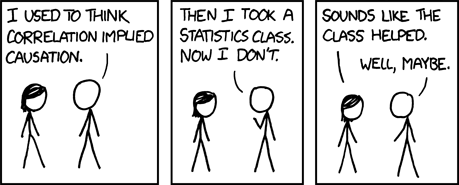
Hehe.
It took me a few seconds. I think the punchline could have been clearer with a response like "Not necessarily!" but only @ xkcd can you enjoy humor like this.
:)
March 04, 2009
What If God Disappeared?
This made me chuckle.
hat tip to Pharyngula
I used to read Pharyngula posts religiously (pun intended) but his plethora of atheistic(sp?) and politically charged posts overran his other more science/education related posts. Ranting about Dawkins and Creationism and Christianity made him very popular/renowned/reviled on ScienceBlogs though.
And in many ways, I do agree with a lot of the things that he says as a staunch defender of the Atheistic ways.
However, his contempt and dislike for religious people does rub me the wrong way. My personal feeling is that a lot of people happen to be religious and they happen to be good people as well. In many cases it provides as much guidance (as there is mischief and misguidance,) but that could be said for any other institution.
Atheism is not immune either despite its rational and empirical/experiential roots.
One of my dreams/nightmares is that the world as we know it may get wiped out someday and all that would be left is our books, our information, our knowledge. Rebuilding civilization on these documents would be interesting. Institutions would be created that would worship Rationalism in defiance of common sense things -- despite an ability to blast off into space and take a picture of earth for example, the newbies would assume that the Earth is round.
All of the things that they might be taught would still be founded on assumptions -- and who is to say that these people would not lose their sense of skepticism when so much of what they read turns out to be true anyway? They'd take things at face value. Unquestioning. Unyielding. Yet, still right for the most part.
I guess what I'm getting at (before I get lost in a tangent again) is that it is not about being Right or Wrong. I used to focus on this a lot, when I held some disdain for the truly religious -- especially classmates in science. How could they hold such different concepts in juxtaposition without considering themselves to be hypocrites? I'd wonder.
It's all about the perspectives that we hold and slowly becoming Aware that we only see things from a certain angle. Sometimes we are blessed with new points of view and these glimpses help us to understand others as long as we keep our eyes open. That's the point of religion, in my opinion. Through understanding comes love and acceptance for our fellow man.
hat tip to Pharyngula
I used to read Pharyngula posts religiously (pun intended) but his plethora of atheistic(sp?) and politically charged posts overran his other more science/education related posts. Ranting about Dawkins and Creationism and Christianity made him very popular/renowned/reviled on ScienceBlogs though.
And in many ways, I do agree with a lot of the things that he says as a staunch defender of the Atheistic ways.
However, his contempt and dislike for religious people does rub me the wrong way. My personal feeling is that a lot of people happen to be religious and they happen to be good people as well. In many cases it provides as much guidance (as there is mischief and misguidance,) but that could be said for any other institution.
Atheism is not immune either despite its rational and empirical/experiential roots.
One of my dreams/nightmares is that the world as we know it may get wiped out someday and all that would be left is our books, our information, our knowledge. Rebuilding civilization on these documents would be interesting. Institutions would be created that would worship Rationalism in defiance of common sense things -- despite an ability to blast off into space and take a picture of earth for example, the newbies would assume that the Earth is round.
All of the things that they might be taught would still be founded on assumptions -- and who is to say that these people would not lose their sense of skepticism when so much of what they read turns out to be true anyway? They'd take things at face value. Unquestioning. Unyielding. Yet, still right for the most part.
I guess what I'm getting at (before I get lost in a tangent again) is that it is not about being Right or Wrong. I used to focus on this a lot, when I held some disdain for the truly religious -- especially classmates in science. How could they hold such different concepts in juxtaposition without considering themselves to be hypocrites? I'd wonder.
It's all about the perspectives that we hold and slowly becoming Aware that we only see things from a certain angle. Sometimes we are blessed with new points of view and these glimpses help us to understand others as long as we keep our eyes open. That's the point of religion, in my opinion. Through understanding comes love and acceptance for our fellow man.
March 01, 2009
"Too much time."
I've been criticized multiple times by various preceptors that I spend "too much time" with my patients. "FOCUS! LIKE A LASER BEAM!" and "C'mon C'mon C'mon!" are the mantras one of my docs enters before all of my patient visits.
Admittedly, even some of my patients are exhausted by the end of the interview and I've had a few that needed to take a bathroom break before I started the physical examination. (In one case, it led to chuckles and jokes by the nursing staff who assumed that the patient left in a huff because I overextended their patience.)
I laugh along with them and I understand WHY it can be a bad thing to spend too much time with my patients. There's other people in the waiting room and the schedule gets backed up. I get it.
My take? I'm a friggin' MEDICAL STUDENT. I'm still learning! The best way I learn is by spending time with my patients, thinking through their problem in real time under real pressures, deciding what questions to ask, clarifying parts of the story I'm confused about, which pieces of medical advice to dole out, which path of management I would engage in if I were the doctor (so they can see where I'm coming from before the real doc comes in and says something completely different. ;)
One of my more critical preceptors gave me a lecture this past week: "Look... I'm not saying you shouldn't know all of those things you're sharing with me. But we are trusting other docs to do their job before they come and see me. That's the point of this. You need to get some perspective."
I feel that this is the crux of the issue. There's different philosophies in medicine. One of the "Laws of the House of God" is
10) IF YOU DON’T TAKE A TEMPERATURE, YOU CAN’T FIND A FEVER.
In other words, if you intentionally don't ask the right questions, you won't need to follow up on them.
Some will gloss over parts of the history that are not pertinent to their particular field or interest at the time. Perhaps they have the data readily available on a computer. Perhaps they've seen the patient in the past and have addressed it already, or maybe they've made a referral to a specialist.
As the ignorant medical student seeing a patient for the first time with nothing more than a blank sheet of paper on a clipboard, I don't have those luxuries or assurances. I only have one tool -- the brute force of the consistently thorough history and physical. In many cases, it can take 30+ minutes. But I find all the fevers. And the headaches. And the chest pains. And the dizziness. And I need to talk about them with the patient to learn more.
The law that follows #10 is:
11) SHOW ME A BMS (Best Medical Student, a student at the Best Medical School) WHO ONLY TRIPLES MY WORK AND I WILL KISS HIS FEET.
Even though I feel harried all of the time (and perhaps rightly so in most cases,) I'm glad that these docs have volunteered half a day out of their week to teach me -- because I don't really add much to their practice. I just make their work harder. I'm the one that takes "too much time."
February 25, 2009
By the fans, for the fans
My favorite part is batman standing on the roof of a building, looking out at the (C) in the sky.
Hat tip to NPR
Vidders Talk Back to Their Pop-Culture Muses
On another note, I heard this story on NPR and I knew that I had to look it up when I got home. How did I find it? Well, I typed in "british vidding NPR" into Google. That's when I realized that Google Search is just like assembling a differential diagnosis -- coming across exactly the thing you're looking for (an answer) by a unique combination of findings. More on this later.
February 22, 2009
Top Ten: Study Methods and Habits
Medical school is one of those interesting fields where obsessive-compulsive behavior is reinforced and rewarded to no end. While I am not an inherently organized and disciplined person, I decided that I needed to change for the better upon entering med school. Here are some of the strategies that I employ:
- Buy a lot of different colored highlighters
I use each color for a specific purpose when I read. Colors are a fast way of categorizing items. It helps keep me awake if nothing else. The bonus: having nice colorful notes that are easy to review. - Tag chapters in textbooks
Dog ear or put in little tags for chapters. When I tag more than the chapters, there's too many slips of paper and it takes a while to find what I want. I also try to use different colored tabs to represent different things: Red = CV, Pink = OB, Blue = Pulm, Purple = ID, Yellow = Renal - Develop concept-maps/case-maps for basic physiology/pathophysiology concepts with integrated management.
Algorithms are boring and thus, terrible ways to learn. A concept map that systematically thinks through a problem is much more engaging. I use C-maps for this purpose. - Use mnemonics. Use them often!
Mnemonics are highly individual and some do not work at all for anyone else but yourself. I've done my best to try and share ones that I thought others might appreciate or those that I've heard but were not readily available online. I made a bank of mnemonics in an excel spreadsheet with the comments as the expanded version -- when I float my cursor over the mnemonic it pops up with the reminder of what it means. - Learn how to think.
Problem-Based Learning helped me develop on the spot differential diagnosis development and consequential workup, diagnosis and management. I like it when experts tell me how they think through a problem... that's why one of the books I'm reading right now is Learning Clinical Reasoning (Excellent resource; unfortunately, it seems like its no longer in print.) - Stay up to date.
Read medical journals, news and blogs. Clinical Cases and Images answers the question: "How do you Eat an Elephant?" by setting up Google Reader. I read feeds on the latest articles in NEJM, JAMA, Annals of Internal Medicine, AFP and The Lancet. Also, I follow some great blogs -- I share the entries that I find of special importance (seen in the sidebar.) - Use a multi-monitor setup.
Buy an extra monitor! The more desktop real-estate you utilize, the more you can read and learn. Typically, I use one monitor for reading something and the other monitor for taking notes on the subject. - Centralize ALL of your notes. When I was studying for Step 1, all of my notes went into First Aid. Now that I'm studying for Step 2 and all of my different shelves, it'll take more than a book to hold my notes. Which takes me to my next point...
- Use an online notetaking service.
Evernote is my all-time favorite application now. I can put text notes into it as well as pdf files... perfect for clipping key parts all of those articles I'm reading! It has the benefit of being available on any computer (so I can find my notes on diabetes anywhere I go.) - Use a question-bank to keep things in perspective.
I use USMLE World.
It is easy to lose track of what might be considered "important/high yield" for exams if you don't use a Q-bank on a regular basis. Mark all of the questions you get wrong (be honest!) and review those specific topics and questions again. Repetition is the key to rote memorization... and sometimes that's whats necessary to remember things like drug names. Ugh! - Above all else... Have fun!
Otherwise you'll just end up wasting time . :)
| Yellow = important facts |
| Green = examples, lists, subheadings, lab values/Diagnosis, (+)/increasing |
| Orange = Key Topics/Vitally Important facts |
| Pink = In contrast to, (-)/decreasing |
| Blue = Treatment/medications |
| Purple = difficult to remember names/eponyms |
Cheers,
February 17, 2009
Wondering about Wanderers?
Suppose your grandmother wanders out of the house in the middle of the night. What can you do for some peace of mind to keep them safe?
One option is a MedicAlert + Safe Return bracelet. Here's some information:
What are some important considerations for dementia?
Here's a few mnemonics that might be helpful:
Remember the reversible causes of DEMENTIA
I'm very fond of important mnemonics that help me quickly recall things at the bedside, especially if they can be easily detected and treated before it progresses into something much more permanent.
GOMERS go to ground - The Fat Man, House of God. (Elderly people have a tendency to fall.)
There's a ton of mnemonics on falling. IHATEFALLING, CATASTROPHE*... those are too long but you can google them at your leisure.
GMA MOVES is more to my liking.
References:
See my post on the Mini Mental Status Exam (ORArL 321 RWD!)
Medical Mnemonics.com
Fall Prevention checklists: Patient Handouts
[edit] * The CATASTROPHE mnemonic is not available on the AAFP article so I've tracked it down for you.
Functional hx after a fall in the elderly
Caregiver/housing
Alcohol (including w/drawal)
Tx (meds & compliance)
Affect (depression, lack of initiative)
Syncope
Teetering (dizziness)
Recent illness/hospitalization
Ocular problems
Pain w/ mobility
Hearing
Environmental hazards
One option is a MedicAlert + Safe Return bracelet. Here's some information:
Enroll in program: 1.888.572.8566 Report a wandering incident: Call 911 first. Then call 1.800.625.3780.
MedicAlert + Safe Return enrollment package
For $49.95, with a $25 annual renewal fee, the enrollment kit includes:
* MedicAlert Identification bracelet or pendant
* Wallet card
* "6 Steps to a Safe Return" magnet
* Personal Health Record Summary
* Alzheimer's Association brochure
What are some important considerations for dementia?
Here's a few mnemonics that might be helpful:
Remember the reversible causes of DEMENTIA
Drug intoxication
EtOH
Metabolic (hypothyroidism, order TSH!)
Emotions (screen for depression!)
Nutrition (Vit B1/B12... order B12!)
Tumor/Trauma/"Tension"-Normal Pressure Hydrocephalus
Infection (neurosyphilis, consider RPR!)
Anemia/Atherosclerosis (order CBC!)
I'm very fond of important mnemonics that help me quickly recall things at the bedside, especially if they can be easily detected and treated before it progresses into something much more permanent.
GOMERS go to ground - The Fat Man, House of God. (Elderly people have a tendency to fall.)
There's a ton of mnemonics on falling. IHATEFALLING, CATASTROPHE*... those are too long but you can google them at your leisure.
GMA MOVES is more to my liking.
Gait impairment
Multiple Meds-Polypharmacy
Alcohol and drug use
Medical illness (PNA, MI, anemia, hyponatremia)
Orthostatic/postprandial hypotension
Visual Impairment
Environmental hazards (poor lighting, stairs, rugs, uneven floors)
Syncope, vertigo, presyncope, or disequilibrium
References:
See my post on the Mini Mental Status Exam (ORArL 321 RWD!)
Medical Mnemonics.com
Fall Prevention checklists: Patient Handouts
[edit] * The CATASTROPHE mnemonic is not available on the AAFP article so I've tracked it down for you.
Functional hx after a fall in the elderly
Caregiver/housing
Alcohol (including w/drawal)
Tx (meds & compliance)
Affect (depression, lack of initiative)
Syncope
Teetering (dizziness)
Recent illness/hospitalization
Ocular problems
Pain w/ mobility
Hearing
Environmental hazards
February 14, 2009
Patient Education
What are some good sites for patient handouts?
Family Doctor.org
ACP's HEALTH TiPS
JAMA's Patient Page
ACOG (OB/GYN) Pamphlets
Pediatrics: AAP Pamphlets
Postgraduate Medicine: The Practical Peer-Reviewed Journal for Primary Care Physicians (AccessMedicine Login required)
American Heart Association: Diseases and Conditions
National Digestive Diseases Information Clearinghouse (NDDIC): Digestive Diseases
What about online resources for proactive patients?
The Google Approach: Patient Education
Health.gov
Healthfinder.gov: U.S. Dept of Health and Human Services
MedlinePlus: Interactive Tutorials
Health research: NIH
ACC: Cardiology education
This is part of an ongoing process to collect reliable health information on core medical topics for Family Medicine. This post will be updated with new information and comments on a regular basis.
It is my goal to easily provide a handout and education for all of my patients in a cooperative and collegial manner... basically, allowing my patients to take charge of their own health!
See my Patient Education Handouts widget* on the bottom of this page as well for more resources.
*Disclaimer: My Patient Education Widget is a series of clips from other sources. I have provided citations where appropriate.
Family Doctor.org
ACP's HEALTH TiPS
JAMA's Patient Page
ACOG (OB/GYN) Pamphlets
Pediatrics: AAP Pamphlets
Postgraduate Medicine: The Practical Peer-Reviewed Journal for Primary Care Physicians (AccessMedicine Login required)
American Heart Association: Diseases and Conditions
National Digestive Diseases Information Clearinghouse (NDDIC): Digestive Diseases
What about online resources for proactive patients?
The Google Approach: Patient Education
Health.gov
Healthfinder.gov: U.S. Dept of Health and Human Services
MedlinePlus: Interactive Tutorials
Health research: NIH
ACC: Cardiology education
This is part of an ongoing process to collect reliable health information on core medical topics for Family Medicine. This post will be updated with new information and comments on a regular basis.
It is my goal to easily provide a handout and education for all of my patients in a cooperative and collegial manner... basically, allowing my patients to take charge of their own health!
See my Patient Education Handouts widget* on the bottom of this page as well for more resources.
*Disclaimer: My Patient Education Widget is a series of clips from other sources. I have provided citations where appropriate.
February 13, 2009
Finding Common Ground
When you run up against a patient who is difficult to talk to, how can you come to a meaningful compromise?
These tips make a lot of sense and I'm thrilled that my Family Medicine rotation had us read an article on this all-too-important subject. It is difficult to learn these sorts of things... a lot of it is intuitive and to be quite frank, I've had to work very hard because it does not come naturally to me.
As a medical student, I lack a lot of the clinical judgment that my preceptors and residents have. About the only good tool I have on hand comes from being systematic, being thorough and hoping that nothing slips through the cracks. I've found this strategy to be especially effective in dealing with long-winded, opinionated patients. Only students have the luxury of time to outlast patients by performing an exhaustive interview. I plan to use this tool for as long as possible, because in the end, my patients walk away happy knowing that someone listened to them -- even though I might not have offered them everything they wanted.
Interest-Based Negotiation and Conflict Resolution:
by Roger Fisher and William Ury’s Getting to Yes
1) Separate the people from the problem.
2) Focus on interests, not positions.
3) Generate a variety of possibilities before deciding what to do
4) Use objective criteria to judge the solution, rather than pit one personal opinion against another.
These tips make a lot of sense and I'm thrilled that my Family Medicine rotation had us read an article on this all-too-important subject. It is difficult to learn these sorts of things... a lot of it is intuitive and to be quite frank, I've had to work very hard because it does not come naturally to me.
As a medical student, I lack a lot of the clinical judgment that my preceptors and residents have. About the only good tool I have on hand comes from being systematic, being thorough and hoping that nothing slips through the cracks. I've found this strategy to be especially effective in dealing with long-winded, opinionated patients. Only students have the luxury of time to outlast patients by performing an exhaustive interview. I plan to use this tool for as long as possible, because in the end, my patients walk away happy knowing that someone listened to them -- even though I might not have offered them everything they wanted.
February 12, 2009
Psych: Biopsychosocial Formulation Pocketmod
I wish I knew who I could credit for the majority of this information... I got it as a brainstorming handout that's very useful for developing a comprehensive assessment and plan for psychiatry patients.
I made a handwritten version for myself and then I got concerned that I might lose it eventually. What better place to immortalize the these gems than to share it freely with others?
Pocketmod PDF: Biopsychosocial Formulation
Wondering how to fold this document? See my previous post on the subject of PocketMods on the Wards.
I made a handwritten version for myself and then I got concerned that I might lose it eventually. What better place to immortalize the these gems than to share it freely with others?
Pocketmod PDF: Biopsychosocial Formulation
Wondering how to fold this document? See my previous post on the subject of PocketMods on the Wards.
February 10, 2009
Pondering on: Psych diagnosis
I tweeted the following:
Here's my follow-up on this question.
What is the reason for coming up with a diagnosis?
Initially, the attraction for coming up with a diagnosis is to determine the CAUSE of the disease. It's nice to have an explanation and for a long time, Freud's psychoanalysis gave us causes. Internal conflict of competing and often unconscious desires manifested themselves as various disorders. It was an attractive hypothesis.
However, psychiatry has come a long way since then. Namely, the discovery of a number of psychoactive drugs that are successful at treating conditions.
Suddenly, the underlying predisposing causes and precipitating factors that were the emphasis of a psychiatric visits took a back seat as a set standardized definitions emerged in the form of the Diagnostic and Statistical Manual of Mental Disorders: the DSM for short.
Initially, it started off as a way for psychiatrists to communicate clearly with each other and for researchers to make sure that treatment modalities were consistent. After all, if one psychiatrist called something "schizophrenia" while another thought it was a clear-cut case of "manic-depression," they would have different approaches. And indeed, British psychiatrists were wondering why the rates of U.S. schizophrenia and bipolar disorder were so different from their own.
However, it has now become an engrained part of oh-so-important BILLING. There are codes attached to all of these diagnoses and in order to ensure that they are properly billed, they must be documented to meet criteria. Before, psychiatrists had an intuitive sense from taking a history with the patient and observing them about what the diagnosis is. Now, it has almost become a requisite to slog through a long list of things to establish criteria.
Here's an example of the criteria for ADHD:
Indeed, the "checkbox" medicine was the sort of approach that I had taken when I was doing in-patient psychiatry. Unfortunately, a list of criteria is much harder to memorize than some elegant "pathoneurology"/psychoanalysis, unless it's in the form of some handy-dandy mnemonics. For example, I'd routinely hit a few things from SIGECAPS and DIGFAST to rule out depression and bipolar disorders during the interview with some very scripted questions.
My psych preceptor has challenged me to think more about the genesis of the DSM criteria and indeed, many of these so called "criteria" are based on professional opinion with very little evidence or scientific basis. So I've become much more accustomed to a more natural interviewing process and I think that this will help my approach to psych diagnoses much more.
Psych disorders: diagnosis with cause or arbitrary definitions w/o reason?
Here's my follow-up on this question.
What is the reason for coming up with a diagnosis?
Initially, the attraction for coming up with a diagnosis is to determine the CAUSE of the disease. It's nice to have an explanation and for a long time, Freud's psychoanalysis gave us causes. Internal conflict of competing and often unconscious desires manifested themselves as various disorders. It was an attractive hypothesis.
However, psychiatry has come a long way since then. Namely, the discovery of a number of psychoactive drugs that are successful at treating conditions.
Suddenly, the underlying predisposing causes and precipitating factors that were the emphasis of a psychiatric visits took a back seat as a set standardized definitions emerged in the form of the Diagnostic and Statistical Manual of Mental Disorders: the DSM for short.
Initially, it started off as a way for psychiatrists to communicate clearly with each other and for researchers to make sure that treatment modalities were consistent. After all, if one psychiatrist called something "schizophrenia" while another thought it was a clear-cut case of "manic-depression," they would have different approaches. And indeed, British psychiatrists were wondering why the rates of U.S. schizophrenia and bipolar disorder were so different from their own.
However, it has now become an engrained part of oh-so-important BILLING. There are codes attached to all of these diagnoses and in order to ensure that they are properly billed, they must be documented to meet criteria. Before, psychiatrists had an intuitive sense from taking a history with the patient and observing them about what the diagnosis is. Now, it has almost become a requisite to slog through a long list of things to establish criteria.
Here's an example of the criteria for ADHD:
A. Either (1) or (2):That's a long list to try and wade through!
(1) six (or more) of the following symptoms of inattention have persisted for at least 6 months to a degree that is maladaptive and inconsistent with developmental level:
Inattention
(a) often fails to give close attention to details or makes careless mistakes in schoolwork, work, or other activities
(b) often has difficulty sustaining attention in tasks or play activities
(c) often does not seem to listen when spoken to directly
(d) often does not follow through on instructions and fails to finish schoolwork, chores, or duties in the workplace (not due to oppositional behavior or failure to understand instructions)
(e) often has difficulty organizing tasks and activities
(f) often avoids, dislikes, or is reluctant to engage in tasks that require sustained mental effort (such as schoolwork or homework)
(g) often loses things necessary for tasks or activities (e.g., toys, school assignments, pencils, books, or tools)
(h) is often easily distracted by extraneous stimuli
(i) is often forgetful in daily activities
(2) six (or more) of the following symptoms of hyperactivity-impulsivity have persisted for at least 6 months to a degree that is maladaptive and inconsistent with developmental level:
Hyperactivity
(a) often fidgets with hands or feet or squirms in seat
(b) often leaves seat in classroom or in other situations in which remaining seated is expected
(c) often runs about or climbs excessively in situations in which it is inappropriate (in adolescents or adults, may be limited to subjective feelings of restlessness)
(d) often has difficulty playing or engaging in leisure activities quietly
(e) is often "on the go" or often acts as if "driven by a motor"
(f) often talks excessively
Impulsivity
(g) often blurts out answers before questions have been completed
(h) often has difficulty awaiting turn
(i) often interrupts or intrudes on others (e.g., butts into conversations or games)
B. Some hyperactive-impulsive or inattentive symptoms that caused impairment were present before age 7 years.
C. Some impairment from the symptoms is present in two or more settings (e.g., at school [or work] and at home).
D. There must be clear evidence of clinically significant impairment in social, academic, or occupational functioning.
E. The symptoms do not occur exclusively during the course of a Pervasive Developmental Disorder, Schizophrenia, or other Psychotic Disorder and are not better accounted for by another mental disorder (e.g., Mood Disorder, Anxiety Disorder, Dissociative Disorder, or a Personality Disorder).
Code based on type:
314.01 Attention-Deficit/Hyperactivity Disorder, Combined Type: if both Criteria A1 and A2 are met for the past 6 months
314.00 Attention-Deficit/Hyperactivity Disorder, Predominantly Inattentive Type: if Criterion A1 is met but Criterion A2 is not met for the past 6 months
314.01 Attention-Deficit/Hyperactivity Disorder, Predominantly Hyperactive-Impulsive Type: if Criterion A2 is met but Criterion A1 is not met for the past 6 months
Coding note: For individuals (especially adolescents and adults) who currently have symptoms that no longer meet full criteria, "In Partial Remission" should be specified.
Indeed, the "checkbox" medicine was the sort of approach that I had taken when I was doing in-patient psychiatry. Unfortunately, a list of criteria is much harder to memorize than some elegant "pathoneurology"/psychoanalysis, unless it's in the form of some handy-dandy mnemonics. For example, I'd routinely hit a few things from SIGECAPS and DIGFAST to rule out depression and bipolar disorders during the interview with some very scripted questions.
My psych preceptor has challenged me to think more about the genesis of the DSM criteria and indeed, many of these so called "criteria" are based on professional opinion with very little evidence or scientific basis. So I've become much more accustomed to a more natural interviewing process and I think that this will help my approach to psych diagnoses much more.
February 09, 2009
Gout
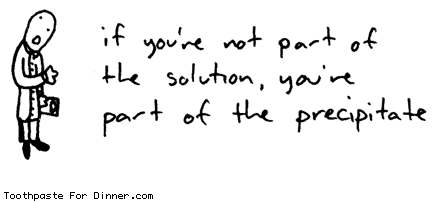
Gout is one of the few arthritides that is reversible and curable with a few simple dietary/lifestyle changes and drugs.
Current Rheumatology Diagnosis and Treatment elegantly describes it like matches. With flare-ups, the "matches" in the joints light up and cause pain. They can be blown out by NSAIDs, made wet with colchicine and removed entirely with allopurinol. This metaphor is akin to the pathophysiology, with the "matches" representing uric acid crystals precipitating in joint space and lighting up when they get inflamed by the invasion of neutrophils.
On a more clinical note, here's some mnemonics to remember Gout:
A TIC ("thick") red, inflamed joint:
-Trauma, Infection, Crystals
ROPE in your ddx of arthritis:
RA, OA, Pseudogout/Psoriatic, Everything else (some crazy zebras: reactive/Reiter's, Still's, Hemochromatosis, Lupus, Lyme, Whipple's, Behcets, Ochronosis)
When tapping a joint, order 3C's for Synovial Fluid ("CCCnovial")
Cell Count, Culture, Crystals
Synovial glucose is not as sensitive as WBC count (>500-1000) for infection.
The aim for the management of chronic tophaceous gout is <6.0 mg/dL of serum uric acid.
Think: <6 to fix.
If the 24 hour urinary uric acid is >800, probenecid can be an alternative to allopurinol. Probenacid is a weak organic acid so it affects the renal levels of other organic acids (ASA, PCN, etc.)
Think: >800, ProbenAcid instead.
February 08, 2009
USMLE Step 1 score: a pissing contest
What Score do I need for my Specialty?
It's the culture of medicine, working at its best.
Here's the way it works for those of you who haven't been inducted into the secret society of white-coat-dom:
Everyone pisses and whoever can piss the farthest wins.
The guy who pisses for the longest wins also.
Wins what? The easiest and cushiest lifestyle, of course.
Why? Because that's the reason we all applied for medical school, right? Who wants to work long hours for no reward when you can do elective procedures and break the bank?
Why not let everyone win if they aren't pissing red blood or albumin? That's my win-win definition of a pissing contest -- yay, you can pee healthy!
For some reason I keep talking about piss, but I assure you, I'm not pissed.
Even people who don't subscribe to the "lifestyle" theory of natural residency selection agree with its prestige: it is much more difficult to land a derm or radiology residency spot than it is internal medicine or pediatrics. (The unspoken therefore: the people who go into derm or radiology are smarter/better! Too bad supply and demand economics doesn't drive students into the professions we need the most.)
Now, I'm not bashing people who truly love Plastics or Rad Onc. On the contrary, I DO have a great amount of respect for them for having the ambition that I clearly lack to aim for one of those spots. Me, I'm envisioning myself being content to have a small group of patients that I will help give birth to, raise and grow old with (and blog on the side.)
I still want to do my best and that means:
I will counsel the HELL out of people who are determined to lose weight and start exercising!!
I will be an awesome educator for all sorts of common ambulatory complaints!!
I will strive to catch all of the rare zebras in their horse clothing and send them off to the right specialists so I won't be one of the dull-wits in primarycareville.
I will spend that extra time to see the last-minute walk-in or the guy without insurance.
Why? I decided to become a doctor because I want to do the right thing. That's righteous (hopefully without seeming too self-righteous.)
THAT is a first tier goal in my mind. (GOAL being the key word. I doubt I'll live up to any expectations, but I hope to never lose sight of them.) These goals are much more forward looking than a step board score determining what I will do for the rest of my life.
...I'm all for reporting what score you need to get to be considered for a specialty you're interested in. However, it really irks me that the most challenging specialties (of breadth) are in the bottom "tier."
There is one highlight pertaining to USMLE Step 1 scores worth mentioning, located on a chart in the document above (page 16 of the pdf, page 11 in print) There appears to be 2-3 tiers of scores with the most competitive specialties falling under the highest tier. A potential breakdown is:
Tier 1 (Median USMLE Step 1 Scores of 233-243):
* Plastic Surgery
* Dermatology
* Otolaryngology
* Diagnostic Radiology
* Radiation Oncology
* Orthopaedic Surgery
* Transitional Year
Tier 2 (Median USMLE Step 1 Scores of 217-222):
* Internal Medicine
* Pathology
* General Surgery
* Emergency Medicine
* IM/Peds
* Anesthesiology
* Neurology
* Pediatrics
Tier 3 (Medan USMLE Step 1 Scores of 208-213):
* Ob/GYN
* Family Medicine
* PM&R
* Psychiatry
It's the culture of medicine, working at its best.
Here's the way it works for those of you who haven't been inducted into the secret society of white-coat-dom:
Everyone pisses and whoever can piss the farthest wins.
The guy who pisses for the longest wins also.
Wins what? The easiest and cushiest lifestyle, of course.
Why? Because that's the reason we all applied for medical school, right? Who wants to work long hours for no reward when you can do elective procedures and break the bank?
Why not let everyone win if they aren't pissing red blood or albumin? That's my win-win definition of a pissing contest -- yay, you can pee healthy!
For some reason I keep talking about piss, but I assure you, I'm not pissed.
Even people who don't subscribe to the "lifestyle" theory of natural residency selection agree with its prestige: it is much more difficult to land a derm or radiology residency spot than it is internal medicine or pediatrics. (The unspoken therefore: the people who go into derm or radiology are smarter/better! Too bad supply and demand economics doesn't drive students into the professions we need the most.)
Now, I'm not bashing people who truly love Plastics or Rad Onc. On the contrary, I DO have a great amount of respect for them for having the ambition that I clearly lack to aim for one of those spots. Me, I'm envisioning myself being content to have a small group of patients that I will help give birth to, raise and grow old with (and blog on the side.)
I still want to do my best and that means:
I will counsel the HELL out of people who are determined to lose weight and start exercising!!
I will be an awesome educator for all sorts of common ambulatory complaints!!
I will strive to catch all of the rare zebras in their horse clothing and send them off to the right specialists so I won't be one of the dull-wits in primarycareville.
I will spend that extra time to see the last-minute walk-in or the guy without insurance.
Why? I decided to become a doctor because I want to do the right thing. That's righteous (hopefully without seeming too self-righteous.)
THAT is a first tier goal in my mind. (GOAL being the key word. I doubt I'll live up to any expectations, but I hope to never lose sight of them.) These goals are much more forward looking than a step board score determining what I will do for the rest of my life.
Subscribe to:
Posts (Atom)

 Posts
Posts


