A New Model of Cognition
My main
driver for getting a Masters degree in Medical Education was to have the
opportunity to do high-level research in the field of clinical reasoning and
medical decision-making. Even as a fourth-year
medical student tutoring first-year students through their Problem-Based
Learning seminars, I was very keen on the process of developing a differential
diagnosis and becoming an expert diagnostician.
I recently discovered an old email showing that I looked through the literature
with a librarian for this exact question:
Hello, I am a fourth year medical
student interested in conducting a research project on the cognitive process of
generating a differential diagnosis (ddx) geared to second year medical
students… the project I want to do involves teaching second year med students how
to be systematic in making a ddx and avoid the pitfalls, with a pre-unit and
post-unit survey to measure their progress and confidence in differentials.
Some of the questions I might ask are:·
How many
ddxs do you routinely make in PBL sessions on the first page of your [case]?
·
How often
do you feel that you have the right, specific diagnosis in your HCPs before the
conclusion of the case?
·
How
confident are you that you have a broad number of ddxs in your [case]?
·
How would
you rank your ability to generate a ddx compared to your peers?
·
Pick the
best definition for the following terms: heuristic, bayesian analysis,
attribution error, pre-test and post-test probability
I have done
some general searches on Pubmed looking for articles on medical education and differential diagnosis, but I have not
found any literature that has done any similar projects in the past. It
would be helpful to know if there are any surveys that have similar assessment
measures.
I recently discovered
a new constructivist theory that explains the cognitive process of clinical
reasoning that I am calling “[redacted, pending publication]”. In a nutshell, the current dominant
dual-process model involves weighing judgments as Type I automatic thinking vs
Type II deliberate thinking, in which we toggle between the unconscious heuristics/biases
brain and our rational, conscious brain.
I think this is incorrect. I feel
that we form ALL ideas as spontaneous, self-assembling “crystals.” The formation of diagnostic crystals is
catalyzed during the brewing process by nucleation on heuristics/rules/prior
experience under the right cognitive conditions. (see Appendix
1 for details)
My
vision is that
in the next 10 years, I will change the way doctors think
about clinical reasoning. I plan
to accomplish this
in the next 6 months
by doing research to justify my “[thesis]” theory through a
demonstrative literature review for my Dundee thesis project. I plan on showing how my new theory meets the
criteria of quality (trustworthiness, transferability, dependability and
conformability) as well as authentic criteria of fairness (ontological,
educative, catalytic and tactical) as outlined by Guba and Lincoln (1989). Then, I plan on working as a
clinician/researcher and
in the next 5
years, I will publish articles on this subject in several major journals (aiming
for Academic Medicine, Medical Education and Psychological Review where most of
my literature review has derived).
In the
next 10 years, I write a book on “[redacted]” as a new theory on
the psychology of judgment.
These are “big,
hairy audacious goals (BHAGs).” I will
share my vision by telling stakeholders that "
We will change the way doctors think about clinical reasoning, using
procedural methods to ---[to be revealed]." According to Collins and Porras,
“A
true BHAG is clear and compelling, serves as a unifying focal point of effort,
and acts as a catalyst for team spirit... A BHAG engages people—it reaches out and grabs them. It is
tangible, energizing, highly focused. People get it right away; it takes little
or no explanation.” (Collins and Porras 1996)
The idea of changing
the way all doctors think is compelling.
Even though the theoretical concept will need to be explained, I feel
that everyone intuitively“gets” the concept that our brains bubble and brew and sometimes,
while we are in the shower or out on a walk – BAM! An idea comes up seemingly from nowhere. "[The thesis]" model elucidates this
process and invites people to maximize their chances of creating “Eureka!” moments.
My
institution has a Department for Clinical Decision-Making (CDM) that is
well-known for its leaders in the field of CDM. (Tufts, n.d.) We have a course for first-year medical
students called “Introduction to Clinical Reasoning” that I will be building on
by preparing fourth-year medical students for residency in an elective called “Family
Medicine Exploration Elective” in which I plan on exploring the concepts of
flow and intuition for expertise development.
In order to gain alignment with the CDM
department, I plan on utilizing
Kotter’s
model (1996) for Change Management, to determine how to best accomplish our
shared goals. I will share a hybrid
model that adds in
Heath and Heath’s “Switch”
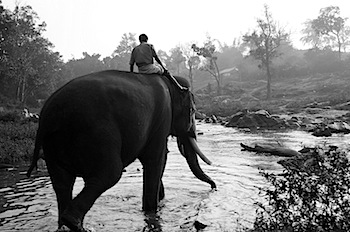
concepts (2010) that use a visual analogy that making change is hard, like
a human rider trying to force an elephant to walk down a path. (Appendix 3.)
The first
step in the hybrid Kotter-Heath-Heath model is to Motivate the Elephant. This
means that I need to “Find the Feeling and Create a Sense of Urgency.” I plan on instigating a change with a shift
from the analytical Bayesian approach that the Department for CDM is used to
and publishing my radical new theory which is an intuitive “adaptive toolbox”
approach that Gigerenzer (2002) utilizes.
(Appendix 2.) Convincing the
majority of people that change is needed (Kotter recommends convincing at least
75% of managers that the status quo is more dangerous than the unknown) will
hopefully prompt a forthright discussion, leading to the next step.
Next, I will
Shape the Path. This means that I need to “Rally the Herd and
Form a Powerful Guiding Coalition.” My
fellowship advisor can facilitate a meeting with various members of the CDM
department to discuss the implications of my research. I need members with enough power to lead a
change effort. Kotter specifically
encourages the team to work outside the normal hierarchy:
“This can be awkward,
but it is clearly necessary. If the existing hierarchy were working well, there
would be no need for a major transformation. But since the current system is
not working, reform generally demands activity outside of formal boundaries, expectations,
and protocol.” (Kotter 2007)
Together with
a group of change agents, we will Direct
the Rider. In other words, “Find a
Destination and Create a Vision.” My
preliminary vision statement to share with stakeholders is: "We will change the way doctors think about
clinical reasoning and help them [in ways outlined in future works]." I would like to focus on medical education by changing our
curriculum for PBL and clerkships to include these scaffolding concepts. I already have a hand in creating a new
fourth-year FM elective that will integrate these principles for outpatient
primary care.
Providing
rational explanations is not enough to push the broader community to
change. Next, we will Motivate the Elephant by “Pointing to
the Destination and Communicating the Vision.”
If we are going to push all physicians to change how they think about
generating a differential, we have to tap into their feelings. All physicians strive to become expert
diagnosticians and are afraid of missing the diagnosis. Achieving “expertise” is nebulous, but
Ericsson (2004) provides us with a clear goal.
Deliberate practice and the acquisition and maintenance of expert
performance require 10,000 hours over 10 years of practice. It is my belief that we can get the attention
of various parties within the institution with the following message:
- Medical students: “You CAN dedicate 160
hours of 10,000 hours towards becoming an expert in Primary Care reasoning in a
month-long elective.”
- Family Medicine Residents: “You CAN accumulate around 2,000-3,000 of the
10,000 requisite hours towards becoming an expert in clinical reasoning”
- Family Medicine Faculty: “You will only
be supervising residents for ~300 hours of primary care clinical reasoning in a
year.” How do you plan on making the
best use of this time?
With enough
medical students, residents and faculty sufficiently motivated, we need to
Shape the Path and “Tweak the
Environment and Remove Obstacles.” This
involves revamping the first-year medical student “Introduction to Clinical
Reasoning” curriculum so it is developmentally appropriate. I would propose moving material like illness
scripts, better suited for the onset of clinical exposure in the third-year. Additionally, memorizing numerical likelihood
ratios for determining post-test probabilities is not practical for real
clinical practice. Research by Czerlinksi,
Gigerenzer and Goldstein (1999) has shown that utilizing the Tallying heuristic
(Appendix 2) can achieve a higher predictive accuracy than multiple linear
regression analyses when applied intelligently.
After the concepts of numeracy are established, we can change these
burdensome LR to more teachable concepts like the Tallying method. A smartphone “app” can be
created to make the cognitive checklists we will design freely available for
everyone to use (
and hopefully if someone else does this grunt work for me... they will also make it free to the public!). Many of these ideas are
nontraditional and risky, which is encouraged (Kotter 2007.)
Finally, we
will establish a set of Milestones for
the Rider and the Elephant to achieve.
Typically, this is done by “Following the Bright Spots and Scripting
Critical Moves” for the Rider to perform, as well as “Shrinking the Change and
Recognizing/Rewarding Contributors” so the Elephant isn’t frightened and feels
motivated to contribute. However, my
ideas are completely novel (my initial literature search in 2009 and updated
search in 2014 provided no leads), so I will have to forge a path ahead. I hope we will be able to set up curriculum
for all years of medical school and my family medicine residency to include
relevant clinical reasoning topics.
Personally, I have already achieved some milestones for myself in terms
of spreading this information: designing medical student elective curriculum,
presenting a Grand rounds on this subject in 2012, and give a regional
conference on this topic in 2014. My
future milestones will include presenting a national conference on my thesis
material in the next 3-5 years as well as publishing in major journals in
medical education and psychology. I hope to give a TED Talk on the subject of
[redacted] as an analogy for judgment in general and spice it up with
some memorable clinical examples. Eventually,
I will strive to write a book.
Kotter has a few more steps on “Systematizing Wins” and “Institutionalizing
New Approaches” that will not matter to me specifically, unless I become a
department chair or some other leader in medical education. The vision statement and milestones I’ve set
up for myself are ambitious and I would be happy even if I can make a local change within my residency.
In summary, one of my goals in life is to become a master clinician and
systematize an approach for clinical expertise.
I feel that my theory on [redacted] is novel and opens up a
lot of avenues for future research, medical education and continuing professional
development. The hybrid
Kotter-Heath-Heath model I outlined above will help me align my personal goals
with my institution. It also helped me
develop a key strategic plan that I can enact to become a leader in the field
of Clinical Decision-Making and change the way doctors think.
Appendix 1. [redacted theory.]
Appendix 2: Gigerenzer’s
Adaptive Toolbox.
Combined
Model for Change Management (Heath 2010
and Kotter 2007)
|
1.
Motivate the Elephant: Find the Feeling and Establish
a Sense of Urgency
a.
Knowing something isn’t enough to cause
change.
b.
Make people feel something.
|
|
2.
Shape the Path: Rally the Herd and Form a
Powerful Guiding Coalition
a.
Behavior is contagious. Help it spread.
b.
Assemble a group with shared commitment and
enough power to lead the change effort
c.
Encourage them to work as a team outside the
normal hierarchy
|
|
3.
Direct the Rider: Find a Destination and
Create a Vision
a.
Change is easier when you know why its’ worth
it.
b.
Create a vision to direct the change effort
c.
Develop strategies for realizing that vision
|
|
4.
Direct the Rider: Point to the Destination and
Communicate the Vision
a.
Change is easier when you know where you’re
going.
b.
Use every vehicle possible to communicate the
new vision and strategies for achieving it
c.
Teach new behaviors by the example of the
guiding coalition.
|
|
5.
Shape the Path: Tweak the Environment and
Remove Obstacles
a.
Remove or alter systems or structures
undermining the vision
b.
Encourage risk taking and nontraditional
ideas, activities, and actions
|
|
6.
Milestones:
a)
Direct the Rider: Follow the Bright Spots &
Identify Potential Wins
b)
Direct the Rider: Script the Critical Moves &
Engineer Wins
c)
Motivate the Elephant: Shrink the Change &
Recognize/Reward Contributors
|
|
7.
Systemize the Wins
a)
Motivate the Elephant: Develop/promote/hire
visionary employees
b)
Motivate the Elephant: Tweak the Changes
a.
Reinvigorate the change process with new
projects & change agents
c)
Shape the Path: Tweak the Environment and
Build Habits
a.
Use increased credibility from early wins to
change systems, structures, and policies undermining the vision
|
|
8.
Institutionalize new approaches
a)
Direct the Rider:
a.
Articulate connections between new behaviors &
corporate success
b)
Shape the Path:
a.
Create leadership development & succession
plans consistent with the new approach
|
Heath, C. and
Heath, D. (2010) Switch: How to Change Things When Change is Hard. Broadway Books: New York.
Kotter, J. (2007)
Leading Change: Why Transformation Efforts Fail. Harvard Business Review. Jan 2007.
Reprint R0701J.
References
Croskerry,
P. (2003) The Importance of Cognitive
Errors in Diagnosis and Strategies to Minimize Them. Academic
Medicine. 78(80) pp775-780.
Czerlinksi,
Gigerenzer and Goldstein (1999) How Good
are Simple Heuristics? In G. Gigerenzer,
P.M. Todd, & the ABC Reseach Group, Simple heuristics that make us smart
(pp. 97-118). New York, NY: Oxford University Press.
Kruglanski
and Gigerenzer. (2011) Intuitive and Deliberate Judgments are Based on Common
Principles. Psychol Rev. 118(1) pp97-109.
Gigerenzer,
G. and Selten, R. (2002) Bounded Rationality: The Adaptive Toolbox. Cambridge,
MA: MIT Press.
Heath, C.
and Heath, D. (2010) Switch: How to Change Things When Change is Hard. New York, NY: Broadway Books.
Kotter,
J. (1996) Leading Change. Cambridge, MA: Harvard Business School Press.




 Posts
Posts


