March 19, 2008

Are Glow-Sticks toxic?!?

MSDS = Material Safety Data Sheets

I learned about MSDS during an on-job training at my first job in high school, the brutal, dangerous environment aka McDonalds. I got splattered with oil and I burned myself more often than not (not seriously, mind you) working at the grill. When I found myself a nicer summer job at the YMCA as a camp counselor, I jumped at the chance. How cool is that, to get paid to play with kids and have fun?

It turned out to be more work than I imagined. My relationship with the kids had to swing from the Fun Guy to the Enforcer on a dime. The trouble-kids always became the ones I was most fond of at the end of the program... perhaps it was just a consequence of spending so much one on one time with them. I remember one kid had a glow stick in his mouth (for some reason) and he freaked out because it broke and he swallowed some of it. "Oh don't worry... it's probably non-toxic. I'll take you to the supervisor and we can check that. For some reason, I was under the impression that the MSDS sheets at the YMCA would have facts about glow in the dark chemicals. My supervisor gave me this weird look when I brought him in and said "what... are... you... talking about?" She was only a few years older than me, but she had mastered the ability to talk down to someone that stood almost a foot above her (taking some poetic license here.)

Still, that incident stuck with me. What IS the effect of glow stick stuff on the GI tract?

Tonight, the answer is solved, thanks to ToxNet, a resource brought to my attention by the Health Sciences Library.
Most incidences of exposure to chemiluminescent products involve asymptomatic ingestion of fluid that leaks from glow sticks or ingestion of an intact glow stick. Symptoms occur after exposure to chemiluminescent fluid and consist of transient irritation at the site of exposure.

Figures... went along with my instincts. Perhaps I'm revealing my level of hidden neuroses, but my mind feels more at ease knowing the easy way to find the answer to these questions. All I had to do was go to ToxNet and type in "glow stick" into the search box.

More and more, knowing random trivia bits will come from knowing WHERE to look... not necessarily just Knowing. The internet is very two-faced though. For every bit of information out there, there's 10x more garbage (growing day by day) Everyone should begin acquiring their set of reliable fact-checker bookmarks (like snopes.com) to combat these sorts of things.

References: Hoffman, RJ. Pediatric and young adult exposure to chemiluminescent glow sticks. Arch Pediatr Adolesc Med. 2002, Sep; 156(9):901-4.

March 14, 2008

Sleep Hygiene: a self-critique

I recently prepared a presentation on sleep apnea and sleep hygiene. I tacked on the bit about sleep hygiene because it's a concept that's quite foreign to me and I wanted to learn more about it. Quite frankly, I suck. I routinely go to sleep around 3 or 4am and I take a nap in the afternoons to try to catch up on my sleep deficits. On days when I can't take a nap, my mind wanders, I yawn a lot, I feel on the edge of nodding off around 3 or 4pm.

Here's some of the basics about it:

  • Areas important to sleep hygiene:
  • Circadian rhythm
  • Aging
  • Stress
  • Common social or recreational drugs like nicotine, caffeine, and alcohol
  1. Adapt your habits
    o Set a bedtime and waking time (no sleeping in more than 2-3 hours on weekends)
    o Avoid napping (if you do, make it short and before 3 pm)
    o Avoid EtOH, caffeine, heavy/spicy/sugary foods 4-6 hours before bedtime
    o Exercise! (but not right before bed)

  2. Adapt your environment
    o Comfortable bed, comfortable temperature, dark room
    o Block distractions (NO TV, NO computer for at least an hour or more before, but radio is OK)
    o Only two S’s for bed
    o Proper positioning

  3. Prepare yourself nightly
    o Light snack (warm milk)
    o Relaxation techniques
    o No worries in bed!
    o Pre-sleep ritual

  4. Problems?
    o If you don’t fall asleep in 20 min, go do something else (like reading) until sleepy (~20 min later)
And here's my self-critique.

My waking time varies every day. Basically, I set it as late as possible so I can sleep in because it's just so hard for me to get up in the morning. I nap around 4-5pm whenever I can, which is usually 2 or 3 times a week. My naps are about 1-2 hours long, depending on what finally rouses me (usually hunger). On the plus side for me, I hardly ever snack late at night (but it's not really a problem for me to go to bed once I'm there. It's more an issue of studying when I feel most mentally alert... it's just unfortunate that it happens to be 10pm onward.


My environment for sleeping is pretty good. I actually sleep on a bed now, which different from the ~20 years of sleeping on a futon at home (the parents' place) One of my S's is lacking... I've pretty much replaced it with another S: studying.


My pre-sleep ritual usually involves brushing my teeth for close to half an hour while I browse blogs on the internet (or on especially good days, I decide to blog!) Perhaps an unwise decision, since the lights from the computer screen and the content of the blogs stimulate me and I decide "oooh, another 15 min wouldn't hurt..." and before I know it, it's 3am and I've got class at 830 tomorrow.

So my sleep hygiene is about as bad as it could be. If I want to start sleeping earlier and reset my circadian rhythm to a more decent hour, I've got to exercise more, stop my midnight blog browsing, and stop studying in bed. I should have a warm glass of soy milk, settle in with a book and read for about 15 minutes before turning in at midnight.

Ha! I wonder if that's even possible to manage, med school and beyond.

References:
http://www.umm.edu/sleep/sleep_hyg.htm
http://www.webmd.com/sleep-disorders/guide/sleep-hygiene
http://www.cdc.gov/sleep/hygiene.htm

Reproductive Issues

Today was a day of reproductive problems.

I went to the Maternal/Fetal Medicine department at Queens and I shadowed a physician there for a few hours. She was a "problem-pregnancy specialist."

The first patient that we saw was a young woman with suspected preeclampsia. It's basically a condition of high blood pressure, protein loss in the urine and sometimes accompanied by edema. It can lead to further complications like seizures, preterm delivery and stillbirth, so it can be pretty serious. She had chloasma and linea nigra, darkened pigmentation of the cheeks and a dark line down from the belly button. It was the first time I'd ever seen (or heard) of it. It's also called the "mask of pregnancy."

I had a good time chatting with her and her husband about school and their physician and such during their non-stress test (fetal heart rate monitoring) that I missed the beginning of the Dr. B's next patient encounter.

It was with a young diabetic woman who recently found out that she was pregnant. Unfortunately, she is a "RFN", meaning that she has retinopathy (can't see), ne'f'ropathy (kidney problems) and neuropathy (sensation loss in her lower legs.) These are long term complications of poorly managed diabetes and from the looks of it, she had a lot of support problems in her family that prevented her from getting quality care. It was really sad, because it meant that she had to make a difficult choice -- continue the pregnancy and risk early preeclampsia, possible miscarriage and progression of her blindness and kidney failure that would put her on dialysis... or terminate the fetus.

I... I don't know what to say about this. There were some other emotional issues that complicated her decision-making process that really surprised Dr. B. and I. I wish that Dr. B. followed up on it, because it was quite striking. Perhaps at a later visit she will. It's a tough position to put anyone in, deciding which life will suffer to ensure the welfare of the other.

Perhaps it could be a blessing for her if she decides to continue... I said hopefully. Dr. B. expressed her doubts and I can see why. She has difficulty maintaining a stable life for herself; adding a child would just be an additional stressor. The child will likely have a lot of complications due to vascular insufficiency in utero... diabetes is one of those silent systemic diseases that wreaks havoc on all parts of your body but doesn't let you know what it's doing until it's too late.

I left that obstetrics session with a lot of things to think about. How will I handle these issues with my own patients? What level of autonomy vs paternalism do they want? After all, it takes an expert's opinion in order to figure out what to do... and then the choice is left up to an overwhelmed patient. On the other hand, being harsh or judgmental affects the relationship with the patient who relies on the doctor to be their advocate... it would undermine everything to pull in biases and overrule what is in the patient's best interests.

I guess it all comes down to that. Interests. Values. Discovering what matters most to the people you see in the clinic and seeing how that affects their decisions. Helping them to understand the significance of the issues at hand and the role that they play.

---------------------------------------

Later on tonight, I went to the homeless shelter near school to help out at our free clinic.

One of the fourth year students gave a short talk entitled "Reproductive Issues in the Homeless." He shared some statistics with us, basically saying that physicians often avoid the issue of sexual matters with homeless and that limits their contraceptive use. Ironically, being monogamous and not engaging in sex trade is actually associated with lower contraceptive use since "commercial sex workers" are the types who seek out these methods of protection.

Some of my classmates, so inspired, decided to take a bag of condoms and distribute them to residents of the shelter. Later on, he told me that a lot of the women there would initially refuse to take any condoms, but when pressed, they would glance around, see if anyone is looking.... and then they'd take the entire cup of condoms being offered.

Truly there is more we can do to help these women in the area of reproductive health than just offering them a dozen condoms on a particular night. A lot of them have health insurance and just educating them about some of the options (IUDs, rod implants, Depo-Provera) can go a long way.

All in all, it's been quite a day for me.

March 10, 2008

Munchausen by proxy

I first learned about Munchausen syndrome by proxy through the movie Sixth Sense, where young Cole conquers his fears and learns why he is being haunted. A young girl shows him a videotape revealing that her mother intentionally poisoned her to keep her sick! WTF?!? People really do that?!? I felt ill. It was totally outside of my realm of comprehension. In our last Unit on Neurology and the Musculoskeletal system, one tutorial group had a running gag when they hypothesized about the diagnoses for the cases: ascending paralysis? Munchausens. bouts of mania and depression? Munchausens. kids having trouble walking? Munchausens by proxy. headache? I think you get the point.

Browsing through my blog reader today, I came across this:
A Redlands mother of four was accused of Munchausen syndrome by proxy, fabricating or inducing illnesses in her own children
-LA Times, via the Lone Coyote @ Medical Student Musings

It certainly must be frustrating to deal with hypochondriacs... even more so with hypervigilant parents! Every little cough or sniffle becomes a sign of some impending disaster to the point where the doctors become desensitized to the Truth. Just because someone is seeking attention for a medical illness that they read about on the internet doesn't mean that they are Attention-Seeking and worthy of only a cursory exam and subsequent dismissal.

Perhaps this is just my naivete and inexperience speaking, but the patients with the irritatingly vague and persistent complaints may just BE the ones who deserve the most attention and cognition. Maybe, just maybe, they have a genetic condition like Ehlers-Danlos Plus (though I couldn't find it definitively on OMIM) with a chiari malformations that could explain the seizures, centralized sleep apnea and joint dislocations.

March 06, 2008

No, I can't do this all on my own...


I'm no.... I'm no Superman. doo doooo do dooo dooooo....

Scrubs is one of my favorite TV shows that I don't watch. It jumped around a lot and I always thought that JD was too silly, but in many ways, he's my role model. He takes sad and bad situations and turns them into funny and amusing situations and really, that's the whole point of Scrubs to me. It's a sitcom about serious topics like life and death.

Still, I don't like to watch it. Why? It's always served as a warning flag.

Last year, I discovered a website that hosted all of the previous episodes and started watching them from Season 1 onward. I'd typically watch 5-6 episodes a night in lieu of studying and it almost felt like an addiction. I felt down about the whole med school thing and for some irrational reason, I felt like no one at school really liked me. It was easier to just watch another episode than it was to crack the spine on one of my textbooks... it wasn't until I failed my Anatomy midterm that I snapped out of my funk and started studying again. Luckily, midterms just serve as a wake-up call and don't count for credit.

I fell into this pseudo-depression last week as I restarted Season 1 on DVD.

I saw it as a good opportunity to learn more about defense mechanisms. The show is chock-full of psychiatric issues! It was quite funny/dorky to watch My Heavy Meddle and think "Oooh! Dr. Cox is pissed off and he's using Displacement to vent his anger towards inanimate objects. Of course, J.D.'s main defense mechanism is humor (which is one of the mature mechanisms, but every time he flips into one of his extended fantasy, it seems whimsical and childish to me.) Almost all of the characters utilize altruism as well.

In My Old Man, Turk and Eliot's parents come to listen to a presentation and J.D.s dad decides to visit also... and they all regress back to childhood! :)

In my examination of the different characters, I realized that I was just intellectualizing the entire process to hide from my own anxiety and loneliness. That's always been my response to things and it's served me well -- it helps me understand things technically, but it comes at the cost of sacrificing my own emotions.

Dang. I can't handle these sorts of things on my own. Once again, the underlying wisdom of Scrubs saves the day, ironically and I stopped watching it to get back to the issues at hand.

March 04, 2008

Storytelling

Thirteen years ago, I met a group of people who crouched around a map with tiny miniatures scattered around it and rolled dice as they exclaimed what their imaginary characters were doing. I read a lot of fantasy novels and it SHOCKED me that you could sit down with a group of friends and play a role as a character for fun! We played Dungeons and Dragons during recess. I was a hobbit by the name of Shorty, who loved to play the flute and annoy people. Shorty was very good at being sneaky and he eventually got the ability to fly. It was a silly game, but it meant a lot to me as a seventh grader. I learned about philosophy through the game. I found a website hosted by a doctor! who called himself the Pathguy and in his spare time, he wrote blurbs about other planar dimensions filled with mythical creatures and treasure, as well as world-views and values.

Sadly, I found out that Gary Gygax passed away today. He was one of the creators of Dungeons and Dragons that inspired a generation of geeks to channel their creative energies and create entire worlds for storytelling and fun. So much of today's movie and video game industries have him to thank for providing the framework for gaming.
His wife, Gail Gygax said that he had a lot of health problems for several years, including an abdominal aneurysm. Despite his declining health, he hosted weekly games of Dungeons & Dragons as recently as January, she said. "It really meant a lot to him to hear from people from over the years about how he helped them become a doctor, a lawyer, a policeman, what he gave them," Gygax said. "He really enjoyed that."

I am one of those fine citizens that benefitted from the cooperative adventure game he created. I still play to this day. Through D&D, I learned about leadership, cooperation, tactics, problem-solving, resourcefulness, attention to detail, mastering obscure rules and most of all, empathy.

I love stories. One of the things I feel so lucky about as a student doctor is my opportunity to hear the stories of my patients! They give me with small snippets of their lives, bits and pieces that I scribble down onto their character sheets. Then I report to the attending physician and get my experience points in the form of teaching topics. My life may not have a Dungeon Master guiding me along on a quest to rescue a damsel in distress, but I do feel glad that I get the opportunity to play a hero sometimes :)

March 03, 2008

woot! new blog format up.

A friend told me that she lost the link to my blog a while back and that's why she stopped commenting. A few new people stumbled upon my blog somehow and one of them even offered to interview me!

Wow, it's nice to have that sort of attention. :)

After two months of puttering around with some minor changes, I decided to clean house and unveil my new blog. ta da! It probably looks the same as always. Perhaps the most important change I made was a mental one.

I reviewed some of the questions on Y.S.'s blog. It made me think about my motivations for blogging and what I had hoped to gain from all of this extra work. My biggest reason for blogging was for self-reflection. To think about the things I've done and form opinions about them. Somewhat ironically, I picked the name "Not My Second Opinion" as if I had some outrageous and strong opinions about subjects, like the folks at MDOD. I'm actually quite conservative (not in the political way) and I'd hate to be caught in the middle of a flame-war.

Let me tell you about my biggest fear with this blog though. I was afraid that someday I would get hauled into the Office where an Administrator would pull out my blog and list the violations I made to their Honor code and the privacy violations I made to HIPAA. The infractions would be minor, like mentioning a neat fact I learned from a case on that particular day, except it gives away the diagnosis of the case. Since the first two years of JABSOM is based on these cases, it constitutes cheating to provide this information to students. Arrgghhh!

There's been a lot of times where I wanted to share some things, but decided against it, erring on the side of caution. I've been burned before.

Still, I'd like to throw back the curtains of anonymity. Hello World! My name is Clinton. I'm a second year med student currently going to JABSOM, Hawaii's medical school. I love it. It's a strong cooperative place and my classmates are the best friends a guy could have. I'd like to start sharing my experiences with you as I move into my Board studies and prepare for my third year of school... that exciting, sleepless time filled with great stories and interesting patients.

I'd like to begin blogging fearlessly and passionately once again. After all, it's personality, not really content that drives Blogs. Otherwise they'd just be called websites with regular updates.

March 02, 2008

I heart the Google

I'm not exactly an early-adopter when it comes to new technology. I don't like to spend a lot of money on the latest souped up laptop mobile phone, PDA or digital camera. I prefer something that is cheap and popular because it's familiar.

However, there's one situation where I'm all for the early-adoption.
Google.

I remember the first day I was introduced to Google. It was back in high school, during my sophomore or junior year. Mind you, this was a time when search engines were horrible things to use; there was some clunky programming language you had to learn in order to pull up items from the internet to make it remotely useful. This was a time of Gopher and AltaVista and Yahoo. I was at my friend J's house (where we'd occasionally convene to have "LAN parties" and hook our computers together to play a game) and he said "hey, there's these people from stanford that are trying this new idea out for search." I liked the layout. It was clean and simple. It bugged me that they misspelled the word googol though... but it was a dream to use.

Since then, I've been keeping track of their progress into internet apps. I use Gmail and Google Reader as my main processing applications. I tried to convince my friends to use Google Docs with only some success. I heart the Google.

Google is free.
Google is open.
Google is creative.
Google is friendly! Recently, I emailed Google Scholar the suggestion that they include PubMed IDs into their searches. Less than a day later, I got an email from one of the developers, thanking me for the idea! Cool beans.
Google's motto is "do no evil"... which pleases me immensely that a company believes in something like the Hippocratic Oath.

Google's latest endeavor is Google Health., announced on the Official Google blog a few days ago. My local drugstore (Longs) is participating with Google as they prepare to debut the Personal Health Record later this year.

I'm very excited about this project.
As people collect more and more of their lives (their e-information) online through photos, diaries and other such services, it makes sense to have something like their Health accessible as well. It's the ideal of Patient Autonomy -- a quick list of their medications, further resources for health topics they are interested in, a link to their family history, etc... all at their fingertips should the need arise. I can foresee a subset of very involved, very dedicated net-savvy people utilizing the PHR to great effect.

However, I've got a few questions.
  1. Who has access to what?
    * Will doctors be the only ones who can modify the patient's list of medications?
    * Security problems are of special concern in this area. I already dread the idea of someone finding my username and password because they could hijack my gmail, my subscriptions, my blog... basically my entire internet life. What would happen if a hacker got ahold of my health as well?
  2. To what degree will patients finesse their PHRs to sound good? I was surprised the first time I got ahold of my own medical records and found that 'patient denies smoking, drinking alcohol or using illicit drugs.' I'm not in denial! It's a language thing and the point remains.
    *Will patients lie about their diet, exercise and other lifestyle choices more or less with a PHR than with their own doctors?
  3. Will this affect the quality of health information find through "google"?
    *Free medical information is not equivalent to trained medical judgment. I have access to the same free info that everyone else does (yay!), but I'm learning more and more everyday what it takes to be a clinician. It requires journal articles and guidelines and understanding of basic science and mechanisms of action... which are all found more easily through closed channels than the open ones.
  4. Will people have better contact with and access to their doctors through the PHR?

Eric Schmidt, the CEO of Google Inc. provides a few answers.

He starts off with great story how Google saves a man's life (he was having a heart attack, typed his symptoms into a search engine and the first hit said: you're having a heart attack. dial 911.")

PHRs have been done before. Google Health aims to integrate closed-systems and help them talk to each other. Standardization is currently lacking in fields like cell phone menus and health management systems.

You own your own PHR data and determine who has access. Transferring to a new doc? Boom. Privileges granted with a simple shift in privacy settings. Trust is important to Google.

Cloud-computing, server-side storage of important information means that your information will be accessible via any computer rather than just one hospital or one clinic.

A health advisory counsel was formed to advise Google on the services needed. Issues like organization, reliability and security, the same concerns that I have are mentioned.

Companies like Longs, Walgreens, and Walmart, as well as places like UCSF and Cleveland Clinic cooperated with Google through a series of ongoing projects to try and integrate Google Health into their services.

Go to ~30:40 to hear more about "Diana", the Cleveland Clinic patient. Her conditions page has a list of things that she added herself, as well as those she added in from her doctors. A safety check alerts her to a prescription of amoxicillin since she's allergic to penicillin. Health reference pages provide basic context on health conditions, illustrations, news, web searches, google scholar links and discussion groups. Diana can opt to "connect" her PHR to third-party programs. A google gadget can provide her with medication reminders to her google homepage(hey, maybe a text msg would be a better idea!)

A few other notions are entertained and illustrate Google Health's potential for offering even more services. They like the idea of a mother writing a vaccination checklist for her kids, news alerts on a Cure for their condition (which brought laughter to my lips in delight)

Q&A follows, bringing up questions on the success and long-term implementation of something like Google Health, Doctors being informed by Google Health, Monetization of Medical information, Open-vs-Closed models, Google EMR for billing and insurance, etc.

Wow.

Disclaimer! I know very well that I'm just promoting Google through viral advertising, but they've got some great ideas and I've always been a huge fan. I hope Google Health succeeds.... hey and maybe someday I could get hired as a consultant! hmmm?!? hehe.

March 01, 2008

Simulated Patient Experience

One of the most exciting things about the first two years for me here at JABSOM is our clinical skills lab.

Here, we get to perform our fledgling clinical skills on "simulated patients." Sometimes they are trained actors mimicking specific health complaints. Other times, they are computerized mannequins programmed to crash in certain ways. "Doctor, his vital signs are dropping rapidly. He is desatting below 60! What do you want to do?!"


I always find them to be terrifying. Not in a crippling sort of way, but a heart pumping, anxiety filled sort of way. These clinical skills exams are few and far between, scheduled around weekends or holidays so they don't interrupt our regular programming.

They started us off easy in the first year. We would interview a patient on some sort of psychosocial issue; it was rarely a difficult medical problem, just some common topics that come up like "giving bad news," "talking with a difficult adolescent," etc. Everything culminated in the performance of a full basic physical exam, from head to toe, excluding the breast, genital and rectal exam, in 15 minutes. Whoa! I would inevitably skip a few steps (usually forgetting to listen to the carotids for bruits or perform an axillary exam,) but overall, I'd be ok.


The second year has been a little more difficult.

We've had a few sessions with mannequins where we had to manage a comatose patient and a newborn baby. Those were really fun! I felt the adrenaline pumping through my veins and a sense of preparedness after rehearsing the ABCs of First Aid. So at the very least, I won't be running around like a chicken with its head cut off when I'm faced with the same situation in the ED. :)


Today, we had an exam where we went through a series of 5 patient encounters, 15 minutes each, for a history and physical. They were pretty basic complaints and I didn't feel like I was unprepared for any of them. Regardless, I was very nervous and I felt the time-pressure. My first encounter dragged out for a long time as I slowly went through all of the steps that I thought were necessary and by the time the overhead said "YOU HAVE FIVE MINUTES REMAINING," I was scrambling to wash my hands and perform some sort of routine physical. I didn't even know what to do, so I delayed by spending some time listening to his heart and lungs as I wondered how to approach the examination. I discussed this particular man's complaint in the parking lot with my friends and I realized belatedly that I should've had him walk around for me. For another patient with abdominal pain, I should have asked her about her menstrual history. It's one thing to post about it... it's another thing to recall its utility under pressure in a clinical skills exam. Oh well.

I left the rest of stations early though, after going through my questions and doing a focused physical exam because I tried to take as few notes as possible. The down side to this strategy was that I found that I forgot a few of the details that the patients had mentioned to me. Ironically, the details that I asked them multiple times always happened when I tried to take notes. Turning my attention away from the patient towards note-taking makes it much more difficult to listen... that was very apparent to me after going through a few of the encounters.

My techniques for approaching the patients and my efficiency went up noticeably as I progressed through the five patients.


That is the best part about this whole thing. Sometimes it feels like a distraction to get all dressed up and come to school to talk with fake patients. But if I'm going to mess something up, I'd rather it be with someone who is an actor than a real patient. I get to refine my skills and structure my interviewing questions in a more systematic format. I have a set of patients that I can discuss freely with my classmates (we all saw the same people after all) without having to worry about HIPAA. Unfortunately, I can't discuss them freely here as much as I'd like to.

Here's my main point.
I spend so much time learning about the science of the medicine... I'm glad that we get to practice the art from time to time too :)

February 26, 2008

Connecting with kids

I raced back and forth, darting from exam room to exam room, following the brisk strides of my two peds attendings for the day. It was only a brief moment in time... a single afternoon for only three hours... and I had to meet with my study group right afterward, so I couldn't stay longer. If I could've, I would've.


I love pediatrics.

The first child came from the outer islands. She was a 1 weeker, 40 weeks gestation who got RSV bronchiolitis and she was here for a followup. My attending tried to elicite a few of the primitive reflexes for me, but she was a little fussy. She was a total cutie though!


The second kid I saw came in because the school "nurse" pulled her out of school because of a suspected case of pink eye. I learned that the public school nurses aren't nurses at all, actually.... they just have a bachelor's degree in something or other and then they get recruited to sit in the office and put ice bags and bandaids on kids without any real training! Here in my state, at least. The really interesting thing was that out of this false case of conjunctivitis came a true history of asthma! She was sent off to get a chest x-ray and was prescribed some albuterol and corticosteroids. She had a hard time listening to the directions for the correct way to take her medications... which got me thinking about some of the things I would have liked to do if I were in charge of the patient encounter. First, I'd put her in charge of her care. Give her all of the pieces, the two inhalers, the spacer and have her put it together. I'd have her recite the instructions out loud, practice once without actually using any medication and then again with the inhaler. Instead, it turned into a chaotic shouting match with the pediatrician and the mom telling her to listen. Yikes.

The third kid I saw was a teenager who sprained his wrist while skateboarding. The doctor took an x-ray and found a hairline fracture in the adjacent finger to the one he was complaining about! Turned out that it was dislocated and he reduced it on his own afterward which added to the swelling. The pediatrician buddy taped the two fingers together, his right pinky and ring finger together and splinted it. He didn't like the pink tape, so she went off to find an ace bandage. While she did that, he turned to me and said "good, at least I can still play the PS-II," wiggling his index and middle fingers. When she came back with the PURPLE ace wrap and covered up his entire hand, it didn't go over so well with him. She revised the wrapping to just the two fingers and all the nurses complimented his splint, saying that it looked really cute. The pediatrician recommended taking some NSAIDs for pain relief and he went "what? no, i don't take meds for pain." I chimed in "well, they also help reduce the swelling so your fingers won't be so uncomfortable." "Oh.... in that case, ok." The mom gave me a thumbs up and a knowing nod.

That really made my day.

February 21, 2008

SAFE Moms Take Really Good Care, others go "AAAAA!"

Antibiotics to avoid in pregnancy:
SAFE Moms Take Really Good Care
Sulfonamides
Aminoglycosides
Fluoroquinolones
Erythromycin
Metronidazole
Tetracyclines
Ribavirin
Griseofulvin
Chloramphenicol


Other serious teratogens that make moms go "AAAAA!"
Alcohol
Anticonvulsants (Valproic acid, Phenytoin, Carbamazepine)
Accutane (aka Isoretinoin, Vitamin A)
Aminopterin
Androgens


References
First Aid for USMLE Step 1
Wikipedia

February 20, 2008

Life updates.

I've been pretty busy, so I thought I'd take some time to compose my thoughts and share them before they all drain away.

I took my midunit exam today on OB/GYN and pediatrics. It was a good exam, but there were a few multiple choice questions that bothered me. The prompt went something like this:*

So you decided to skip pharm lecture and sleep in, but your conscientious friend pimps you on relevant facts for the USMLE.
1) Which of the following is NOT used for lymphoma?
2) Which of the following is the primary indication for esophageal
cancer?

Here's my beef.... what the heck does this have to do with OB/GYN/peds? What does it have to do with Step 1 for that matter?!? the drugs listed were very specific. We didn't even learn about them during our Heme/Onc cases. I thought it was patently unfair to quiz us on useless information and on top of that, insult us in a passive-aggressive way.

*actual questions modified to avoid Honor code violations, but the essence remains.

------------------------------------

In other news, prepping for Step 1 has begun. I bought Kaplan Qbank and I immediately decided that I didn't like it. The format is slightly different than USMLEworld and the highlight/cross out function doesn't really work. There's no easy way to rapidly review just the wrong answers for an exam you took previously. Still, it's more questions and I'm going to use it (since I bought it) to supplement my learning from First Aid and World.

My approach for studying is slightly different than most of my classmates... everytime we hit something in PBL, I hunt down every possible board-relevant fact about it and try to commit it to memory. Some study groups are hitting up subjects like biochemistry and microbiology already. IMO, that's too early. It's gonna go in one ear and out the other.

The coolest news by far, was the discovery of a FREE Qbank for Step1. One of my classmates told us about it via the class listserv... here's what she had to say:

Ahoy board studiers! I'd like to pass on a resource - it's a free step 1
test bank written by 3rd & 4th year med students. Some facts:

* Free and always accessible
* Questions reflective of Step 1 because they are written by students who took the test
* Good explanations with right and wrong answers emphasized
* Links to wikipedia for more info (provided in answer) - and everyone loves wikipedia!
* Lots of features like qbank where you can look at your results and how you compare to others, flag questions, create personalized tests, etc
* NMBE practice questions too

I think it's pretty cool that a bunch of med students are working together to provide a completely free test bank, and one of my friends (4th yr @ Mt. Sinai) writes questions for it.

Hopefully you find it useful (more questions = better)

February 12, 2008

One word to sum it all up.

A lot of learning in medicine teeters upon this point of tragedy and education. After all, it is only through the sick misfortune of others that we learn our craft. It ties me up inside to be excited when I see someone with a rare disease that I learned about only a few days before... or to finally understand the mechanism of a medication that will limit someone's lifestyle for many years to come. The cost of these things is often times too much to bear on the cold side of the stethoscope, yet they can be treated so cavalierly from an objective, learning standpoint.

After playing around with a few words with a friend, contemplating "tragimarkable," "remorsexciting"... I settled on my vocab word to sum it all up.

Terribleriffic:
Terrible and Terrific encompass both ends of the sad/exciting spectrum of medicine into a single word. It has the additional advantage in colloquial use by emphasizing different parts of the word.

I think this word is very versatile and it will serve me well. :) IIRC, graham @ overmymedbody! had a similar idea, but I can't for the life of me remember what his word was.

February 07, 2008

Don't be MEEC about Aseptic Meningitis

There's no need to be "MEEC" with your differential diagnosis for aseptic meningitis! Here's a mnemonic to help you out.

Mumps virus
Echovirus
Enterovirus (like polio)
Coxsackie virus

If an infant comes in with a stiff neck, altered mental sensorium, irritability and high fever, get some CSF. If it's clear and fluid analysis shows elevated protein, but no decrease in glucose and high lymphs... think aseptic meningitis. Bacteria would make it cloudy and eat up the glucose.

Meningitis is one of those critical ER diagnoses. Don't hesitate or the baby could die! Unless its viral, then there's not much you can do but provide supportive care until it resolves. :-\ Herpesviruses and varicella can be treated with antivirals.

Step 1 Starts Now

Thus begins my journey into the gaping maw of dread and doom.

It is time to begin studying for the Step 1 US Medical Licensing Examination, ironically abbreviated USMLE (which most second year med students DO NOT smile about.)

We selected out dates to take this exam a few weeks back. Everyone traded notes and talked about which subjects they already covered and what they were going to cover. A lot of this happened in secret, since our curriculum directors wouldn't be happy to hear that we're studying something aside from their material. My medical school is very different in its setup from other schools. I hear that other students are groomed to take Step 1 the moment they enter medical school. We are groomed to learn clinical and problem solving skills, do research and present it effectively to small groups. I strongly believe in the PBL curriculum but even I'll admit that it doesn't leave much time for the board exams.

One of the things that caused me great anguish was that my brother was graduating from college in the middle of board studying time. Right after he graduates, my parents, his girlfriend and her family are all planning on going on a nice family vacation.

What about me?!?!
I've got this HUGE exam that I'm recommended to take on the week of the 27th of May, the day after my parents return from this awesome family vacation. The score from this exam plays a role in determining where I go for residency as it sums up pretty much my knowledge base for the first two years of medical school.

I reluctantly declined the invitation, choosing school over family. One night, when I was cleaning out my car, I glimpsed at the itinerary that my brother's girlfriend, J, has "forgotten" there. They were going to the Grand Canyon, Las Vegas and Bryce National Park... WHAAAT?!?! I've always wanted to go to the Grand Canyon!!!!! DANG IT

I thought about it and I realized that it would be the LAST family vacation I'd be able to take with all of them.Very painfully, I reluctantly withdrew my resignation and decided to accept instead. J squealed with happiness and they both agreed to do whatever it took to support me (and help me pass my Boards.) Don't know how they'd do that from California, but whatever.

I do have one thing in my favor for taking this exam two weeks earlier though. We took a practice exam in October and I somehow managed to pass that one with a 66/190. I was one of three people (that I know of) in the entire class who pulled that off without even formally studying for the exam! I figure that I must have retained some of that brilliance.

Hopefully.

January 21, 2008

Chatter and silence

There was a delightful amount of chatter in our classroom three weeks ago as everyone converged for our first lecture of 2008. Fresh from winter break where many people went abroad, friends reunited to share their holiday events with each other.

Strangely, I found myself in the midst of this exchange of excited words and gestures with my nose buried into the papers of the day's lecture notes and the future lecture schedule. I found this surprising... normally, I'm very talkative, but I didn't feel like participating in any discussions. I felt lazy. I felt unmotivated. I felt blase and boring.

Was I turning into an introvert?!? Last semester, I had to study nearly 10-15 hours/day without any breaks on the weekends just to keep up with the material. Neuroanatomy, Half of Robbins, Neuropathology... that was the "bonus" material we had to study in addition to the typical case material and Anatomy/Path labs. 10-15/7 (almost 24/7, accounting for food, sleep and bathroom breaks) left very little time for socializing. When it was over and winter break started up, I felt very burned out. I didn't want to call up my friends to hang out. I slept in until 11 or 12 on a regular basis, just because I could. I wasted as much time doing as little as possible. Looking back, it was a reaction to the pending realization that THIS would be the last restful break I'd ever have.

I heard the horror stories of third-year clerkships. I knew about the restless nights of being on-call.

I withdrew into my shell.

Now, I can honestly say that I am breaking out of that shell.
I've moved into town so I'm closer to school.
I've got myself an outgoing upperclass roommate.
I've been sticking to my resolution to spend more quality moments with my family, having dinner, playing games, talking, etc.
Heck, I've been going out twice a week! Whoa... that's pure heaven for the typical med student. The downside is that I feel like I'm drinking a lot of alcohol. I'm a social drinker (read: not a big fan of EtOH, but succumbs easily to peer pressure). Guilty pleasures, indeed. I've met a lot of new people and old friends in the past three weeks that I feel happier now than I ever did in my first year of med school.

That's not to say that I wasn't happy before... but I definitely wasn't taking care of my "goose" as much as I should have. (FYI, UH med school has a running gag about caring for your "goose", so it continues to give you golden eggs.)

A part of my neglectful goose has been this blog. I'm sad that I posted more as a pre-med than as a med-student.

The silence ends now. I'm going to reorganize this blog and turn it more into a commentary on my life. I'm going to make myself more transparent. No more "pseudo-anonymity" from me! I'm going to be participatory in my favorite feeds. It'll mean more work, but I want to contribute to the cyberverse of medicine and such.

January 20, 2008

OLD PAM's menstruation

Sometimes, young women are reluctant to talk about their female problems. It is important for primary care physicians, then, to ask OLD PAM some screening questions about her menses.

Onset: When did your menses begin?
LMP: On what date did you last menstrual periods occur?
Duration: How often do your menstrual periods occur? How long do they last for?

Pain: Is there any pain associated with menstruation?
Activity: Are you sexually active?
Meds: Are you practicing any form of birth control?

Questions gathered from
Seller. Differential Diagnosis of Common Complaints. 4th ed. 2000. (the purple ddx book)

January 06, 2008

Cold Shock

My watch went off at 6:30am this morning and I toyed with the alarm to give myself another 15 minutes of respite before my blessed winter break ended. Ugh. Fifteen minutes can pass by all too soon in the flashes of REM-lidded sleep. My dreams fled as the bleary edges of reality set in. I needed a shower to wake up.

My feet slid across the carpet, licking the polyester edges and I gathered up a towel, soap and scrubber.

FOOSHHHH.
waaugh!!! frick, that's cold water. i would have sworn if i could, but the chill knocked the breath out of me. i slammed the water off and toyed with the knob some more. was there some sort of trick to this? at home, the solar water heater takes a while to heat up the pipes. i tested it again. ice cold.what was i doing here?!? i've got hot water at home. is it really worth trading in a 30-45 min drive to school everyday for this?!?

i felt unprepared to move out of my parents' home all of a sudden. perhaps after close to two decades in the place, i had grown accustomed to everything. i couldn't tolerate the changes. the reason i was tired in the first place was that i was tossing and turning all night in this new, empty cottage. this foreign place i staked a claim for as if it were my own.

with the water a bare trickle, i focused on the sensation. describing it.raw nerve endings tingling, sending salty electrical signals up my ALS. What does that stand for? Amyotrophic, Lateral Sclerosis aka Lou Gehrig's.... but that was a different ALS.
What? oh yes. anterolateral system.
erector pili muscles across the entire surface area of my body strain in unison to raise the hairs on my body.
my skin puckers and quivers from the cold shock of the water.
my body quakes violently to burn excess ATP, wasting energy to generate excess heat. it just makes me feel more like a fool.
the anterolateral system conveys signals of pain and temperature. sometimes it doesn't tell you which one.

as my medico-scientific perspective unfolded, the water grew more bearable. was it actually getting warmer? i couldn't tell... i already finished my shower.

maybe i could get used to living in a cottage as well, parents or not!

January 05, 2008

Homework setup

I just moved into a new place in downtown near punchbowl. I went shopping for a desk and office chair for my room (the old one was too big) and I found this great computer desk by orispace for only 90 bucks @ Fisher Hawaii!
I like the multi-tier corner idea; it really clears up the room. Dual-monitor setup allows me to surf the web or pull up a journal article on one screen while I work on the other.

[edit] Typing on a cell phone keypad with word guessinng leads to some delays and spelling errors... not sure if I'll continue to use this blogging method, as accessible as it may be.

December 26, 2007

A Man of Principles

Perhaps it is because of the intersection of my free time, my "expertise" in the health field and my selection of friends, but I had multiple encounters with the charged topic of politics today.

#1) I was in a chatroom with some friends on AIM and someone linked to a blog entry discussing Christmas. In it, the author (a friend of my friends) said "if I were rich, I'd like to take in lonely people and feed them to let them know that not every rich person is a cold-hearted bastard" (or something to that effect.

One of my friends replied (with some degree of underlying hostility, probably fanning the flames of some old argument) and quoted the author's position on universal healthcare and said "no wonder there are depressed and lonely people; they don't have access to mental health services! rich people prefer to buy them dinners to feel better about themselves rather than pay taxes to help them." Whoa!

#2) While I read this exchange, my mom knocked on my door and said "your brother wants to talk with you about healthcare and tell him why Hillary has a good plan (and Rudy doesn't.) Obviously she doesn't have an opinion on the issue. :-\ I'm completely incompetent on this issue, so I talked about basic principles of governing with my brother to feel out his position on capitalism, its values, the role of government in serving its people, what society should do to support itself and the questions he should be asking.

A few things emerged from these conversations.
I boiled it down to two questions:
"If you had money and power, who would you help?"
and the follow-up question: "who is 'not deserving' of this help?"

What I look for in a leader is someone of principles. What does that mean? To me, it means someone who can tell me what their philosophy of governance is and is consistent with my own views. Someone who would answer question 1 with "Everyone!" and #2 with "I don't know."

I'm going to go out on a huge limb here and tell you my idealistic, blazing future for America that fixes all of our woes as I know them, in my completely zany worldview.

First of all, I think that capitalism plays up the wrong traits for a functional society. It breeds smart, cutthroat people who care about success and sneak by with as much as they can get away with. People who don't buy into this philosophy don't rise to power, whereas a true democracy would speak out for the rights of the impoverished and disadvantaged over those of the rich and powerful. Everyone deserves a chance at an equal footing and in this day and age, that applies to healthcare!

Secondly, I think we've got the priority of our National Budget all wrong. A large chunk of our spending goes towards "Defense" when it could be better spent on Education, Health Care and Science/Research, in that order, with defense and everything else following that. Having a core of healthy, well-educated individuals would go far. What would we do with our military that would suddenly be out of a job? I'd make them part of our new Peace Corps. They'd be "invading" other countries with education, like missionaries without the religious agenda. It'd be a share-the-wealth-and-spread-the-goodwill-agenda. Building up relations, networking and if necessary, make a few bucks here and there.

Immigration policy would be relaxed because I'd like to have people cycle through to become trained. They might even be inspired to become a part of the Peace Corps so they can return home and better serve their friends and family back home.

Social security is a difficult subject ethically because the better that our health care gets, the more of a burden we develop with this. I don't think we should ignore senior citizens and delegate them to the "useless waste of money" category. They have proven their worth to our society and they can still provide value! We just need to find more ways to keep them connected with society so we don't see them as a burden on our tax dollars.


I've got more insane ideas. They need to be better honed, because I feel like I'm starting to spout off garbage already...

December 22, 2007

Goo-ey game

This game sort of reminds me of an amoeba battle. It makes sense, since that's the name of one of the skins the goo can wear.


If I had any programming skills, I'd make a game that mirrors the microscopic environment. It'd be cool to play a game based on immunology for example... it has all the classic elements! You've got your alien invaders (bacteria) that you have to detect (via antibodies and the complement cascade), and destroy (via lytic enzymes and free radicals released by neutrophils and macrophages.)

Besides, the more elements of immunology you add in, the more realistic and educational the system would be.

I'm not sure what the controls would be though. It's a completely autonomous system within our bodies (despite whatever Airborne or other immune-boosting products claim)... aside from the simple factors of nutrition, rest and stress. Perhaps the whole point could be to construct a reliable immune system that can fight off a variety of immunologic stimuli without getting any autoimmune diseases. Ooh! There'd be special levels for TB and HIV for sure. Maybe a few penalties if you accidentally induce lupud following an EBV infection.

Yeah, I'm a total dork. Gamers are dorks too... maybe it'd give a pre-med an excuse to kick it and play Immunology! for a few hours every day to unwind.

Stumbled upon through:
http://www.kloonigames.com/blog/
(home of the awesome crayon game!)

December 14, 2007

Hypnotic Wasp turns Cockroach into a Zombie

As an undergrad, I worked in a bug lab working on gene sequencing of very rare moths, indigenous to Hawaii (found no where else.) In my searches for press releases on one of our projects announcing the discovery of a carnivorous caterpillar, Hyposmocoma molluscivora, I stumbled across the wealth of science information found on blogs like Pharyngula (the top hit for H. molluscivora) and The Loom. Carl Zimmer posts about nifty parasites and I always felt that this story takes the cake.

December 12, 2007

Stedman28 review

My parents got me an early xmas present ... a new phone/PDA! I'm thrilled about it; it has a camera and email and all that jazz my original nokia block phone did not have. It also means new programs! I'm shopping aroung to find medical software for my Windows mobile and I noticed a lack of critical reviews on a lot of things. Reading reviews like "THX SO MUCH OMG" and "I love this program! Keep up the great work!" are nice and all... but very uninformative.

I thought I'd do my blogger duty and contribute my opinions to the all-powerful google cache.

---------------------------------

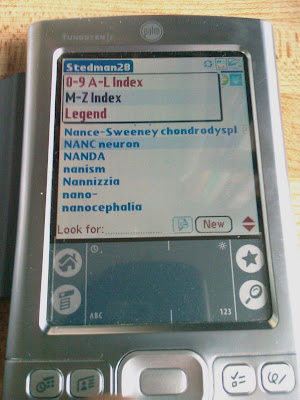
My first review is on my most-used program on my old PDA... Stedman28. It is the 28th edition of Stedman's dictionary and I purchased a cool combo of hardcover book, PDA software and accompanying spellchecker last year. I don't remember the price, but it was WELL-WORTH it. Just having the spellchecker makes you seem more intelligent; spelling out words like chondrocalcinosis or progressive multifocal leukoencephalopathy with autocorrect is beautiful.

The nice thing about Stedman28 is the simplicity of use. Just write out the word and it flips through the index until it finds the one you're looking for! The definitions usually match up with those from the electronic Stedman's Medical Dictionary for the Health Professions and Nursing 1.0... so the hardcover book had a few more details (and pictures!) of items not included in the e-version.

Now for the critique.
Stedman28 takes too long to use. Here's the steps I have to go through to get my definitions:
Since my 1 year subscription expired, I get a message that says:

"Stedman expiry status: your subscription expired on 06/27/2007. Please renew
now for continued access to product updates and Skyscape support.

I have to click a red x to move through that alert message. I don't like the renewal model... when I buy a textbook, the first page I open up to doesn't say "sorry, you've owned this book for more than a year, please buy our new version"... why should it be any different with an e-book?!? I don't want my programs to harass me.
Then I have to select the correct word list index. As you can see from the above graphic, the menu is split between the A-L and the M-Z list. If you are in the wrong index, i.e. searching for the word "neuron" in the A-L section, it chirps at you a bunch of times as it scrolls all the way to the end of "L."
If I search for a word like "NANC neuron" or "motor neuron," it takes me to the broader definition of "neuron" and then I have to scroll down the list until I find the correct word. Sometimes this can take a long time because of the number of words clustered in the list.

I give this program an B+. I have never had any technical difficulties and the word list is impressive. There are a few eponyms that it misses, but those are easily caught by the Eponym program (review to come.)

December 10, 2007

All done!

After a few months of grueling studying (and a week of being completely BURNED OUT and neglecting studying), I finally finished my week-long set of exams.

The tests were challenging and fair... in the sense that we were given advance warning about the material we would be tested on (unlike the year before us who found our mere weeks before their final that the first 10 chapters of Robbins was going to be on the exam.) I got high marks in all sections, which pleased me. Apparently taking a few days off to just veg out right before the exams didn't hurt me as much as I feared... in fact, it probably reinforced my knowledge-base. I didn't dig out my notes or learn new materials during the past week. Instead, I kept reviewing the things I already knew. It was a good feeling to be so prepared; even though the written essay exam threw a bunch of curveball material that I had to struggle to recall to get partial credit on.

So, where do I find myself during the first weekday of my three-week long freedom?

At school, of course!

Gah. It's not as bad, nor as shameful as it may seem. I have put a research project on hiatus during my finals studying and the lab assistant who was helping me out recently left the lab. I've got to pick up my old project again! How horrible. ;)

Today we had a seminar by a visiting professor on Alzheimer disease, focusing on beta-amyloid proteins effects on neurons. The cruz of the matter is that people with Alzheimers get these plaques of junk (aka beta-amyloid) that cruds up in our brains and messes up with the connections. The professor made the argument that beta-amyloid had a normal neuro-modulatory function in the brain and cautioned against treatments that would reduce levels of beta-amyloid.

This was a big surprise to me. I don't know much about the molecular pathology of Alzheimers... but I thought that amyloid was a waste product, an abnormal process. beta-secretase function predominates over alpha-secretase function for the dysregulation of neurotransmitters in AD!

I asked him a question about the normal function of alpha-secretase and he said that the protein produced is much smaller and it doesn't have any effect. To me, that seems to imply that the normal brain doesn't use amyloid-precursor protein for any positive function, but hey. I'm not a researcher in his field and I didn't want to say "huh? why do you think it has normal physiological functions then?"

I'd like to poke around and do some research on this, but judging by the crazy slides of graphs and his talk about knockout mice missing different nicotinic receptors having strange dose-response curves... I'm not sure I could follow that level of technicality.

One of the things I've learned through my research experience is that I enjoy asking the big questions. Research is something I admire, but I don't really have the lab skills and temperament to enjoy it on a long term basis. Still, I'll be coming in this week to summarize my lab results thus far and start finishing up my experiment. Wet labs are fun, but my goodness! They are SO stressful too! I had an experiment get pushed back a full MONTH because of difficulties with malaria parasites and blood and the lab equipment... it felt like the whole chain of protocol was breaking down piece by piece and we chased after it until everything died and we had to start all over again.

Sorry about the long post. It's been a while since I last wrote and I have a lot to say. I've got more thoughtful things on queue, but these are the things that have been on my mind.

November 19, 2007

PLoS Medicine: How Drug Reps Make Friends and Influence Doctors

Clinical Cases and Images shares a refreshing insight into the manipulative drug rep mentality from the POV of an ex-drug rep.

This article reminded me a lot of a book a friend loaned to me about the way physicians are "bought out" to sell drugs. Unfortunately, I cannot remember the name of that book now... but it made some good points that made me wary of drug reps before I entered medical school.The thrust of the book was that it is unethical to accept gifts from drug reps because they would unconsciously influence prescription writing in their favor. Doctors are not as objective as they would like to think.

However, I was met with an uncomfortable scenario as early as my third day of orientation week in medical school. We had a recruitment fair and some organizations gave out "free stuff" with pharmaceutical names stamped all over them. I wanted free stuff. I didn't want to turn my Ethical Upbringing into a big deal. As a result, I came up with this reluctant compromise... I would be OK accepting small gifts (pens, pads of paper, etc.) as long as I erased the name from their free products.

I bought some acetone that afternoon and scrubbed the names off of those products. I can tune out the names pretty well... but I do feel conflicted if I learn about a new drug in school and I go "hey, that's just like the name on those sticker tabs!" I'd like to come up with a better solution for dealing with drug reps when it really counts.

November 16, 2007

Saccular aneurysms

A quick and dirty way to remember the risk factors for developing berry (saccular) aneurysms

MEN HAS sac(cular aneurysms)
Marfan's
Ehler-Danlos
NF-1
HTN
ADPKD
Smoking

Berry aneurysms are outpouching of blood vessels that exploit developmental defects hidden in the lining. They occur within the Circle of Willis, a series of connected arteries at the base of your brain that provide collateral blood flow just in case something fails. These puffy red berries can burst and bleed out into the brain causing a hemorrhagic stroke.

November 15, 2007

The Big update

I've been pretty busy lately. I have exams coming up next month (11/3-6, 3 3 hr long essay/multiple choice/lab exams, 2 4 hr long NBME neuroscience, neurobehavior exams), but I had to put some time aside to prepare for the Medical Student Mentorship Program's (MSMP)1st Annual Ethics Workshop.

The idea was proposed by one of our senior officers and I immediately jumped at the opportunity to help organize it. I made a shortlived effort to start up an Ethics club last year; I realized that I didn't have the time and energy to commit myself to another club since I'm already an officer for MSMP and the Family Medicine Interest Group (FMIG). We put together a Problem-based learning case on ethics. I found this great case about Andrea, a "locked-in" patient from an article in the Discover Magazine's Vital Signs column. "Andrea Beauchamp" helped the students talk through such difficult topics as advanced directives, access to medicine, universal health care, and physician assisted suicide.

The Ethics Workshop was a great success; a local MD/JD came out to give a primer on medical ethics and opened the room up for questions. At first, no one really asked anything, but then a few brave people started asking some really good and insightful questions. I was impressed! We split up into small groups to work on the cases.

I hesitate to post the case here online... most of the text is taken verbatim from the Vital Signs column. I will email the case to anyone who is interested. We put in some tutor prompts and background information and it is a good ethics case for anyone from pre-med to doctorhood, IMO.

--------------
On a completely different note, I got the results for our practice NBME exam last week. It's the big exam that we take at the end of the second year to qualify for medical licensure. I got a 66/100 (a weighted score), which translates to a 190/300 (185 is a passing score, anything above 220 is considered competitive, I believe.) So... without any formal Board studying, I passed!

Woo hoo! :) The only downside of that is the ego boost and dangerous overconfidence that comes with hubris. crap.

Branches of the ECA & ICA

Branches of the External Carotid Artery (ECA)
STAPLe OF PAM ST
Superior Thyroid
Ascending Pharyngeal
Lingual
Occipital
Facial
Posterior Auricular
Maxillary
Superficial Temporal

Branches of the Internal Carotid Artery (ICA)
OPAAM
Ophthalmic
Posterior Communicating
AChor
ACA
MCA


References
Moores Clinical Anatomy
Blumenfeld's Neuroanatomy through Clinical Cases

October 17, 2007

House MD predictions

I like this show. It has bad medicine. It features a doctor who is the antithesis of good medicine. He regularly commands underlings to break and enter peoples' homes to search for clues about their current disease. He says very rude and insensitive things to patients and their families. He's done outright illegal and unethical acts in the name of saving his patient. Well, I suppose its the thought that counts. He does care, after all.

I get my House fix over at Polite Dissent. There wasn't a new episode of House this week (much to my disappointment when I sat down to watch TV at 8pm) but Scott did put out a challenge to his readers: guess what diagnoses are going to be featured in future episodes!

Most of my studying is out of a hefty tome called "Robbin's Pathologic Basis of Disease." A lot of the random names that fly about in House episodes come straight from this book, so I'm glad to say that after just a year and a half of med school training, I can ID nearly 90% of the lingo from the show.

House has made it easier to remember some of these bizarre entities and ridiculous diseases because I can put a face and a story to many of them now. It's greatly added to the appeal of the show for me. I haven't ever nailed a diagnosis, but maybe someday I will.

Here's my list of predictions. I'll report back week after week about how I'm doing.
1) Bronchogenic carcinoma (some sort of paraneoplastic syndrome, myasthenia gravis, Trousseau)
2) Small cell carcinoma (w/ ACTH or SIADH) … just because I like the ddx of paraneoplastic syndromes, I wanted to toss this in
3) Neurofibromatosis -> acoustic neuroma
4) Cryptococcus infection (c’mon now. A disease you get from pigeons? They’ll use this at some point.)
5) Strep mutans -> subacute endocarditis -> weird stroke syndromes, etc. (i picked this because they’d get use the line “s/he died just from brushing his/her teeth!”)
6) McCune-Albright polyostostic fibrous dysplasia (w/ endocrinopathies GH, TSH, ACTH… might show up in #2’s ddx or vice versa w/ cafe au lait spots)
7) Lyme disease -> Neuroborreliosis (maybe concealed by something like psoriatic arthritis)
8) AVM (maybe concealed w/ something like a traumatic brain injury in a soldier from Iraq… shrapnel would prevent them from running an MRI, House’s favorite diagnostic test)
9) Systemic Progressive Sclerosis (the clinic case of the day of Peyronie’s disease could be the eureka moment for House’s diagnosis)
10) Syphilis -> neuro, cardio etc.

October 13, 2007

OLD AGE is bad for Gout


O besity & HTN
L ead poisoning --> saturnine gout (hits the knee preferentially)
D rugs (i.e. thiazides, furosemide, low dose ASA)
 
A ge
G enetics (partial HGPRT deficiency, etc.)
E tOH (beer > liquor > wine)
 
Gout is a disease of imbalanced production & excretion of a substance called uric acid.  Humans are unusual animals in that we do not break down our purine DNA metabolites beyond uric acid (into substances like allatoin.)  When uric acid accumulates in joints, it can spontaneously form into sharp needle-like crystals that cause inflammation and extreme pain, most commonly in the big toe (podagra.)
 
It can be avoided by reducing OLD AGE risk factors, especially through an appropriate diet of no alcohol and low-purine foods.  That means no beer, seafood or organ meats.
 

References/Resources

Lippincott's Biochem 2nd edition

Harrison's Internal Medicine

Robbins Pathologic Basis of Disease

Poor, G. Saturnine Gout. Baillieres Clin Rheumatol. 1989 Apr;3(1):51-61. I just used the abstract to figure out what made Pb-induced gout different.

Choi, Hyon. Pathogenesis of Gout. Ann Intern Med. 2005;143:499-516.

Golan's Principles of Pharmacology

October 12, 2007

On Loss

My Healer's Art class assignment for the week is to write an antry on loss or disappointment. Here's what I came up with. It has a lot of personal details that I didn't feel like stripping away. This is my life. This is who I am and what I think.

This story takes us back about two and a half years in time. I just finished my last round of interviews at medical schools and I was waiting to hear back from them. My classes were fairly easy; I was taking a music and an acting class to finish off my reqs for graduation and a microbio and embryo class to prep for med school. This waiting time was a big moment in my life... I knew that a good chunk of my life would be altered by the decisions of anonymous others.

One idle night, I was on Myspace and I stumbled across the profile of someone who had captured my interest. She had a picture of herself with a quirky smile and turtles in the background at sea life park. I messaged her, telling her that I felt 'compelled to contact her because I thought she had the coolest pic ever' and 'I wanted to get to know her better.' She messaged me back almost instantly; she was online at the same time. We ended up sending messages back and forth several times a day for a week. Our conversation shifted to instant messaging and then to the phone. We met each other for the first time two weeks later.

It was an exciting time for me. We shared some strange similarities. We both used to play the trombone. We both went to Portland, Oregon for a year of undergrad and loved it there. We clicked so well that I was rarely nervous and I felt as though I could talk about anything with her. I often did. Our best times together always involved just talking. We'd have a picnic in the park together and talk. We'd walk through Waikiki in swim trunks at midnight and talk. We'd go camping and stroll on the moonlit beach and talk. This was a new form of communication for me, to share what I was feeling fearlessly with someone. I'd even say I became addicted to it.

This was a time filled with some uncertainty. Would I have to choose between a love and a life of medicine? I didn't know what would happen in a few months, as the letters came in. Rejection. Rejection. On the waitlist. Rejection. Waitlisted. One night, we were at the park, tossing a frisbee around together and my parents called me.
"Your letter from the University of Hawaii came in! Should I open it?"
"Sure," I said somewhat disappointed. "It says something already that it's a letter and not a packet..."
*sounds of a tearing envelope*
"'Dear Clinton, we regret to inform you that the University of Hawaii will not be accepting your application at this time. We have had a record number of extremely talented and qualified applicants such as yourself...' Oh, I'm sorry, son. Are you Ok?"

To be honest, I don't think I was ever so happy to hear bad news in my life! Getting rejected from medical school was a blessing. It gave me the time to get to know this new and wonderful woman, who was genuine and goofy and adventurous and positive and communicative.

Two months later, we went on a road trip together for close to 8 weeks, up and down the West Coast. We started off in LA, went down to San Diego and Tijuana and then all the way up to Vancouver, B.C. We spent most of our time in Oregon, where we had both gone to undergrad. It was a strange and risky thing to do. After all, we had only known each other for 4 months or so and we were basically homeless, living together for 2 months in a trailer van! It was a great way to do what I loved most... just talking with her.

I tell you all of this to explain my love, so it in turn illustrates the depth of my loss. She is a woman I love with my heart and soul. I would have proposed to her a long time ago if she could have ever uttered three little words that meant so much to me -- "I love you."

She did, you know. It was evident by her joy being around me. However, she wanted to save those words for someone that she wanted to spend the rest of her life with. Someone that wasn't me.

The freedom I felt with her was a failing as well. As easily as I could share my joy with her, I shared my wrath. I was an angry person back then. Angry with myself, mostly. A lot of that sort of mulling self-hatred drove me to improve as I beat myself up mentally. My insecurities, my competitiveness, my self-hatred, all of these things came out because I was totally open with her. She might have liked it that I was so honest and open with her, but she did not like my flare-ups. It also made for a sometimes dysfunctional relationship when I had trouble accepting when I was wrong and she was right. She never rubbed in my face when this was the case. She never gloated. She never did anything passive-aggressive when it was the other way around. It took me a long time to realize that she was incapable of doing any of these sorts of hurtful things. I'm a sensitive guy. She definitely brought this out of me, intentionally or not. I don't really know if being sensitive is something I'd like to change about myself.

The ANGER though... that was her major turn-off. Eventually, it grew worse as our relationship grew longer. She got accepted to the JET program and she was planning on going to Japan. I got accepted to medical school and I was planning on staying in Hawaii. Bitterness grew as I realized more and more that her philosophy of anti-long-distance relationships would apply to us. And there wasn't anything I could do to change that. The helplessness I felt tainted our time together. It came out in bursts of depressive despair and grouchiness that left me wondering... why doesn't she just break up with me already? Why is she drawing this out for as long as possible? Those feelings would pass, swiftly forgotten in my fickle mind... but they would build in her like steam. She didn't like that feeling and often told me that I was too much of a rollercoaster for her.

I knew our relationship was terminal when she would start saying things like "someday, you'll meet someone who will make you very happy" during my bouts of despair. Of course, I was thinking to myself that I already HAD met the person of my dreams... what were the chances of finding that again? Especially if it meant letting her go?

My white-coat ceremony was a bittersweet affair. She was flying off to Japan to teach English the day after I would set foot on the path of medicine. We parted on good terms and the promise to always remain good friends.

For a long time, I was filled with regret. Of all the relationships I've had, this breakup was the hardest by far. I was selfish. I didn't understand how someone couldn't love the oh-so-perfect-Me. I definitely made the relationship strained towards the end because of my unwillingness to accept failure. Looking back, it was always so childish and so ridiculous. I am embarrassed that I acted so terribly on a few occasions with the person who I cared about the most... and even worse, I chased her away because of it.

I visited her in Japan a few times since then. More and more, I've changed to the point where I don't think she'd recognize me. She only knows the old, flashpan angry clinton. After a long discussion with her recently, she sent me a clip from an audio file she was recording to help a student for a English Speech festival. It was particularly pertinent to our talk.
One day, someone came into my life and changed my thinking. He is someone very special. He said "do you think people grow more when they meet someone or when they say goodbye? Saying goodbye can be hard, but we realize the good things about them. At the same time, we start to feel regretful. By remembering those regreful moments, we're able to stop making the same mistakes and start improving ourselves. Saying goodbye gives us a chance to grow.

The big loss I speak of here is not so much the loss of my love, since she still swoops into my life from time to time. It's a loss of a part of me. That is a loss that I can celebrate now, thanks to her kind lesson. :) Thank you, Y!

October 11, 2007

Midterms and Midnight

So I took my midterm on Tuesday.

I had a close friend come to visit from Japan and I wanted to spend as much time with her as possible before she left, so I had to really schedule my study time out in advance. I like having these sorts of "planned distractions" because they really make me focus.

Ok, you've got to quit fooling around and get to work! I tell myself. And it's a good thing too -- the midterm was challenging, but I felt prepared for it. There were only a few questions I was thrown by... and they were the "duh, you should know this already" type of questions. Talking with my fellow classmates, I got the sense that a lot of people were flooded with anxiety after the exam.

What, me worry? I did good enough. That's the WORST possible feeling to have after a midterm, I feel. In some ways, I should have studied less so I'd feel worse about the test and that would motivate me to study even HARDER for the final.

This brings up the pressing point of the night.
I slacked off yesterday. I decided to watch House on TV, take two naps and then go to sleep early.

Because of that ill-advised decision, I had to stay up until *checks watch* 4:15am today!!! It turns out that the limbic system is very confusing and difficult to understand. Hopefully I have a good enough grasp on it tomorrow to be able to present it in a clearer manner than I received it.

At least I have my motivation back. I also had some good lazy naptimes. Now it's back to business!

October 05, 2007

Chatting with a friend

This is something that I'd like to come back to later on. The AIM names have been changed to protect the innocent. ;-)
NotMySecondOpinion (11:34:22 PM): are you going to join the air force?
religiousfriend (11:34:37 PM): I'm not sure
religiousfriend (11:34:43 PM): they need leaders in the air force
religiousfriend (11:34:50 PM): I don't have much leadership experience
NotMySecondOpinion (11:36:27 PM): i think it would be good for you to join, but at the same time, i wouldn't want you to go
religiousfriend (11:36:37 PM): ah
religiousfriend (11:36:40 PM): why do you think so?
NotMySecondOpinion (11:37:16 PM): the military would give you discipline and direction
religiousfriend (11:37:27 PM): that's true
religiousfriend (11:37:36 PM): I don't know about direction
NotMySecondOpinion (11:37:38 PM): but its dangerous, even in the air force
religiousfriend (11:37:40 PM): but discipline, yes
NotMySecondOpinion (11:37:55 PM): and you'd become a part of the military culture, which i dislike
religiousfriend (11:39:29 PM): I don't care for military culture
religiousfriend (11:39:45 PM): I don't want to become a further drain on taxpayer resources
religiousfriend (11:39:56 PM): besides which, the AF is scaling down its officer corps
NotMySecondOpinion (11:42:37 PM): what do your other plans comprise of?
religiousfriend (11:43:27 PM): I'm thinking of entering a monastery
religiousfriend (11:43:40 PM): other than that, law school/grad school
NotMySecondOpinion (11:45:04 PM): is there any incident you can think of that prompted your religiosity?
religiousfriend (11:45:20 PM): a realization of my own finitude
NotMySecondOpinion (11:46:12 PM): thats rather abstract.
religiousfriend (11:46:23 PM): When I was ten, I remember thinknig
NotMySecondOpinion (11:46:31 PM): was it from reading something or doing something?
religiousfriend (11:46:31 PM): "ah, I've lived through one eighth of my life"
religiousfriend (11:46:49 PM): I've read a lot of things
religiousfriend (11:46:54 PM): I've done a lot of things
religiousfriend (11:47:18 PM): but faith is something from God. You can't get it by your own efforts
NotMySecondOpinion (12:02:28 AM): how do you define faith?
religiousfriend (12:02:41 AM): I'm still working on that one
religiousfriend (12:02:54 AM): But ultimately Faith is personal
NotMySecondOpinion (12:04:05 AM): i'm just wondering why you think it comes from God
religiousfriend (12:04:37 AM): Well, from the Materialist side people could say it comes from all kinds of chemical reactions
religiousfriend (12:05:27 AM): but at any rate, I don't have enough faith to faithfully answer your question
NotMySecondOpinion (12:06:18 AM): I disagree with the statement that it comes from all kinds of chemicals
NotMySecondOpinion (12:08:09 AM): I think Faith comes from a strong desire/belief in the connections you make with others and the world around you. Those connections are immaterial, but they might be represented by chemical reactions that take place concordantly or disconcordantly, depending on whether or not your Faith is misplaced
religiousfriend (12:10:54 AM): that's a bit over my head
NotMySecondOpinion (12:14:43 AM): i didn't know what faith meant until i loved someone. i could never really know if they loved me back. that's when i had to decide whether or not I could step back and relinquish control of ... almost everything and just have faith.
religiousfriend (12:15:36 AM): I think you're getting close
religiousfriend (12:15:56 AM): but I don't have much faith, so what can I say
NotMySecondOpinion (12:16:02 AM): yeah, i don't know where God fits in there.
NotMySecondOpinion (12:16:20 AM): thats what i was hoping you could help me with
religiousfriend (12:16:35 AM): mmm, it's hard for me to give what I don't really have
religiousfriend (12:16:42 AM): It's important to be humble, first of all
religiousfriend (12:17:06 AM): Hell is full of people who think they're too good for Heaven
NotMySecondOpinion (12:18:31 AM): what does that mean?
religiousfriend (12:19:16 AM): Well, according to the Faith, Hell and Heaven are the same place
religiousfriend (12:19:34 AM): Think of Gollum
religiousfriend (12:19:44 AM): and how he hated the Lembas bread
religiousfriend (12:20:04 AM): and other elvish things
religiousfriend (12:20:39 AM): Those "in Hell" experience the glory of God in the same manner
religiousfriend (12:20:57 AM): because their hearts are too prideful
NotMySecondOpinion (12:21:31 AM): we make our own heaven, then.
religiousfriend (12:21:57 AM): We don't really "make" it
religiousfriend (12:22:00 AM): we accept it
religiousfriend (12:22:12 AM): but yes, ultimately Faith is a matter of the heart
religiousfriend (12:26:40 AM): http://fatherstephen.wordpress.com/ anyway, this site is much more articulate than me in expressing this sort of thing
religiousfriend (12:26:51 AM): I suggest you add it to your google reader
religiousfriend (12:28:09 AM): http://fatherstephen.wordpress.com/christianity-in-a-one-storey-universe/ this might be of interest to you
NotMySecondOpinion (12:29:20 AM): he spells story weird
religiousfriend (12:30:48 AM): that's to distinguish storey as in a building with story as in a book
NotMySecondOpinion (12:35:07 AM): ah
NotMySecondOpinion (12:52:59 AM): i'll definitely have to read more of that later
NotMySecondOpinion (12:53:10 AM): for now, i'm off to do more work. ttyl!

September 29, 2007

Discover's "Vital Signs" Podcast

One of my favorite sections of the Discover Magazine has always been "Vital Signs," in which a medical mystery was presented and solved in an articulate article. It's House, MD without the attitude.

I recently found the podcast version of these articles!

September 26, 2007

Healer's Art Part 1

I signed up for an elective course this semester on "Healers Art." I was really excited about it because I thought it would be the perfect opportunity to talk about my feelings on medicine and hear what other peoples' thought. Unfortunately, I found out that I was one of two people who had signed up for the course, which dramatically changed the group dynamic idea I had in mind.

I attempted to start up an ethics club last year with the same idea in mind, but there was a similar lack of interest from my fellow classmates.

The course was created by Rachel Naomi Remen and uses her book, Kitchen Table Wisdom, as the text.

We had our first session last week and I really liked it. I'm glad that I had an outlet (with people, face to face, unlike here) with whom I could share my thoughts on medicine. We talked about:
IDing, strengthening & cultivating the human dimensions of the practice of medicine
Recognize the commonality of personal concerns among peers
Discovering and nurturing our Wholeness
It sounds like real Chicken Soup for the Soul type of stuff... and I guess it is. I'm taking it with an open mind.

We drew pictures about what we wanted to change about ourselves by the time we graduate from medical school. It was very open-ended, but I didn't want to get too personal with the thing that I want to change most about myself (which is an attitude shift of reacting to negative things with anger --> reacting w/ constructive actions.)

Here's my pic:

It's about stories. More on that later.

September 25, 2007

Medicine is a man-whore

For you aspiring pre-meds out there, heed this advice:
-get the training over with while you're young; don't take breaks (or alternatively, wait until you're a bit older)

-keep it in perspective. You are not a saint because you are a doctor (don't be arrogant and think more highly of yourself than you should). It is not a calling. See it as a stable, respectable, secure, job. Your work is valuable, but not more valuable than yourself, or your family.

-know the drawbacks, and balance those with the benefits of becoming a doctor today.

-the money *does* matter (both the student loans, and the eventual salary).

-don't sacrifice having children, visiting aging parents, or other significant life events in lieu of becoming a doctor. It will not be worth that sacrifice.

-Choose your specialty with care. Chose based on your personality...not based on what is most prestigious, what other people want you to do. Your specialty will determine your potential work environments, your pay, your lifestyle, and the number of years you spend 'training.'

-Finally, don't work too many hours. If you do, you'll be more tired, less healthy, and more likely to experience dissatisfaction and fatigue.
EM Physician makes some really good points with a healthy dose of good humor. I'm worried about a few of these things myself... I've been more aware of maintaining balance recently and I am so much happier for it. However, I have been rather dependent on my student loans for sustenance and I'm sure that this will come back to bite me. :-\

It's an interesting point to say that you should treat medicine as a man-whore. A seductive, back-stabbing, all-consuming vacuum. Don't fall in love with it or it will hurt you.

I'll do my best to keep that in mind.